Aloe vera has been used as a healing plant for nearly 6,000 years. Here’s why it sits at the heart of nearly every Dermagic formulation.
A 6,000-year-old healer
Aloe — a succulent, a member of the lily family — is believed to have originated in Africa. The earliest written record of its medicinal use is a Sumerian clay tablet from 2200 BC listing it among the plants of great healing power. The name itself comes from the Greek alsos, referring to the bitter juice of the leaves — probably derived from the earlier Arabic alloeh or the Hebrew allal, both meaning bitter.
The Egyptians called aloe “the plant of immortality.” Six thousand years ago they were using it for everything from baldness to cancer. Cleopatra and Nefertiti are recorded as using the plant to keep their skin looking young.
It spread with civilisation. Alexander the Great used it to treat his soldiers’ wounds. Pedanius Dioscorides discussed its therapeutic qualities in his five-volume encyclopedia De Materia Medica, written around 40–90 AD — a work that remained the primary source of natural medicine in Europe for more than 1,500 years. Pliny the Elder wrote about it in Natural History.
In Japan — where aloe was introduced by missionaries when the country reopened to foreign trade — it was traditionally called “the plant to make a doctor needless.” Fresh leaf juice was taken internally for stomach problems and applied externally for burns, wounds, and abrasions.
What it actually does
This section used to open by calling aloe a natural antibacterial, antifungal and antiviral and placing it “firmly in the super foods category”. It then listed two compounds as the reason it works — lignins, said to carry other active compounds deep into the skin, and saponins, said to be powerful natural antimicrobials — and closed by saying that studies show chemicals in aloe gel increase circulation and kill bacteria.
We have withdrawn all of it. It is the single most overclaimed passage we have published about any ingredient, and it was ours.
Here is the honest version.
What aloe gel demonstrably does on skin is hold water against it. It is roughly 99% water with a polysaccharide fraction that forms a soft film as it dries, and that film slows water loss from the surface. The best-characterised constituent is acemannan, a mannose polysaccharide. In humans, the strongest clinical evidence for aloe is in partial-thickness burns and minor wounds, where it performs like a decent dressing — comfort, moisture, a covered surface.
What we cannot say:
- That it kills anything on your dog. Aloe extracts inhibit organisms in a petri dish. So do most plant extracts, at concentrations and contact times that have nothing to do with a finished product on a living animal. In-vitro activity is not an antimicrobial claim and we should never have presented it as one.
- That lignins carry other ingredients through the skin. This is repeated everywhere in the aloe trade literature and we have not found a study establishing it. Penetration enhancement is a measurable thing; nobody has measured this.
- That saponins are “powerful antimicrobials”. Saponins are surfactants. They foam and they emulsify. That is a useful property and not a pharmacological one.
- That it increases circulation. We could not source this to anything. It reads like it was copied from a brochure, because it probably was.
The amino acid, vitamin and mineral content is real, and also beside the point — those are nutritional figures for aloe juice taken internally, and they tell you nothing about what a topical does. Quoting a nutrition panel to explain a skincare effect is a category error, and this page made it for eleven years.
Why ancient peoples spotted it
The likely answer is the simplest one: the gel from the leaf just feels good. It’s slightly slimy, cool, moisturising. At some point thousands of years ago, someone noticed it also took the sting out of a wasp bite or a cut on the hand — and word spread.
In Dermagic products
Organic whole-leaf aloe vera gel or juice appears in nearly every Dermagic product, and in the two liquid products it is at or near the top of the ingredient list.
This section used to say that what Dermagic looks for from aloe is “powerful healing, skin-soothing, anti-inflammatory action, and the ability to kill the bacteria, fungi and yeasts that drive most chronic skin problems” — and that “aloe does all four”. The fourth is withdrawn, for the reasons above, and with it the premise that killing organisms is what drives recovery in chronic canine skin disease. It usually isn’t. Allergy is.
What aloe is doing in these formulations is more modest and more useful than the old copy allowed: it is the vehicle. It carries the formula, it spreads easily on sore skin, it doesn’t sting, and it leaves a film that holds moisture while the barrier repairs. On a dog that has been scratching, a cool, non-stinging, moisture-holding base is not a small thing — it is most of what a topical can honestly offer.
It’s not just for pets
A regular pattern in customer feedback: people start using Cell Restoration Crème on their dog and end up using it themselves. The organic aloe vera base makes it useful for human psoriasis, eczema, dry skin and sunburn.
It was never the goal, and it is not something we claim. These are products for animals; they are not assessed as human cosmetics, and we have withdrawn the line that said “the formulations are non-toxic”. If you use one on yourself, that is your call.
That’s the plant of immortality doing what it’s been doing for 6,000 years.
 Start the treatment
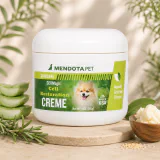
DERMagic Cell Restoration Crème
Aloe-based recovery — dermagic.eu →
For specific guidance email customerservice@dermagic.eu or call +44 7425 388643.