
Every September, the same article gets published a few thousand times: cold air and central heating dry out your dog’s skin, so bathe less and add an oil. We went looking for the study behind that claim and could not find one. What we did find is that something real and measurable does change in autumn — it is just not the thing everybody writes about.
This is the honest version. Some of what follows is well established, some of it is plausible but untested, and some of the most confidently repeated advice in the category is simply wrong. We have marked which is which, because on a page that also sells skincare, that distinction is the only thing that makes the recommendations worth anything.
The honest starting point: nobody has measured it
The standard claim is that cold outdoor air and dry heated indoor air strip moisture from the skin, raising water loss through the epidermis and leaving the skin dry, flaky and itchy.
In humans, that is real. Winter xerosis is well documented, stratum corneum hydration measurably falls in cold dry months, and the dermatology literature on it is substantial.
In dogs, the measurement has not been done. Transepidermal water loss — the actual quantity the claim is about — can be measured in dogs, and it has been, in controlled nutrition studies. Nobody has published the seasonal version: the same dogs, measured in August and again in January.
So the position we are taking is this. Owners genuinely do see more flaking, more scratching and duller coats from September onward. That observation is real. The explanation everyone reaches for is imported from human medicine and has never been tested in this species. And there is a better explanation available that has been studied.
What actually changes in autumn is the coat
Research on the canine hair cycle found that the proportion of hair follicles sitting in telogen — the resting phase, where the hair is finished growing and is being held in place until it is shed — peaks in late summer and autumn. Anagen, the active growing phase, peaks in spring and summer. The driver is photoperiod: day length, not temperature.
The classic figures come from a small kennel population of one breed, so treat the exact numbers with appropriate caution. The direction of the effect is not in doubt, and it is visible in every double-coated dog in Europe right now.
This matters because it reframes the complaint. A coat that looks dull, dusty and lifeless in October is, in most cases, a coat full of dead hair that has not been brushed out yet. It is not a coat that is short of oil. The single most effective intervention for autumn dullness is mechanical: strip the telogen coat out with an appropriate brush, repeatedly, over several weeks.
That is not a satisfying answer if you are hoping to buy a solution. It happens to be the correct one, and no topical product outperforms it for this specific complaint.
Why the dullness reads as “dry”
Dead telogen hairs sit differently in the coat. They catch light poorly, they lie at inconsistent angles, and they trap loose scale rather than letting it shed. The tactile result — rough, dusty, lacking slip — is exactly what most owners describe as dry. Brush the coat out and the shine underneath is usually already there.
Normal autumn shedding versus hair loss that needs a vet
This is the distinction worth getting right, because a seasonal explanation is the most common reason genuine alopecia goes unexamined for months.
| Normal seasonal shed | Needs veterinary assessment | |
|---|---|---|
| Pattern | Diffuse, all over, thinning rather than bald | Focal patches, or bilaterally symmetrical bald areas |
| Skin underneath | Looks normal | Scaly, thickened, reddened, darkened or greasy |
| Symmetry | Generalised | Strikingly symmetrical flanks, or one-sided patches |
| Itch | Absent or unchanged | New or worsening |
| Hair pull | Hairs come out with a brush, not with fingers | Hair epilates easily in tufts |
| Regrowth | Comes back through winter and spring | Fails to regrow, or regrows a different colour and texture |
| Odour | None | Noticeable |
If the picture sits in the right-hand column, the relevant reading is hair loss without itching, which works through the endocrine and follicular causes, and alopecia in dogs for the broader differential. Symmetrical hair loss with darkened skin in particular has a list of causes behind it, and black skin disease is the one owners most often find first and most often misapply.
“Winter dandruff” is a sign, not a diagnosis
Scaling has a proper name — seborrhoea sicca — and naming it does not tell you what caused it. Calling it winter dandruff attaches a cause and a season to a sign that has neither by default.
| What it might actually be | The clue that points to it |
|---|---|
| Cheyletiella (surface mite, nicknamed walking dandruff) | Large, sometimes visibly moving scale, often along the back; contagious to other pets and to people |
| Primary keratinisation disorder | Breed pattern — Golden Retriever, Standard Poodle, Cocker Spaniel; lifelong, not seasonal |
| Malassezia overgrowth | Greasy rather than dry scale, odour, redness in skin folds and ear canals |
| Atopic dermatitis | Itch came first, scale second; affects the concave inner ear, armpits, groin, feet |
| Hypothyroidism | Scale plus poor coat regrowth, weight gain, lethargy; middle-aged dog |
| Post-parasite self-trauma | Follows a flea or harvest mite season; scale where the dog has been chewing |
| Genuinely dry, low-humidity flaking | Fine, dust-like, no itch, no odour, skin otherwise normal |
Only the last row is the thing the seasonal articles are describing, and it is the least common of the seven. Fine dust-like scale on a comfortable dog is unremarkable. Thick scale, greasy scale, odour, itching or hair loss alongside it is a reason to look properly — the full differential for flaking and itching together is in why is my dog so itchy, and the signs of yeast involvement covers the greasy variant.
Bathing in cold weather: the advice we are correcting
We have carried a post on this site since 2013 that told readers to bathe less in winter, on the reasoning that washing strips protective oils. That advice is now corrected, and here is why.
International guidance on canine atopic dermatitis recommends regular bathing — frequently weekly or more often — with a non-irritating shampoo. Bathing physically removes surface allergens, scale and microbes, and it is one of the few interventions that is both cheap and genuinely supported. When that guidance addresses the drying effect of frequent washing, the recommended answer is to follow the wash with a conditioner or emollient, not to reduce how often you wash.
So there are two tracks, and the blanket advice was wrong for the dogs who needed it most.
If your dog’s skin is healthy
Frequency is a preference. There is no evidence that bathing a healthy dog weekly harms it, and none that bathing it monthly helps. Choose based on how dirty the dog gets and how it smells. Nothing about the calendar changes this.
If your dog’s skin is itchy, flaky or prone to infection
Do not cut the frequency back for winter. Keep washing, and add the conditioning step that the guidance actually recommends. A conditioner bar after a shampoo bar is the whole correction in two steps, and in bar form there is no bottle to store and nothing to freeze in an outdoor utility room.
 Wash, then condition — the two-step correction
DERMagic Shampoo & Conditioner Bar Combo
Shop on dermagic.eu →
Wash, then condition — the two-step correction
DERMagic Shampoo & Conditioner Bar Combo
Shop on dermagic.eu →If you already have the shampoo bar and only need the conditioning half, it is sold on its own.
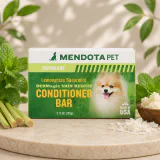 Add the step that was missing
DERMagic Skin Rescue Conditioner Bar
Shop on dermagic.eu →
Add the step that was missing
DERMagic Skin Rescue Conditioner Bar
Shop on dermagic.eu →There is more on why bars behave differently from bottled shampoo in soap, shampoo or shampoo bars.
The part that genuinely does go wrong in winter: drying
Here is the risk that the “bathe less” advice was groping towards and got backwards. The problem is not the bath. It is the incomplete dry afterwards.
A dense undercoat holds water for hours. A damp, warm, poorly ventilated coat is a recognised predisposing environment for Malassezia — a lipophilic yeast that is a normal resident of canine skin and overgrows opportunistically — and for bacterial overgrowth. Trapped moisture in the ear canal is a well-established risk factor for otitis externa. In summer the coat dries in an hour on a walk. In November it does not.
So in cold weather the rule tightens: dry to the skin, not to the touch. Towel first, then warm air, and keep going past the point where the outer coat feels dry.
Where to check before you stop
- Behind and under the ears, and the ear canal opening
- The armpits and the groin
- Between the toes and the pads
- The tail base and under the tail
- Skin folds, and behind the elbows
- Under a collar or harness that went straight back on
Those are the same locations where damp-related trouble shows up first. Ear care covers the canal properly, and paw care the feet. If something has already gone wrong in one of those spots — a hot, wet, rapidly spreading patch — that is acute moist dermatitis, and hot spots and how to treat them is the relevant reading.
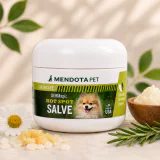 For a localised damp-trapped patch
DERMagic Hot Spot Salve
Shop on dermagic.eu →
For a localised damp-trapped patch
DERMagic Hot Spot Salve
Shop on dermagic.eu →If you genuinely cannot dry the dog properly
Some households cannot manage a full wash-and-dry cycle in midwinter, and a badly dried dog is worse than an unwashed one. Freshening between baths without wetting the coat through is a legitimate compromise.
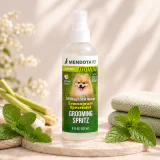 Between baths, without soaking the coat
DERMagic Skin Rescue Grooming Spritz
Shop on dermagic.eu →
Between baths, without soaking the coat
DERMagic Skin Rescue Grooming Spritz
Shop on dermagic.eu →Autumn is peak parasite season, and that part is measurable
Where the seasonal skin claim is unmeasured, the seasonal parasite claim is not.
Fleas
Surveillance across 191 Great Britain practices over six years — 4.8 million dog consultations and 1.9 million cat consultations — recorded fleas in 0.25% of dog and 1.17% of cat consultations, in every month of the year, with a clear peak across roughly July to October. That is the real autumn skin story, and it is the first thing to exclude in any dog that started itching in September.
Two corrections to what this page used to say. We attributed that data to “the UK and Ireland.” The study is Great Britain only, and we could find no equivalent Irish dataset. And the peak is not an autumn influx — fleas do not migrate indoors when it turns cold, because they were already indoors.
The mechanism usually offered for year-round breeding — that centrally heated homes let the life cycle run indoors all winter — is plausible but unmeasured, and we previously stated it as established. No survey isolates heating as a variable. What the data do support is the practical conclusion: cases occur in every month, so flea control is a year-round job rather than a seasonal sprint.
This page also said the household environment “matters as much as the dog.” That overstates it. The off-animal life stages do outnumber the adults, but monthly on-animal treatment alone gave virtually complete control in a six-month carpeted home simulation with no environmental product used — so household treatment is an adjunct for a heavy infestation, not a co-equal half of the job.
Fleas are one of the most common causes of itching in dogs and the first to rule out, because they are the cheapest thing to fix. Our full account is in flea allergy dermatitis in dogs and cats, and parasitic causes of skin problems has the wider picture.
Harvest mites
If the itch started suddenly in late summer or autumn and is concentrated on the feet, there is a specific parasite to look for, and it leaves visible orange-red dust between the toes. It does not burrow, routine flea products do not reliably prevent it, and the itch outlasts the mite — so finding nothing in October does not exclude it. The full account is in harvest mites in dogs.
Cheyletiella
Worth naming again separately, because it is the parasite most often dismissed as winter dandruff. Large scale, often dorsal, sometimes visibly mobile, contagious between pets and to people. What mites and mange actually are covers how these are distinguished.
Pollen does not simply stop
A dog that improves in November has not necessarily grown out of anything. House dust mite sensitisation is the most common allergen picture in atopic dogs, and that exposure is year-round — so many atopic dogs are no better in January than they were in June.
There is one genuinely useful technical finding here. A study comparing allergen test methods found that intradermal test reactivity to pollens varied by season, running higher in autumn, while serum IgE testing showed no such seasonal effect. Practically, that means the time of year an intradermal skin test is performed may influence what it shows. It is a point to raise with the vet who is planning the test, not a reason to postpone one.
Two related cautions, both of which we have had to correct elsewhere on this site. A dog that itches year-round points towards house dust mite atopy first, not to food. And the widely repeated claim that indoor heating makes dust mite allergy flare in winter is an unsupported import from human medicine — a longitudinal canine study found no seasonal variation in dust and storage mite responses at all.
For the underlying distinction, atopy versus allergy and what canine atopic dermatitis actually is are the definitional posts; grass pollen allergy covers the seasonal end.
The one skin disease that really is seasonal
Recurrent flank alopecia is the exception that proves the rule. It is genuinely photoperiod-driven, and it looks like this:
- Bilaterally symmetrical hair loss over both flanks
- Well-demarcated margins — you can see where the bald area stops
- Often hyperpigmented, so the bald skin is visibly darker
- Onset typically late autumn or winter
- Not itchy
- Frequently regrows spontaneously in spring, and in some dogs recurs annually
Boxers, Airedale Terriers, Bulldogs, Schnauzers and Labradors are over-represented. It is a cosmetic condition. Melatonin is sometimes used, with inconsistent results. No topical product will alter its course, and we are not going to suggest one.
The reason it still needs a vet is that the other causes of bilaterally symmetrical hair loss — hypothyroidism, hyperadrenocorticism, sex hormone imbalances — are not cosmetic, and they can look similar from across a room. Hair loss without itching is where that differential is worked through properly.
Paws: grit, ice, and the thing that is actually dangerous
Two substances get conflated in every winter safety article, and the conflation is unhelpful in both directions — it makes owners panic about the harmless one and underestimate the lethal one.
| Rock salt (road grit) | Antifreeze (ethylene glycol) | |
|---|---|---|
| What it is | Sodium chloride | Ethylene glycol, from engine coolant |
| Where it is | Gritted pavements and roads | Leaks and spills on driveways, garage floors |
| Taste | Salty | Sweet — dogs drink it willingly |
| Effect on paws | Irritant, stings damaged pads, drying | Not primarily a paw problem — the danger is ingestion |
| If ingested | Vomiting, stomach upset, excessive thirst in quantity | Acute kidney failure. Minimum lethal dose commonly cited at roughly 4.4–6.6 mL/kg undiluted |
| What to do | Rinse and dry the paws; keep the grit bag out of reach | Emergency vet immediately. Treatment is time-critical and hours matter |
Rock salt is a rinse-and-dry problem. Ethylene glycol is a same-day emergency where waiting to see costs the kidneys. If you suspect it, do not wait for symptoms.
The rest of winter paw care is mundane and effective:
- Rinse and dry the feet after gritted pavements, checking between the toes
- Clear compacted ice balls from between the toes and from the hair around the pads
- Keep the hair between the pads trimmed short enough that snow does not ball up in it
- Check the pads for cracks and the webbing for splits
- Use an emollient on dry pads, elbows and a chapped nose
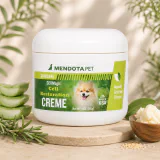 For dry pads, elbows and nose
DERMagic Cell Restoration Creme
Shop on dermagic.eu →
For dry pads, elbows and nose
DERMagic Cell Restoration Creme
Shop on dermagic.eu →There is more detail on pad condition and interdigital problems in dog paw care.
How cold is too cold
There is no single number, and anyone offering you one is guessing. The relevant concept is lower critical temperature — the ambient temperature below which a dog has to actively generate heat to maintain body temperature. Published estimates span an enormous range depending on coat:
- A thin-coated small dog may sit around 20°C
- A heavily double-coated northern breed may sit around −20°C or lower
That is a forty-degree spread within one species, and it is why a single “dogs are fine down to X degrees” figure is meaningless. Age, body condition, health status and acclimatisation all move it further.
The variable that matters most in a European winter is not absolute cold. Wet plus wind beats dry cold. A soaked dog at 5°C in wind loses heat faster than a dry dog in still air well below freezing, because water conducts heat away from the skin far faster than air and wind removes the insulating layer the coat is holding.
Which is the practical argument against clipping a double coat for winter: the undercoat is the insulation, and it works in both directions. Should you shave a double-coated dog covers what actually happens when it is removed — including the claim about permanent regrowth failure, which we have also had to correct.
Two things you will read that we are not going to tell you
“Cold weather makes your dog’s arthritis worse.” The human research on weather and joint pain is inconsistent, and the canine data is essentially absent. What is defensible is simpler and more useful: dogs move less in winter, and loss of conditioning genuinely does affect a stiff dog. Slippery frozen surfaces are a real risk to a dog with poor hind-limb strength. Manage the activity and the footing, not the weather.
“Dogs need more calories in winter.” True for working and outdoor dogs with real heat loss to fund. For a house dog that is walking less because the days are shorter and the weather is worse, energy requirements typically fall. Winter weight gain is the far more common clinical finding, and carrying extra weight does nothing good for skin, joints or coat.
Coat condition is built from the inside, on a two-month clock
A controlled study of dogs on a complete and balanced diet found that supplementing zinc and linoleic acid produced measurable improvement in coat quality and reduced transepidermal water loss.
Two things follow from that, and they pull in opposite directions.
The first is that nutrition genuinely affects the skin barrier in dogs, and it is measurable — this is one of the few places in canine dermatology where the barrier numbers have actually been taken.
The second is the timescale. The improvement developed over roughly two months. Hair is largely protein, the follicle is metabolically active, and it responds on a hair-cycle timescale. Nothing you change in the food bowl this week will show in the coat before December. If you want the coat to look better at Christmas, the window for starting was late September — which is now, and is the only genuinely time-sensitive item on this page.
That two-month window is also the practical argument for buying volume rather than single bottles. A dog with a real skin problem going into winter needs enough shampoo, conditioner and lotion to keep washing weekly for eight weeks without running out halfway, plus the oral half of the job running alongside it. The Total Coat Repair System is the one bundle in the range that covers both — doubled quantities of the wash, condition and lotion steps, the salt scrub, and the Omega 3, 6 and 9 supplement — and it works out cheaper than buying the same items individually.
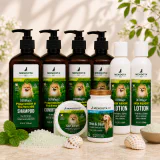 Enough to cover the full two-month window
DERMagic Total Coat Repair System
Shop on dermagic.eu →
Enough to cover the full two-month window
DERMagic Total Coat Repair System
Shop on dermagic.eu →Where Dermagic genuinely helps in autumn, and where it does not
This is the section most seasonal skincare articles leave out. We would rather be specific about the strength of the evidence than imply all of it is equal.
| Claim you will see | What the evidence actually supports |
|---|---|
| Sunflower oil improves the coat and skin barrier in dogs | Real, but the canine studies are oral supplementation. A topical product containing it is not the thing that was tested |
| Shea butter repairs the skin barrier | Plausible as an occlusive emollient by chemistry. No canine clinical data. We are not going to pretend otherwise |
| Dead Sea salt improves skin barrier function | The human atopic dermatitis evidence is for bathing in a magnesium-rich salt solution, not for scrubbing granular salt onto skin. A scrub is also contraindicated on inflamed, broken or infected skin |
| Regular bathing helps itchy dogs | Well supported. This is the one with international guideline backing behind it |
| Conditioning after washing offsets drying | Supported as the recommended approach to bathing-related dryness |
| A topical will fix seasonal flank alopecia | No. Nothing topical alters that condition |
| A topical will fix an autumn telogen shed | No. Brush the dead coat out |
So: where skincare earns its place in autumn is washing and conditioning an itchy or flaky dog without drying it out, keeping damp-prone areas from turning into infections, and looking after pads and elbows that are taking a beating from cold and grit. Where it does not is anything driven by hormones, day length or the hair cycle.
For a flaky but intact and uninflamed coat, the scrub is the right tool — and it is the wrong tool the moment the skin is red, broken or sore.
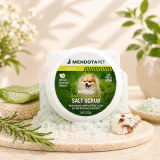 For flaking on intact, uninflamed skin
DERMagic Anti-Dandruff Salt Scrub
Shop on dermagic.eu →
For flaking on intact, uninflamed skin
DERMagic Anti-Dandruff Salt Scrub
Shop on dermagic.eu →For everyday use on dry, scaly or irritated areas through the winter, the lotion is the workhorse of the range.
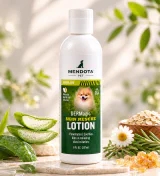 Everyday use on dry or irritated skin
DERMagic Skin Rescue Lotion
Shop on dermagic.eu →
Everyday use on dry or irritated skin
DERMagic Skin Rescue Lotion
Shop on dermagic.eu →And if the dog’s skin needs the full sequence rather than a single product, the four steps work together and are meant to be used together — the reasoning is set out in the Dermagic System, and what’s in the Skin Essentials kit breaks down the individual steps.
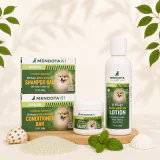 The complete four-step sequence
DERMagic Skin Essentials System
Shop on dermagic.eu →
The complete four-step sequence
DERMagic Skin Essentials System
Shop on dermagic.eu →An autumn routine that is actually defensible
- Brush the telogen coat out. Repeatedly, over weeks. This is the highest-value thing on the list and it costs nothing.
- Check for fleas properly, and keep the household treatment going through winter rather than stopping it.
- Check the feet for orange-red dust if the itch started suddenly in autumn.
- Do not reduce bathing if the skin is itchy or flaky. Keep the frequency and add a conditioning step.
- Dry to the skin. Ears, armpits, groin, toes, tail base, folds.
- Start any dietary change now if you want to see it in the coat by December.
- Rinse and dry paws after gritted pavements; keep antifreeze off the floor.
- Photograph any bald patch the week you notice it, so you have a comparison in six weeks.
- Do not clip a double coat for winter.
When to stop managing it yourself and call the vet
- Hair loss that is symmetrical, patchy, or leaves changed skin behind
- Scale that is thick, greasy, or comes with odour
- Itching that is escalating rather than steady
- Any ear that is sore, smelly or being held down
- A hot, wet, rapidly enlarging patch
- Lethargy, weight change or drinking more alongside a skin change
- Any suspicion of antifreeze ingestion — immediately, without waiting for signs
Related reading
- Why is my dog so itchy? — the full anatomical approach to itch
- Harvest mites in dogs — the autumn paw-chewing parasite
- Hair loss without itching — including the seasonal flank pattern
- Should you shave a double-coated dog? — why the undercoat is insulation
- Dog paw care — pads, webbing and interdigital problems
- Dog ear care — the canal, and why moisture matters
- Winter dry skin and dull coat — the older post this one updates
- How your dog adapts to autumn weather — the coat changes, from the dog’s side
- The Dermagic System — the four steps and why the order matters
- Where to buy Dermagic in Europe — shipping and stockists