We don’t sell chlorhexidine. It is the best-evidenced wash in canine skin care, and if your dog has a skin infection it may well be exactly what your vet should prescribe. Here is what it does, and what it does not do.
If your vet has handed you a bottle of chlorhexidine shampoo, or you have seen it recommended online, you probably have questions. How often, how long, is it harsh, can I keep using it, is it safe with my other products? This guide answers them as plainly as we can.
It also covers something the product label does not: chlorhexidine treats an infection, but it does not fix the skin underneath. Understanding that difference is the key to using it well and to knowing what comes after.
The short answer
- Chlorhexidine is an antiseptic. It kills bacteria and yeast on the skin surface.
- The evidence is strong. International veterinary guidelines give it their highest recommendation for surface and superficial bacterial skin infection, and a chlorhexidine–miconazole combination is the first-choice wash for yeast.
- It can replace antibiotics for superficial infection, which matters as antibiotic resistance grows.
- Use it as prescribed. Usually two to three times a week at first, with about ten minutes of contact.
- The risks are real but narrow. Ears, eyes, licking, and soap in the same wash.
- It is not an allergy treatment and not a long-term routine. When the infection has cleared, the cause still needs managing.
What chlorhexidine is
Chlorhexidine is an antiseptic that has been used in human and veterinary medicine for decades, in surgical scrubs, mouthwashes and wound cleansers. In dog shampoos it is normally found at 2 to 4%, sometimes combined with an antifungal called miconazole.
In the EU, the best-known chlorhexidine dog shampoos are authorised veterinary medicines. The leading chlorhexidine–miconazole shampoo, sold as Malaseb, is a prescription-only veterinary medicine in Ireland and the UK. That is the right status for a product whose job is to kill organisms that cause disease. Under EU veterinary medicines law, it is the claim to treat a disease that makes a product a medicine, which is also why we are careful about what we say about our own range.
What the evidence shows
Bacterial skin infection (pyoderma)
Superficial pyoderma is the most common skin infection in dogs. It shows as small red bumps, pustules, scaly rings and patchy hair loss, often on the belly and inner thighs.
The 2025 international guidelines on canine pyoderma make topical treatment alone the treatment of choice for surface and superficial infection, with their strongest grade of recommendation. Topical-only treatment worked in 12 of the 13 trials they reviewed. Chlorhexidine at 2 to 4% is described as the agent with the greatest support.
Two trials show why:
- Chlorhexidine versus an oral antibiotic. In a 2015 randomised trial, 31 dogs were treated with a 4% chlorhexidine shampoo twice weekly plus a chlorhexidine solution daily, and 20 dogs with the antibiotic amoxicillin-clavulanate, for four weeks. Eight of the dogs carried meticillin-resistant Staphylococcus pseudintermedius. There was no significant difference between the groups, and every dog in the chlorhexidine group resolved, including the resistant infections. The trial was small, and the authors concluded that chlorhexidine may be as effective rather than claiming they had proved it. But it is a striking result.
- Chlorhexidine versus benzoyl peroxide. In a 2011 trial of 22 dogs, a 3% chlorhexidine shampoo reduced pustules, itch and bacterial counts over 21 days. A 2.5% benzoyl peroxide shampoo, an older standard, showed no significant improvement.
This matters beyond your own dog. Every course of antibiotics that a wash can replace is one less chance for resistant bacteria to emerge.
Yeast (Malassezia)
Malassezia is a yeast that lives normally on dog skin and overgrows when the skin is inflamed, usually because of allergy. It causes greasy, itchy, darkened skin and a distinctive musty odour.
The 2020 international consensus on Malassezia gives its highest recommendation to only one wash: 2% miconazole with 2% chlorhexidine, twice weekly, which it describes as the topical treatment of first choice. 3% chlorhexidine alone is rated a step below, on the strength of a single trial. In that 2011 trial of 67 dogs, yeast counts fell by 88% or more in 21 of 22 dogs on 3% chlorhexidine and 30 of 32 on the combination, with no significant difference between them. An earlier 1995 trial in 33 Basset Hounds found the combination improved all 16 dogs that received it, against 11 of 17 on a selenium sulphide shampoo.
Our guide to signs of yeast in dogs covers how yeast overgrowth looks and why it keeps coming back.
Stronger is not always better
It is tempting to assume a 4% product beats a 2% one. The evidence does not say so. In a 2013 study of residual activity on dogs’ hair, the 2% and 3% chlorhexidine products produced the largest effect, and both the 0.8% and the 4% products produced smaller ones. Formulation matters as much as percentage. And the only wash with the highest grade for yeast is a 2% product. Use what your vet prescribes, not the biggest number on the shelf.
How to use it
Follow your vet and the label. For infection, guidelines recommend washing at least two to three times a week at the start of treatment. The best-studied product is used twice weekly until signs settle, then weekly.
Leave it on for about ten minutes. The 2025 guidelines still recommend 10 to 15 minutes of contact for chlorhexidine. A small 2026 study suggested three minutes might be enough, but it was done on 18 healthy dogs with one product, and every result came from laboratory tests on hair rather than any skin outcome. That is interesting research, not a reason to shorten a prescribed medicine.
Get it to the skin. Ten minutes on top of a dense coat achieves little. Work the lather down through the coat until it is against the skin, across all affected areas, then let it sit.
Rinse thoroughly and dry the dog. Don’t let your dog lick the coat until it is dry.
Use it on its own. Chlorhexidine is a positively charged antiseptic, and soaps and many ordinary shampoo detergents are known to inactivate it. Don’t lather with soap, a shampoo bar or another shampoo in the same wash. If your vet wants you to use other products as well, ask how to fit them in around the medicated washes.
Expect a recheck. Guidelines suggest re-examination at around two weeks. If the skin is not clearly better within two to three weeks, go back to your vet rather than carrying on.
The safety points that matter
Chlorhexidine is not “harsh” or “toxic” in normal use on skin. But there are a few real precautions:
| Risk | What to do |
|---|---|
| Ears. Chlorhexidine is toxic to the inner ear. In cats, inner-ear damage has been shown at 2% and cell damage at concentrations as low as 0.05%. | Never put a chlorhexidine shampoo into the ear canal. Only use a chlorhexidine ear product if a vet has confirmed the eardrum is intact. |
| Eyes. It can irritate the eyes. | Protect the face, and rinse the eye with water if it gets in. |
| Licking. | Rinse well and dry the dog before it can groom. |
| Skin irritation. Uncommon, and more likely in allergic dogs. | Stop and tell your vet if redness or itch gets worse. |
| Cats. | Only if a vet prescribes it. The leading product is authorised in cats only as an aid in treating ringworm. |
| You. Severe allergic reactions to chlorhexidine are rare but documented in people. The US FDA reviewed 52 cases, including 2 deaths, over several decades. | Wear gloves, especially if you have reacted to antiseptics before. |
What about resistance? Laboratory studies have found some staphylococci with slightly reduced susceptibility, and associated genes at low frequency. But shampoo concentrations are far above the highest inhibitory levels recorded, and no resistance causing clinical treatment failure has yet been described. Reduced susceptibility in Malassezia has not been reported. It is worth monitoring, not worrying about.
What chlorhexidine does not do
| Claim | Reality |
|---|---|
| “It cures hot spots” | A hot spot is managed by clipping, cleaning, an antiseptic or antibiotic on the spot, anti-inflammatory treatment, and dealing with the cause. A chlorhexidine solution or wipe may be part of that. A shampoo alone is not the treatment. See our guide to hot spots. |
| “Use it every day” | Not as a shampoo. Two to three times a week. Daily use applies only to wipes or sprays on small areas. |
| “It kills mange mites” | No. Mange needs a prescription antiparasitic. See mites and mange in dogs. |
| “It treats allergies” | No. It treats the infection on top of the allergy. |
| “It can replace antibiotics in every case” | No. Deep infections, with pain, bloody crusts or draining tracts, still need antibiotics. |
| “Stronger is better” | Not necessarily. 2–3% has outperformed 4% on residual activity, and the top-rated yeast wash is 2%. |
Why the infection keeps coming back
This is the part most owners find frustrating, and it is the most important thing to understand.
Skin infection in dogs is almost always secondary. The bacteria and yeast involved are normal residents that take advantage of skin already damaged by something else, most often allergy. Chlorhexidine clears the infection. It does nothing about the allergy, so when the washes stop, the conditions that let the infection take hold are still there.
The guidelines do not agree on what to do about that. The 2025 pyoderma guidelines allow once or twice-weekly antiseptic washing as prevention in some dogs. The 2026 international guidelines on atopic dermatitis go the other way: they say infection should be confirmed by cytology before antimicrobial treatment, that routine antimicrobial washing “must be avoided”, and that there is no evidence long-term antiseptics prevent relapse. If your dog needs chlorhexidine again and again, that is the conversation to have with your vet: what is the cause, and how is it being managed? Our guide to why your dog is so itchy is a good place to start.
What comes after: caring for the skin underneath
Once the infection has cleared and your vet’s course is finished, the evidence for what helps an allergy-prone dog is clear, and it is not about killing anything. The 2026 atopic dermatitis guidelines give their highest recommendation to regular bathing, around weekly, as part of management. They also say there is no evidence that any particular shampoo is superior, that moisturising shampoos are likely the most soothing, and that because shampoos can be drying, owners may want to use a moisturiser after bathing.
That is where our range fits, and we want to be precise about it. Our products are not antiseptics, they are not an alternative to chlorhexidine, and nothing in our range has been tested as a way to prevent infection coming back. They are skincare for the long stretch between vet visits: gentle, sulphate-free cleansing for the regular baths the guidelines recommend, and a leave-on lotion and conditioner for skin that bathing has left dry.
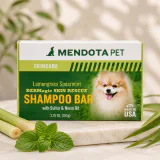 Step 1 — Cleanse
DERMagic Skin Rescue Shampoo Bar
View on Dermagic →
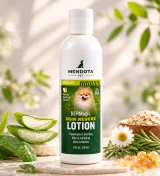 Step 2 — Skin care
DERMagic Skin Rescue Lotion
View on Dermagic →
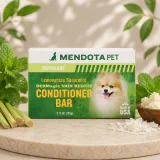 Step 4 — Maintain
DERMagic Skin Rescue Conditioner Bar
View on Dermagic →
Remember the soap rule: our shampoo bar is a saponified soap, so never use it in the same wash as chlorhexidine. While your dog is on a medicated course, follow your vet’s instructions. Our routine is for afterwards.
For a dog with long-term problem skin, we recommend the full Dermagic system rather than a single product, because each step does something the others don’t: cleanse, care for the skin, restore the coat, and maintain between baths. The Bar System puts all of them in one box.
 Start the treatment
The DERMagic Bar System
See the full system — dermagic.eu →
When to see a vet
- Pustules, red bumps, scaly rings or patchy hair loss, especially on the belly
- Greasy, darkened, itchy skin with a persistent musty odour
- Pain, bloody crusts, swelling or draining tracts, which may mean a deep infection
- Any ear problem: head shaking, scratching, discharge or odour
- Infection that returns again and again
- No clear improvement after two to three weeks of a prescribed wash
The short version
- Chlorhexidine is the best-evidenced wash in canine skin care, top-rated for superficial bacterial infection and, with miconazole, for yeast.
- It can replace antibiotics for superficial infection, including resistant staph, which is good for your dog and for everyone.
- Use it as prescribed: two to three times a week at first, about ten minutes of contact, worked down to the skin.
- Keep it out of ears and eyes, don’t let the dog lick, and never mix it with soap in the same wash.
- It clears infection, not the cause. Recurring infection means the underlying problem, usually allergy, needs managing.
- Afterwards, regular gentle bathing and moisturising is what the guidelines support. That is where our skincare fits. It is not a substitute for chlorhexidine.
Further reading
- Why is my dog so itchy?: the main itch guide
- Top signs of yeast in dogs and seborrhoea in dogs
- Hot spots on dogs
- Colloidal oatmeal for dogs, Is tea tree oil safe for dogs and cats? and Sulphur as an ingredient: our other ingredient guides
For specific guidance on your dog’s case, email customerservice@dermagic.eu or call +44 7425 388643.