Dull, flaky winter coats are one of the most common things owners ask us about. This post has been updated: the advice to bathe less in winter was wrong, and the explanation everyone gives for winter dry skin has never actually been tested in dogs.
Updated September 2026. The fuller, current treatment of this topic is in autumn and winter dog skin care, which works through the parasite season, paw safety, how cold is too cold, and what the evidence does and does not support. This page has been corrected to match it.
Why the coat looks dull in winter
The usual explanation is that cold dry air outside and low-humidity central heating inside pull moisture out of the skin. That is well documented in people. In dogs it has never been measured — water loss through the skin can be measured in dogs, and has been in nutrition studies, but nobody has published the seasonal comparison. We would rather tell you that than repeat it as fact.
What has been measured in dogs is the hair cycle. The proportion of follicles resting in the telogen phase peaks in late summer and autumn, driven by day length rather than temperature. A coat packed with dead telogen hair looks dull and dusty and feels rough — which is exactly what most owners describe as dry skin.
So the first thing to do about a dull autumn coat is not to buy anything. Brush the dead coat out, repeatedly, over several weeks. Nothing topical outperforms that for this particular complaint.
Genuine flaking on top of that is worth taking seriously rather than filing under winter. Dandruff is a sign, not a diagnosis — it can be a surface mite, a keratinisation disorder, yeast overgrowth or an underactive thyroid, and the differential is set out in the current guide.
Bathing in winter: correcting what this post used to say
This post previously advised bathing your dog less in winter, on the reasoning that washing strips protective oils. That was wrong, and we have corrected it.
International guidance for canine atopic dermatitis recommends regular bathing, frequently weekly or more often, because washing physically removes allergens, scale and surface microbes. Where that guidance addresses the drying effect of frequent washing, its answer is to follow the wash with a conditioner or emollient — not to wash less often.
- If your dog’s skin is itchy or flaky: keep the frequency and add the conditioning step.
- If your dog’s skin is healthy: frequency is a preference. There is no evidence either way.
What genuinely matters in cold weather is the drying. A dense undercoat holds water for hours, and a damp coat is a recognised predisposing factor for Malassezia overgrowth and for ear infections. Dry to the skin, not to the touch — ears, armpits, groin, between the toes, tail base and folds.
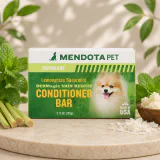 The conditioning step, after every wash
DERMagic Skin Rescue Conditioner Bar
Shop on dermagic.eu →
The conditioning step, after every wash
DERMagic Skin Rescue Conditioner Bar
Shop on dermagic.eu →Three products that help, and what they are actually for
Anti-Dandruff Salt Scrub
For flaking on skin that is intact and not inflamed, an exfoliating mineral scrub lifts loose scale and leaves the coat feeling softer.
Two honest caveats. The human evidence for magnesium-rich salt concerns bathing in a salt solution and its effect on skin barrier function — it is not evidence for scrubbing granular salt onto skin. And a scrub is contraindicated on inflamed, broken or infected skin, where it will make matters worse. Flaking accompanied by redness, soreness, odour or hair loss needs diagnosing, not exfoliating.
We previously suggested a scrub soak for senior dogs with cold-weather joint pain. We have dropped that: the human weather-and-joint-pain research is inconsistent and there is essentially no canine data behind it.
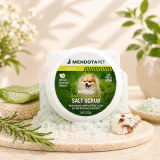 For flaking on intact, uninflamed skin
DERMagic Anti-Dandruff Salt Scrub
Shop on dermagic.eu →
For flaking on intact, uninflamed skin
DERMagic Anti-Dandruff Salt Scrub
Shop on dermagic.eu →Cell Restoration Crème
The heavier occlusive in the range, and the right choice for cracked paw pads, rough elbows and chapped noses — the areas that take the most punishment from cold, grit and de-icer.
Directions: apply liberally to dry areas and to the pads. For cracked pads specifically, our dog paw care guide covers the full routine.
On the ingredient claims: an occlusive emollient is a sound, conventional approach to dry cracked skin. The individual botanicals — sesame oil, shea butter — do not have canine clinical trials behind them, and we are not going to describe them as scientifically proven when they are not.
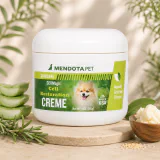 For cracked pads, elbows and nose
DERMagic Cell Restoration Creme
Shop on dermagic.eu →
For cracked pads, elbows and nose
DERMagic Cell Restoration Creme
Shop on dermagic.eu →Skin Rescue Conditioner Bar
The conditioning half of the two-step correction above. A solid bar, so no plastic bottle and no preservative system, and it pairs with the DERMagic Shampoo Bars.
Directions: after shampooing, rinse thoroughly, then stroke the bar down the coat in the direction the hair grows. A light stroke is enough. Massage in, then rinse thoroughly.
It soothes and conditions, and it makes a shedding coat easier to brush out — which, as above, is the thing that actually fixes winter dullness. We have removed the previous claim that rosemary oil helps prevent hair loss; there is no evidence for it.
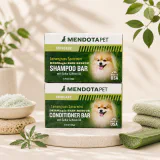 Both steps together
DERMagic Shampoo & Conditioner Bar Combo
Shop on dermagic.eu →
Both steps together
DERMagic Shampoo & Conditioner Bar Combo
Shop on dermagic.eu →Feed the coat as well as treating it
Topical products work on the skin you have; nutrition is what the body uses to grow a better coat in the first place. This part has real canine evidence behind it: a controlled study of dogs on a complete and balanced diet found that supplementing zinc and linoleic acid measurably improved coat quality and reduced water loss through the skin.
The catch is the clock. That improvement developed over roughly two months — a hair-cycle timescale, not a fortnight. Nothing you change in the bowl this week will show in the coat before December, so late September is when to start.
Retrieve Skin & Coat, an Omega 3, 6 and 9 supplement, is the internal half of that job — see the guide to the Mendota natural supplement range for the full line and dosing. It is also included, alongside doubled quantities of the wash, condition and lotion steps, in the bundle sized for exactly that two-month window.
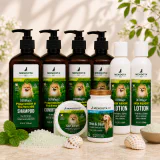 Topical and oral, sized for two months
DERMagic Total Coat Repair System
Shop on dermagic.eu →
Topical and oral, sized for two months
DERMagic Total Coat Repair System
Shop on dermagic.eu →For specific guidance email customerservice@dermagic.eu or call +44 7425 388643.