A dog that shakes its head after every walk is not doing it for no reason. Ear trouble is one of the most common reasons dogs are taken to a vet, one of the most likely to come back after treatment, and one of the easiest to make worse with good intentions and a cotton bud.
This is a guide to the whole of ear care: how a dog’s ear is built and why that matters, what recurrent infections are actually telling you, how to clean an ear properly, and what should never go into one.
Before anything goes in the ear
One rule comes before all the rest, because getting it wrong causes real harm.
Do not put any liquid into an ear that is painful, hot, swollen shut, or discharging — or into the ear of a dog that has suddenly developed a head tilt, a loss of balance, or flickering eye movements. See a vet first.
The reason is that you cannot see a dog’s eardrum without an otoscope. A long-standing or severe infection can perforate it, and once it is perforated, the inner ear is exposed to whatever you pour in. Several substances that are perfectly safe against an intact eardrum are not safe behind a ruptured one. A head tilt or balance loss suggests the problem has already reached the middle or inner ear.
Everything that follows assumes an ear that is itchy, waxy or smelly — not one that is acutely painful.
Why dog ears are built to trap trouble
The single most useful thing to understand about dog ear care is the shape of the canal, because it explains why the problems happen and why the cleaning technique is counter-intuitive.
| Human ear canal | Dog ear canal | |
|---|---|---|
| Shape | Short, roughly horizontal | L-shaped — a long vertical section, then a turn inward |
| Drainage | Gravity carries debris out | Debris and fluid must travel upward to escape |
| Ventilation | Open to the air | Often covered by a flap of ear |
| What you can see | Most of the way to the eardrum | The top of the vertical canal, and no further |
| Hair inside | Effectively none | Common, and dense in some breeds |
Three consequences follow, and they shape everything else in this guide.
A cotton bud cannot work. It cannot navigate a right-angle bend. Pushed into the vertical canal, it compacts wax and debris downward into the horizontal section, where the dog cannot shake it out and you cannot reach it. It is the single most common way owners turn a minor wax problem into an infection.
Water that gets in does not simply run out. After a swim or a bath, fluid sits at the bend. Warm, dark, humid and still is an excellent description of the conditions Malassezia yeast needs.
You are not seeing the problem. What is visible at the opening is the top of a much longer structure. An ear that looks only slightly grubby at the entrance can be considerably worse further down.
Ear infections are usually a symptom, not a disease
This is the part that changes outcomes, and it is the reason ear infections recur so reliably after successful treatment.
An ear infection is an overgrowth of organisms — usually yeast, sometimes bacteria, often both — that live harmlessly on every dog. Overgrowth requires a change in conditions. Something has to make the canal warmer, wetter or more inflamed than usual. That something is the actual disease.
In adult dogs the commonest something, by a wide margin, is allergy. Recurrent ear inflammation is one of the most dependable outward signs of canine atopic dermatitis. The allergy inflames the lining of the canal, the inflamed lining produces more wax and holds more moisture, and the organisms do the rest.
This is why a dog can be treated, clear up completely, and be back in the same state six weeks later. The flare was treated; the cause was not.
| Underlying cause | What points to it | What it needs |
|---|---|---|
| Environmental allergy (atopy) | Ears flare with licked paws, red belly, face rubbing; often seasonal at first | Treat the skin as a whole, year-round management |
| Food-related allergy | Non-seasonal from the start; ears and back end especially; sometimes gut signs | Diet investigation, digestive support |
| Trapped moisture | Follows swimming or bathing; otherwise healthy dog | Drying routine after water |
| Ear mites | Dry dark crumbly discharge, intense sudden itch, young animals, contact with other pets | Veterinary parasiticide — cleaning alone will not clear them |
| Anatomy | Drop ears, hairy canals, narrow brachycephalic canals | Routine cleaning, more vigilance, not a cure |
| Foreign body | Sudden, violent, one ear, frantic shaking — grass seeds in late summer | Vet, promptly; it will not come out on its own |
| Growth or polyp | One ear, persistent, unresponsive to treatment | Veterinary examination |
If the ears keep flaring, the useful question is not “what do I put in the ear” but “what is inflaming this dog”. Our guides to dog skin allergies and the difference between atopy and allergy cover how to tell which one you are dealing with, and the three most common dog allergies covers what tends to be behind it.
Reading the signs
| What you see | What it usually suggests |
|---|---|
| Head shaking, ear scratching | Irritation of any cause — the earliest and most reliable sign |
| Sweet, musty smell; brown waxy discharge | Malassezia yeast overgrowth — the commonest finding |
| Sharper smell; yellow or green discharge | Bacterial involvement — needs a vet |
| Dry, dark, crumbly discharge like coffee grounds | Ear mites — especially in puppies, cats, multi-pet homes |
| Redness at the canal opening, warmth | Active inflammation, whatever is driving it |
| Rubbing the head along furniture or the floor | Itch the dog cannot reach by scratching |
| Tilting the head to one side persistently | Deeper involvement — vet, not a home clean |
| Soft fluid-filled swelling of the ear flap | Aural haematoma from violent shaking — vet |
| Pale wax, no smell, no scratching | Normal. Leave it alone |
That last row matters. Some wax is healthy and protective — it traps debris and carries it outward. An ear that is clean, dry and untroubled does not need to be cleaned on a schedule, and cleaning it anyway strips the defences that were working.
If the smell is what you noticed first and you are not certain it is coming from the ears, our guide to why your dog smells covers how to locate the source — ears, paws, folds and coat each point somewhere different. The signs of yeast in dogs covers what the same organism does elsewhere on the body.
What should never go in a dog’s ear
The list of things that make ears worse is short, and almost everything on it is something a well-meaning owner has been told to try.
| Avoid | Why |
|---|---|
| Cotton buds inside the canal | Cannot follow the bend; packs debris down; risks the eardrum |
| Hydrogen peroxide | Damages the lining and strips natural oils; leaves the canal wet — the opposite of what you want |
| Surgical spirit, alcohol-based cleaners | Sting severely on inflamed skin; dry the canal into flaking and further irritation |
| Human ear drops and wax removers | Formulated for a different anatomy; several ingredients unsafe behind a ruptured eardrum |
| Neat essential oils, including undiluted tea tree | Genuinely toxic at concentration — never put undiluted tea tree oil in an ear. We previously added that it is “useful properly diluted”; we have withdrawn that, as we have no evidence it achieves anything at a formulated dilution. The evidence on the oil |
| Olive oil and cooking oils | Softens wax but leaves a residue that holds moisture and feeds yeast |
| Vinegar and water mixtures | A folk remedy that stings badly on any broken or ulcerated skin, which you cannot see |
| Plucking ear hair as routine | Leaves micro-trauma and inflammation. Reasonable in some breeds on veterinary or grooming advice; not a default |
The pattern is consistent: anything that dries the canal by stripping it, or that leaves residue and moisture behind, makes the next infection more likely rather than less.
How to clean a dog’s ear properly
The technique follows from the anatomy. You are not wiping an ear. You are flooding a canal, breaking up what is in it, and letting the dog remove it.
- Pick your moment and your location. Somewhere easy to wipe down, with the dog calm. Ear cleaning gets messy at step 4, which is a sign it is working.
- Look first. Lift the flap. Check for redness, pain on touch, or discharge. If the ear is painful or discharging, stop — that is a vet visit, not a clean.
- Fill the canal. Lift the flap to straighten the vertical section and squeeze the cleaner in generously until the canal is full. Under-filling is the commonest mistake — a few drops will not reach the bend. Do not let the bottle tip touch the ear.
- Massage the base of the ear for 20–30 seconds. You should hear a soft squelching. This is the step that does the actual work, breaking up wax and lifting debris from the horizontal section.
- Let the dog shake. Stand back. Shaking brings debris up and out of the canal, which is the only direction it can travel. This is the dog doing the part you cannot.
- Wipe only what you can see. Cotton wool or gauze around a finger, on the flap and the visible opening. Nothing goes into the canal.
- Repeat if the wool comes away dirty. A neglected ear may take two or three rounds. Stop if the dog becomes sore.
Then leave it alone. The ear needs to dry, and a canal that has been cleaned and left to air is doing exactly what it should.
The product for the job
The reason the Ear Wash is the right tool is what it leaves out. Most of the ear cleaners on a shelf are built on alcohol or peroxide — both of which clean effectively and both of which damage the lining of a canal that is already inflamed.
DERMagic Natural Ear Wash — 4 oz., €18.99. No alcohol, so it does not sting or dry the canal into flaking. No peroxide, so it does not strip the natural oils that protect the ear. It works instead on witch hazel as a gentle astringent, boric acid, tea tree oil at a formulated dilution, and echinacea extract, in a glycerine base that dissolves wax and lifts foreign debris. Made in the USA.
Its own directions are straightforward: use as often as needed, and especially after bathing or swimming.
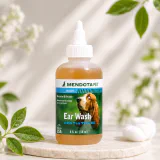 Clean the ears
DERMagic Natural Ear Wash — 4 oz.
View on dermagic.eu →
Clean the ears
DERMagic Natural Ear Wash — 4 oz.
View on dermagic.eu →For an ear that is yeasty, itchy and waxy rather than simply dirty, the Skin Rescue Lotion has long-standing directions for ear use: a small amount on a fingertip, massaged gently downward into the canal once a day for a few days. It is a treatment rather than a cleaner — use the Ear Wash to clean, and the lotion on the yeast. The same rule governs both: nothing goes into a painful or discharging ear before a vet has seen it.
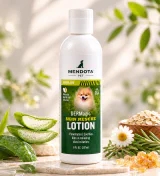 Start the treatment
DERMagic Skin Rescue Lotion
View on dermagic.eu →
Start the treatment
DERMagic Skin Rescue Lotion
View on dermagic.eu →After swimming and after bathing
This is the cheapest ear care there is, and it is the step almost everyone skips.
Water gets into the vertical canal easily and leaves it slowly. In a dog with drop ears it may not leave at all without help. A large share of the ear infections that appear in late summer are simply the delayed consequence of a swim three days earlier.
- Dry the ear flap and the visible opening with a towel or cotton wool after every swim or bath.
- Clean with the Ear Wash after swimming, particularly after lake, river or sea water.
- Never pour water directly into the ears when bathing. Wash the head last, with a cloth rather than a running shower.
- Check the ears the day after, not just on the day. Trouble shows up late.
While the dog is wet, dry between the toes as well — the same moisture logic applies at the other end, and it is covered in our guide to dog paw care.
How often, for which dog
| Your dog | Routine |
|---|---|
| Upright ears, no allergies, clean dry canals | Look weekly. Clean only when there is something to clean |
| Drop ears — Spaniels, Retrievers, Bassets, hounds | Look weekly, clean every one to two weeks |
| Swimmers and water-lovers | Dry after every swim, clean after every swim |
| Hairy canals — Poodles, Bichons, many terriers | Clean every one to two weeks; discuss hair management with your groomer |
| Flat-faced breeds — Frenchies, Pugs, Bulldogs | Weekly check and clean; narrow canals ventilate poorly |
| Allergic dogs with a history of ear disease | Clean two to three times weekly during flares, on veterinary advice; treat the underlying allergy year-round |
French Bulldog skin problems covers the brachycephalic ear in more depth, alongside the folds and tail pockets that come with the same shape of dog. Labrador skin problems covers the breed whose single most commonly recorded disorder is ear infection — including why the swimming explanation is weaker than it sounds, and what the evidence says actually drives it. Golden Retriever skin problems covers the other retriever, which carries higher ear odds still. And West Highland White Terrier skin problems is the one to read if you are unconvinced that allergy rather than ear shape is what drives this — the Westie records essentially the same ear-disease rate as the Labrador, in a small prick-eared terrier that does not swim.
When it keeps coming back
If you are cleaning ears correctly and they still flare every few weeks, the ear is not the problem and no amount of ear cleaning will make it the solution. What follows is the approach that works on the underlying allergic skin disease that is driving it.
Treat the whole dog, on all four steps. The steps compound, and the reason owners conclude the approach did not work is nearly always that they ran part of it.
| Step | Product | What it does for an allergic ear |
|---|---|---|
| Cleanse | Skin Rescue Shampoo Bar — €20.99 | Removes the scale, oil and allergen load from the coat. This is what allows anything applied afterwards to reach skin |
| Treat | Skin Rescue Lotion — €26.99 | The workhorse on yeast and inflamed skin, including inside the ear canal |
| Target | Hot Spot Salve — €24.99 | For the raw patches behind and below the ear that head shaking and scratching create |
| Restore | Cell Restoration Crème — €45.99 | Rebuilds the skin and coat around the ear and on the flap once the flare is controlled |
The first three are sold together as the DERMagic Skin Essentials System at €58.99. Bought individually those three come to €72.97, so the System saves €13.98 — a little over 19%.
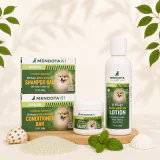 Treat the cause
DERMagic Skin Essentials System
View on dermagic.eu →
Treat the cause
DERMagic Skin Essentials System
View on dermagic.eu →The full four-step protocol is set out in the DERMagic System for dogs, which covers dosing and the recovery timeline.
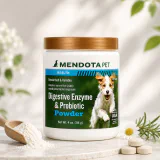
Where the allergy looks food-related — ears and back end affected, non-seasonal from the first day, sometimes with loose stools or wind — Retrieve Enzymes, Food & Allergy Relief (€32.99) supports digestion while you work out the dietary cause. It sits alongside the topical work rather than replacing it, and is covered with the rest of the range in our guide to the Mendota supplements.
 Support digestion
Retrieve Enzymes, Food & Allergy Relief
View on dermagic.eu →
Support digestion
Retrieve Enzymes, Food & Allergy Relief
View on dermagic.eu →One thing worth saying plainly: repeated courses of steroids will clear an ear flare quickly and do nothing about the reason it happened, which is why the interval between flares tends to shorten over time. We have written separately on why steroids are a poor long-term answer for skin disease.
Ear mites, specifically
Mites deserve their own note because they are the one common cause on this page that cleaning will not fix.
They produce a characteristic dry, dark, crumbly discharge, cause intense and sudden itching, and are far more common in puppies, in cats, and in animals from multi-pet environments. They are contagious between pets in a household. They need a specific parasiticide from a vet — and every animal in the house usually needs treating, not just the one that is scratching.
Our guide to mites and mange covers the wider family of mite problems, and parasites and the skin covers fleas and ticks alongside them.
Cats
Do not use the dog range on a cat. Cats tolerate essential oils considerably less well than dogs, and they groom thoroughly enough that anything applied is reliably ingested. Ear mites are also a much more common cause of ear trouble in cats than in adult dogs, and a cat with dark crumbly ear discharge should be seen by a vet rather than cleaned at home. DERMagic makes a separate feline line formulated for the difference — talk to us before applying anything else to a cat.
The short version
- A painful, hot, discharging ear, or a head tilt, is a vet visit. Nothing goes in it first.
- The canal is L-shaped. Flood it, massage it, let the dog shake it out. Never push anything down it.
- No cotton buds, no peroxide, no alcohol, no human ear drops, no neat oils.
- Some wax is normal. Cleaning a healthy ear on a schedule causes the problem it was meant to prevent.
- Dry the ears after every swim and every bath. This prevents more infections than anything else on this page.
- If it keeps coming back, it is not an ear problem. It is an allergic dog, and the skin needs treating as a whole.