Paw licking is the most normalised symptom in dogs. Owners describe it as a quirk, a habit, something the dog has always done. It is almost never a habit. The paws are the first place allergic skin disease appears, and a dog that licks its feet every evening is telling you something specific.
This is a guide to the whole of paw care: what licking actually means, the self-perpetuating cycle that keeps it going long after the original trigger has gone, how to deal with cracked pads, what the seasons do to feet, and — the part that narrows the options sharply — how to choose a product for a surface your dog is going to eat.
Two completely different problems
“Paw problems” covers two things that need opposite approaches. Getting them the wrong way round is why a lot of paw care fails.
| Top-down | Bottom-up | |
|---|---|---|
| What it is | Something makes the dog lick, chew or worry at the foot | The pad surface itself is damaged by contact |
| Where it shows | Webbing between the toes, nail beds, top of the foot | The pads themselves — cracked, rough, peeling |
| Typical causes | Allergy, yeast, parasites, pain, foreign body | Cold, grit and de-icer, hot tarmac, abrasive ground, age |
| What the dog does | Licks, chews, chases the foot, limps | Often nothing — many owners never notice |
| What fixes it | Treat the cause; the skin follows | Restore and protect the pad; reduce the exposure |
A dog can have both at once — a dog with allergic feet that walks on gritted pavements in January has a top-down and a bottom-up problem simultaneously. But they are treated differently, and the first job is knowing which one you are looking at.
Why the paws, specifically
There is a reason feet are the site that flares first.
They are the contact surface. Everything a dog reacts to environmentally — grass pollen, dust mites in carpet, moulds, floor cleaner — gets met by the feet before anything else. In canine atopic dermatitis the distribution is characteristic and consistent: paws, belly, armpits, muzzle, ears. Paws usually lead.
The skin between the toes is thin. Pads are the thickest keratin on the body, but the webbing between them is not — it is thin, hairless in places, and poorly ventilated.
They are warm and frequently damp. Rain, dew, wet grass, and the dog’s own saliva. The gap between the toes stays moist for far longer than any other part of the dog.
They are within easy reach. Unlike a flank or a back, a dog can work on a paw continuously, and will.
The cycle that keeps it going
This is the mechanism worth understanding, because it explains why paw problems outlast their original cause.
- Something makes the foot itch — pollen, most often.
- The dog licks. Licking gives brief relief and floods the area with saliva.
- The webbing stays damp. Damp, warm, poorly ventilated skin is ideal for Malassezia yeast, which lives on every dog in small numbers.
- Yeast multiplies. Yeast itself is intensely itchy.
- The dog licks more.
By the time an owner takes it seriously, the pollen season may be over and the dog is still licking — because the yeast overgrowth is now driving it on its own. This is why “we waited and it didn’t settle down” is such a common history, and it is why treating the surface matters even when the underlying cause is allergic. Our guide to the signs of yeast in dogs sets out what an overgrowth looks like elsewhere on the body.
Breaking the moisture cycle is half the treatment. Drying properly between the toes is not fussiness; it is the intervention.
What paw licking actually means
| Cause | How it presents | What points to it |
|---|---|---|
| Environmental allergy (atopy) | Both front feet, diffuse, no lump | Seasonal at first, becomes year-round; ears and belly involved too |
| Yeast overgrowth | Red webbing, rust-brown staining, distinctive smell | Damp paw prints; worsens in humidity; often follows allergic licking |
| Food allergy | Same distribution as atopy | Non-seasonal from the start; often gut signs alongside |
| Parasites | Sudden onset, intense, may affect one foot | Contact with other animals; mites and fleas |
| Foreign body | One foot, sudden, frantic, often limping | Grass seeds in late summer and autumn; a discrete sore spot |
| Interdigital cyst | A discrete painful red swelling in the webbing | Usually one foot; the dog objects to the foot being handled |
| Pain elsewhere | Persistent licking of one leg or foot | Older dog, stiffness, no skin changes to find |
| Contact irritant | All four feet, onset after a change | New floor cleaner, new bedding, gritted pavements |
| Behavioural | Diagnosis of exclusion | Only after the above have genuinely been ruled out |
The last row deserves emphasis. Anxiety and boredom are blamed for paw licking far more often than they cause it. If a dog is licking its feet, assume there is something to feel until proven otherwise.
Two of our guides go deeper on the commonest cause: dog skin allergies covers the presentations, and atopy versus allergy explains a distinction that changes what you do next. If you have a flat-faced breed, French Bulldog skin problems covers paws and interdigital cysts in a breed that gets more than its share of both. A dog whose paws are being licked very often has flaring ears as well — the same allergy, the same yeast, a different site — and dog ear care covers that end of it.
Cracked pads are a different job
Pads are built to be walked on: thick, keratinised, and without the oil-producing structures that keep the rest of the skin supple. That is what makes them durable, and also what makes them prone to drying out and splitting. Once a pad cracks it is painful, it is a route in for infection, and it will not repair itself quickly while the dog keeps walking on it.
What dries pads out:
- Cold, dry winter air, and the contrast between frozen ground outside and dry central heating indoors
- Grit and chemical de-icers — the single most damaging seasonal exposure
- Hot tarmac in summer, which can blister a pad in minutes
- Abrasive surfaces — sand, gravel, long walks on hard ground after a sedentary winter
- Age, which thins and hardens pads over time
Cracked pads need an emollient rich enough to actually penetrate keratin, applied generously and repeatedly. This is the one paw job where the product choice is genuinely straightforward — see the routine below.
The seasons
Autumn and winter. Grit and de-icer are the main hazard. Common table salt is irritating; some commercial de-icers contain ammonium nitrate, propylene glycol or sodium ferrocyanide, which are outright poisonous. Avoid treated paths where possible, and stop the dog licking its feet on the walk home. Rinse and dry on arrival. Our post on how your dog adapts to autumn weather covers the wider seasonal picture, and winter dry skin and dull coat deals with what the cold does to skin generally.
Late summer and autumn: grass seeds. A grass seed works into the webbing, then migrates. Sudden, frantic licking of one foot with a small swelling or weeping point is a grass seed until proven otherwise, and it is a vet job — they do not come out on their own and they travel.
Spring and summer: pollen. This is the main driver of allergic paw licking. Rinsing the feet and lower legs after every walk removes the allergen before the dog spends the evening working on it, which is a genuinely effective and entirely free intervention. Grass pollen allergy in dogs covers the rest of the management, including boots for the worst-affected dogs.
Summer: hot ground. If you cannot hold the back of your hand on the tarmac for seven seconds, it is too hot to walk on. Pad burns from hot surfaces are common and entirely preventable.
Everything you put on a paw gets eaten
This is the constraint that governs every product decision on this page, and it is the reason improvising from the bathroom cabinet is a bad idea.
A dog licks its feet. Whatever goes on a pad or between the toes will be ingested, repeatedly, in quantity. So the criterion for a paw product is not only “does it work” but “is it safe swallowed”.
Things to keep off paws:
- Zinc oxide — in many human nappy creams and sunblocks, and genuinely toxic to dogs in quantity
- Neat tea tree oil — undiluted essential oil is toxic to pets; a formulated product at a controlled concentration is a different thing entirely
- Human foot creams with high-strength urea, formulated for heels that will not be licked
- Alcohol-based sprays on broken skin — they sting, and a dog that associates treatment with pain becomes harder to treat every time
The DERMagic products below are formulated for animals that groom themselves. The Skin Rescue Lotion and Hot Spot Salve instructions both say it plainly: if your pet licks it off, reapply — there is nothing in it to harm them.
The paw routine
After every walk
- Rinse the feet and lower legs with plain water in pollen season, after grit or de-icer, and after sand or salt water.
- Dry between the toes. Spread the toes gently and dry the webbing, not just the top of the foot. This is the step that breaks the moisture cycle and the step almost everyone skips.
- Look. Ten seconds per foot. Redness in the webbing, staining, a lump, a cut, a grass seed, a torn nail.
Weekly
- Trim the hair between the pads level with the pad surface. Long hair there mats, holds moisture and traps grit.
- Check nail length. Nails that touch the ground when the dog is standing change how it loads the foot and make walking uncomfortable.
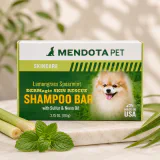
- Wash the feet properly if there is a yeast problem. Lather the feet with the Skin Rescue Shampoo Bar, leave it a minute, rinse thoroughly and dry between the toes. Its neem oil and sulphur are there to deal with fungal and bacterial overgrowth. Washing the feet is not the same as bathing the dog — you are not stripping the oils out of the whole coat — so it does not conflict with the twice-monthly guidance for full baths.
 Start the routine
DERMagic Skin Rescue Shampoo Bar
Shop on dermagic.eu →
Start the routine
DERMagic Skin Rescue Shampoo Bar
Shop on dermagic.eu →Daily, while treating
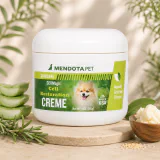
- Cracked or rough pads — Cell Restoration Crème, generously, ideally at night when the dog is settling. Organic aloe leaf gel, shea butter and sesame oil; its own directions name cracked pads and dry noses. It contains no preservatives, so refrigerate it after opening.
- Red, irritated webbing that is not broken — Skin Rescue Lotion, massaged in until absorbed. Twice daily for the first week, then once daily.
- Skin licked raw, or broken — Hot Spot Salve. The salve is the right choice on broken skin and on a surface that gets licked, because it stays put where a lotion would come straight off. Once or twice daily until it has healed.
 For cracked pads
DERMagic Cell Restoration Crème
Shop on dermagic.eu →
For cracked pads
DERMagic Cell Restoration Crème
Shop on dermagic.eu →Matching the product to the problem
| Problem | Product | Why this one |
|---|---|---|
| Cracked, rough or peeling pads | Cell Restoration Crème — €45.99 | Rich aloe, shea and sesame emollient made for pads and noses |
| Red, itchy webbing, no broken skin | Skin Rescue Lotion — €26.99 | Lipid-rich emollient; sulphur, rosemary and sesame oil. The label says reapply if licked off |
| Licked raw, weeping or broken skin | Hot Spot Salve — €24.99 | Stays on broken skin where lotion is licked off; same reapply-if-licked instruction |
| Scaling and flaking between the toes | Skin Rescue Shampoo Bar — €20.99 | Neem oil and sulphur, used as a foot wash twice weekly |
| Dog will not leave the foot alone | Retrieve Chew Stopper — €18.99 | Water-based bitter spray for paws and bandages; no alcohol to sting |
| Poor skin barrier generally | Retrieve Skin & Coat — €35.99 | Omega 3, 6 and 9; reduces scratching and flaking from the inside |
Two of these are worth expanding on.
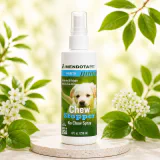
Chew Stopper is the one most owners have not thought of. It is licensed for paws, tails, bandages and sores, it is water-based so it will not sting, it uses rosemary rather than cayenne so it cannot burn, and it can be sprayed over medication you have already applied. It buys the skin the uninterrupted hours it needs to heal. It does not treat anything — it protects the treatment.
 Protect the treatment
Retrieve Chew Stopper Spray
Shop on dermagic.eu →
Protect the treatment
Retrieve Chew Stopper Spray
Shop on dermagic.eu →Retrieve Skin & Coat works on the other side of the problem. A dog with a compromised skin barrier reacts to more, and reacts harder. Omega 3, 6 and 9 supplementation reduces scratching and flaking over weeks rather than days — it is not a paw treatment, it is what makes the paw treatment hold. The full range is covered in our guide to the Mendota supplements.
Treating the cause, not just the foot
If the licking is allergic — and it usually is — treating the paw alone will get you a partial result that relapses. Allergic skin disease is a whole-dog problem that happens to show first on the feet, and the four-step DERMagic System is designed around that.
| Step | Product | What it does for the paws |
|---|---|---|
| 1. Cleanse | Skin Rescue Shampoo Bar | Physically washes allergen, grease and surface debris off the feet — and clears the way for everything applied afterwards |
| 2. Treat | Skin Rescue Lotion | The layer that stays on irritated webbing between baths |
| 3. Target | Hot Spot Salve | Covers the broken, licked-raw areas the lotion cannot stay on |
| 4. Restore | Cell Restoration Crème | Rebuilds pads and repairs the barrier once the inflammation has settled |
The steps compound. The cleanse is what lets the lotion reach skin rather than sitting on grease and debris. The salve covers exactly the places where the lotion would be licked off within the hour. The crème repairs a barrier that took months to break down. Running one step and concluding the range does not work is the commonest reason an owner gives up — it is a protocol, and it performs as one.
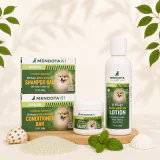
The first three steps are sold together as the Skin Essentials System at €58.99. Bought individually they come to €72.97 — the bar at €20.99, the lotion at €26.99 and the salve at €24.99 — so the kit saves €13.98, a little over 19%. For paws specifically, add the Cell Restoration Crème for the pads themselves.
 Start the treatment
DERMagic Skin Essentials System
Shop on dermagic.eu →
Start the treatment
DERMagic Skin Essentials System
Shop on dermagic.eu →What to expect
| When | What you should see |
|---|---|
| Days 1–3 | Licking reduces. Less overnight worrying at the feet. This is relief, not healing. |
| Week 1 | Redness in the webbing fades. Any smell lessens noticeably. Cracked pads feel softer. |
| Weeks 2–3 | Rust-brown staining stops spreading — existing stain is in the fur and grows out rather than fading. Pads close. |
| Weeks 4–6 | Skin between the toes back to normal colour. Fur regrows over the areas chewed bare. |
| Ongoing | Keep the post-walk rinse and dry. In a seasonally allergic dog, restart the full protocol before the season rather than after. |
If there is no improvement at all after two weeks of consistent treatment, stop and reconsider the diagnosis rather than continuing. Something is being missed — most often a foreign body, a parasite, or pain in the leg rather than the foot.
When to see a vet
- A discrete, painful swelling between the toes
- Limping, or objection to the foot being handled
- One foot only, especially with sudden onset — think foreign body
- Bleeding, a deep crack, or a visible wound that is not closing
- Nail bed involvement — swelling, discharge, or a nail that has changed colour or is loose
- Sudden, frantic licking or chewing of a foot
- No response to consistent treatment after two weeks
A painful lump is not a balm problem. Everything else on this page assumes you are looking at skin.
The short version
- Paw licking is a symptom, not a habit. It usually means allergy.
- The lick–damp–yeast cycle outlasts the original cause, which is why the problem does not resolve on its own.
- Drying between the toes is the single most valuable free thing you can do.
- Cracked pads are a separate problem and need an emollient, not an antimicrobial.
- Whatever you apply will be eaten — that rules out most human products and rules in ones formulated for animals that groom.
- Treat the dog, not just the foot. The feet are where it shows, not where it starts.
We ship the full range across Europe — see where to buy DERMagic in Europe for rates and delivery times to your country. If you are treating a cat rather than a dog, use the feline range instead, and talk to us first.