
Parasites are behind a huge share of dog skin problems — fleas, ticks, chiggers and microscopic mange mites. Here’s how to recognise each one, and what genuinely clears it.
What counts as a parasite
A parasite is an organism that lives in or on the tissue of a host and causes harm without immediately killing it. Some are relatively innocuous, some cause serious disease, and a few are behind the worst skin problems you will see on a dog.
The list that matters for skin: fleas, ticks, chiggers, deer flies, gnats — and then the microscopic mites that cause mange.
Fleas, ticks, chiggers and gnats
When a dog suddenly starts scratching and biting at itself, the first thought is almost always fleas. Often correctly. What makes a flea-sensitive dog different is that it is reacting to proteins in the flea’s saliva, injected under the skin as the flea feeds — an allergic response, not bite trauma. That is why the reaction is out of all proportion to the flea burden, and why the owner frequently cannot find a flea at all.
This paragraph used to say that a single flea bite inflames the skin “for several days”. We have withdrawn the figure. The experimental work on flea-bite hypersensitivity measured skin-test reactions at 15 minutes and 24 to 48 hours; no study has measured how long the itch from one bite actually lasts. The disproportion is documented. The duration is a clinical impression, and we should not have dressed it up as a number.
Flea allergy has a distribution worth knowing: it concentrates on the lower back, tail base and the inner-rear surface of the thighs — close to the opposite of the atopic pattern. Our full account, including the UK prevalence figures and why you so often cannot find the fleas, is in flea allergy dermatitis in dogs and cats.
Chiggers, deer flies and gnats (sometimes called No-See-Ums) are mostly nuisances. They don’t tend to create systemic skin problems, though they make a dog miserable in the moment. Harvest mites — the chigger of European autumn — are worth distinguishing from mange, because unlike mange mites they are visible to the naked eye as orange-red specks. Our guide to harvest mites in dogs covers them properly.
Tick bites rarely trigger an allergic reaction, but they can leave a slow-healing lesion behind — and that lesion is an open door to secondary infection.
Mighty mites and mange
Mites are microscopic creatures that resemble tiny spiders. Three groups matter for dogs — and the word “mange” unhelpfully covers two of them, despite their being unrelated diseases with opposite itch profiles.
Sarcoptic mange mites (scabies)
Sarcoptes tunnels within the stratum corneum, the outermost layer of the skin, causing intense itching, reddened skin, thinning hair and crusting. Bacterial infection follows almost as a matter of course. It prefers thinly haired skin, so it shows up first on the ear margins, elbows, abdomen and hocks.
It is highly contagious, and it passes to people — a self-limiting crop of itchy papules on the arms, neck and waistline, which keeps recurring until the dog is treated. If humans in the household have started itching, that is diagnostic information worth volunteering to the vet.
It is also routinely misdiagnosed as allergic dermatitis, for months at a time. The reason is that skin scrapings are only around 20–50% sensitive — not because the mites are too deep to reach, but because there are so few of them. A dog with full-blown scabies may carry fewer than twenty mites in total, and scratches a good share of those away. A negative scraping does not rule it out.
Demodectic (Demodex) mites
Demodex mites live inside the hair follicles of normal dogs in small numbers. Most dogs carry a few and never notice. Demodicosis is what happens when that population expands — and unlike scabies, it is usually barely itchy unless a secondary bacterial infection has set in.
The widely repeated explanation, that Demodex “proliferates under stress”, does not hold up. In young dogs, generalised demodicosis reflects a heritable, breed-associated defect in T-cell function — which is why affected dogs should not be bred from. In an adult dog with no prior history, it is a red flag for underlying disease: hyperadrenocorticism, hypothyroidism, neoplasia (lymphoma in particular), leishmaniasis, or immunosuppressive medication.
Demodex is usually visible on a deep skin scraping, so diagnosis is comparatively straightforward. Generalised demodicosis is serious: large areas affected, skin red, crusty and warm, pustules, a strong distinctive odour. Localised juvenile cases are the opposite story — roughly 90% resolve without any treatment at all.
Cheyletiella mites
The famous “walking dandruff.” Under a magnifying glass they look like tiny spiders, and what appears to be ordinary dandruff turns out to be the mites moving across the surface.
Less destructive than the other two — but two things owners miss. It is contagious, so every in-contact dog, cat and rabbit needs treating. And the mites survive off the host for days, so bedding and environment need dealing with or it simply returns.
Our dedicated guide to mites and mange goes through all three in more detail, including what each one is actually treated with.
About cortisone
This post used to say a cortisone shot makes a parasitic case dramatically worse. That overstated the evidence, and it is worth stating accurately.
There is no good evidence that anti-inflammatory-dose steroids increase the mite burden in dogs. The harm is diagnostic. Steroids partially mask the itch, can blunt serology, and buy weeks of apparent improvement while the dog stays infested and contagious to every other animal and person in the house.
The clue is in that word partially. Scabies is characteristically only incompletely steroid-responsive, where atopic dermatitis generally responds well. A dog that improves somewhat on steroids but never settles, and relapses on withdrawal, is a dog worth re-examining for mites. Our post on why steroids are a poor long-term answer covers the broader case.
What actually clears the parasite
For fleas and ticks, a modern veterinary ectoparasiticide. This paragraph used to add that environmental treatment was required because “the great majority of a flea population is in the carpet, not on the dog,” and that needs two corrections.
The direction is right — the eggs, larvae and pupae are off the animal, and they outnumber the adults. But we attached a 95:5 split to it, and no primary household census of flea life stages exists; ESCCAP asserts the direction without giving numbers. The second error is subtler: “in the carpet, not on the dog” implies adults commute. They do not. Ctenocephalides felis adults are permanent ectoparasites — in controlled work, 85% of females stayed on the host for 50 days or more. And in a six-month carpeted home simulation, monthly on-animal treatment alone gave virtually complete control with no environmental product used at all. Treat the animal; vacuum and hot-wash bedding; add a household product for a heavy infestation rather than as a matter of course. Full working in our flea allergy dermatitis guide.
For mites, prescription acaricides, and the evidence is not close. The isoxazolines — fluralaner, sarolaner, afoxolaner, lotilaner — achieve 98–100% mite reduction in controlled trials for both sarcoptic mange and generalised demodicosis. Selamectin and imidacloprid/moxidectin spot-ons are label-indicated EU alternatives for scabies. All are prescription-only under Regulation 2019/6.
No shampoo, lotion or essential oil has published cure-rate evidence against these parasites in dogs. We would rather say so than sell you a fortnight of delay while the infestation spreads through the household.
How Dermagic helps
We sell topical skincare, so we will be plain about the line: we can make the skin better, and we cannot kill the parasite.
What is left is not small. Parasites wreck the skin, and killing them does not repair it. Crusting, scale, a damaged barrier and secondary bacterial or Malassezia overgrowth all outlast the infestation — and that damage is what the owner is still looking at weeks after the mites have gone.
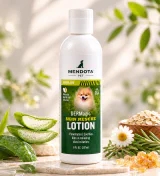
That is the job the products are for. Bathing lifts crusts and scale. Skin Rescue Lotion supports the barrier while the skin rebuilds. Hot Spot Salve covers the open lesions left by ticks, flea bites and self-trauma before they turn into hot spots. Used alongside your vet’s treatment rather than instead of it, that is a genuinely useful role — and it is the part of the recovery nobody else is paying attention to.
 Start the treatment
DERMagic Skin Rescue Lotion
Shop on dermagic.eu →
Start the treatment
DERMagic Skin Rescue Lotion
Shop on dermagic.eu →
 Start the treatment
DERMagic Hot Spot Salve
Shop on dermagic.eu →
Start the treatment
DERMagic Hot Spot Salve
Shop on dermagic.eu →For specific guidance email customerservice@dermagic.eu or call +44 7425 388643.