
Flea allergy dermatitis is not a reaction to being bitten. It is an allergy to proteins in flea saliva — which is why the severity has so little to do with how many fleas you can find, and why “but I checked, there aren’t any” is the least reliable thing an owner can tell a vet.
We sell shampoos, a lotion and a salve. We do not sell anything that kills a flea, and nothing on this page is going to pretend otherwise. What follows is drawn from the primary veterinary literature, with the denominators attached, because the popular version of this subject is full of numbers that nobody has ever measured — including several we published ourselves until today.
It’s the saliva, not the bite
A flea bite is a small mechanical injury. On a non-allergic animal it amounts to very little. What turns it into disease is sensitisation to the proteins the flea injects while it feeds.
The cleanest demonstration is old and still the best. Flea-naive dogs were exposed to controlled challenge with virgin fleas and followed as they sensitised. By week ten they were producing two different reactions to the same bite: an immediate one at fifteen minutes, with oedema and eosinophils, and a delayed one at 24 to 48 hours, with perivascular lymphocytes. That is a type I and a type IV hypersensitivity in the same animal, which is why the condition behaves so inconsistently — some animals flare within the hour, others two days later, many both.
The allergen is not one thing
You will see Cte f 1 named as the flea allergen. It is real — an 18 kDa salivary protein from the cat flea, cloned and characterised — but the claim that it accounts for the disease does not survive contact with the independent data.
The study reporting intradermal reactivity to Cte f 1 in 100% of experimentally sensitised and 80% of clinically flea-allergic dogs came from the company that sells the assay. When an independent group tested recombinant Cte f 1 against whole flea saliva in 15 flea-allergic dogs, 15 atopic dogs and 15 infested but non-allergic dogs, the recombinant allergen managed 40% sensitivity at 90% specificity. Whole flea saliva, in the same animals, managed 93% at 90%. Other work has implicated salivary fractions around 40 kDa and in the 8 to 12 kDa range in different individuals.
So: Cte f 1 is a major allergen. Different dogs react to different proteins, and a test built on one of them misses more than half the cases.
What we have withdrawn from this site today
Two claims that we published, repeatedly, and cannot support.
“A single flea bite causes several days of itching.” This appeared in eight of our posts, and in one of them it had drifted up to “a fortnight of scratching.” The experimental work measured skin-test reactions at fifteen minutes and 24 to 48 hours. Nobody has measured how long the itch from one bite lasts. The point the claim was reaching for is real and better stated without a number: the reaction is out of all proportion to the flea burden. We have replaced the figure with that.
“Intermittent exposure sensitises; continuous exposure induces tolerance.” This is widely repeated and it traces to flea-bite experiments in guinea pigs in the mid-1960s. The one experiment built to test it in a relevant species took 10 flea-naive cats, exposed five intermittently for 120 days, then moved both groups to continuous exposure for a further 120 days. Eight of the ten developed flea allergy, with no difference between the groups. The tolerance idea should not be driving anybody’s flea-control decisions.
How common it actually is
This is where most writing on the subject, including our own, has been loosest. Here are figures with denominators.
| Population | Fleas found | Lesions compatible with flea allergy |
|---|---|---|
| Dogs, 31 UK practices, n=2,653 | 6.82% | 3.32% |
| Cats, 31 UK practices, n=1,508 | 21.09% | 8.02% |
Two things to take from that. Flea allergy is roughly two to three times commoner in cats than in dogs. And the absolute numbers are modest — a few per cent of first-opinion caseload, not the majority of itchy animals.
You will also see much larger figures. The commonest is 29%, from a study of 502 itchy cats across several European countries in which flea hypersensitivity was the single most frequent diagnosis. That is a real finding, but the denominator is cats already referred for pruritus, not cats in general. Quoting it as prevalence is the same error as quoting referral-hospital cancer rates as a breed’s lifetime risk.
A later UK survey of 326 practices found fleas on 14.4% of dogs and 28.1% of cats. Those numbers are higher than the 2005 figures, not lower, despite a decade of far better flea products arriving in between. The methods differ enough that this is not proof of a trend — but anyone claiming modern treatments have visibly reduced UK flea infestation does not have the data for it.
It is nearly always the cat flea
Even on dogs. Of 336 fleas collected from dogs in that UK survey, 313 — 93.15% — were Ctenocephalides felis, the cat flea. The dog flea, C. canis, accounted for five. The later survey put C. felis above 90% again. “Cat flea” is a misleading name; it is simply the flea of both species, and of the household.
Where it itches
Distribution is the most useful clinical clue available to an owner, and it is worth knowing exactly how strong the evidence is.
In 346 dogs each carrying a single diagnosis — 91 with atopic dermatitis, 110 with plain flea infestation and 145 with flea-bite hypersensitivity — the patterns separated like this:
| Sign | Points towards |
|---|---|
| Chewing over the back and dorsolumbar area; chewing at the tail | Flea-bite hypersensitivity |
| Paw involvement; face and neck | Atopic dermatitis |
| Ventral abdomen and inner thigh | Flea infestation without allergy |
The caveat matters as much as the table. Those findings are specific, not sensitive — they are good at confirming when present, and poor at ruling out when absent. Plenty of flea-allergic dogs do not present that way. And the data come from one French referral centre, so the mix of cases is not the mix a general practice sees.
There is at least one breed where the rule actively misleads. West Highland White Terriers commonly have atopic dermatitis involving the lower back, which means lower-back-worst in a Westie is ambiguous rather than diagnostic — one concrete reason Westies get managed as flea cases for years while the real allergy goes untreated. We go into that in our Westie skin guide.
Cats break all the rules
Cats do not express allergic skin disease the way dogs do. They have four recognised patterns:
- Miliary dermatitis — crops of small crusted papules, classically over the back
- Self-induced alopecia — hair removed by overgrooming, often with no visible skin damage
- Eosinophilic lesions — the eosinophilic granuloma complex, including indolent ulcers and plaques
- Head and neck excoriation — scratching damage around the face, ears and neck
The important fact about this list is the one most commonly omitted: none of the four is specific to any single cause. Two large multicentre studies, of 502 and 501 cats, say so explicitly. In them, food-driven allergic disease and allergic disease that was neither food nor flea driven were clinically indistinguishable.
So “my cat has miliary dermatitis, therefore fleas” is folklore. The pattern tells you the cat has allergic skin disease. It does not tell you what is driving it, and the only way to find out is to exclude causes in order — starting with fleas, because fleas are the cheapest and fastest thing to eliminate.
Why you can’t find the fleas
Because the tests are bad, the animal is destroying the evidence, and the allergy does not need many fleas in the first place.
On the tests: in 158 dogs and 97 cats, wet blotting paper detected flea dirt in 47% of animals while microscopy of coat combings found it in 37%. Fifteen per cent were positive by blotting only. The two methods disagreed most at low flea burdens — which is precisely the situation a flea-allergic animal presents in. And because there is no gold standard in any of this work, no true sensitivity figure for flea detection exists. Anyone quoting one has made it up.
On the owner: in that UK first-opinion survey, nearly half the owners of infested pets did not know their animal had fleas.
The practical consequence is that a negative flea hunt is weak evidence. The damp white cloth at the tail base is still the best thing you can do at home — better than looking for the insect — but a clear result does not close the question.
Why the cloth works is worth knowing, because it tells you what the test is good for. Flea dirt is largely dried, partly digested host blood, so rehydrating it smears reddish-brown, where grit and soil do not. There has never been a formal validation study, so treat it as a confirmatory sign. A positive is informative. A negative is not, because a flea-allergic animal needs very few fleas to be miserable.
The life cycle, and the “95% is in the carpet” claim
We have said, on three pages, that “the great majority of a flea population is in the carpet, not on the dog,” usually with a 95:5 split attached. The direction of that claim is sound. The numbers are not ours to quote — no primary household census of flea life stages exists. ESCCAP’s own guideline asserts the direction without giving numbers, and the reviews everyone cites for the split do not contain a measurement of it either. We are keeping the direction and dropping the figures.
There was a second error buried in our wording, and it is the more interesting one. Saying the population is “in the carpet, not on the dog” implies adult fleas commute on and off their host. They do not. Ctenocephalides felis adults are permanent ectoparasites: in controlled work on cats, 85% of female fleas stayed on the animal for 50 days or more, and one survived and went on reproducing for 113 days. The adult that reaches your dog essentially lives and dies there. What is in the carpet is eggs, larvae and cocooned pupae — the output, not commuters.
The output is substantial. A single female measured on cats in metabolic cages produced up to 1,745 eggs over 50 days, roughly 35 a day. The widely quoted “20 eggs a day, 40 to 50 maximum” is a convention rather than a measurement; we cannot source it and will not repeat it.
| Stage | What it does |
|---|---|
| Egg | Laid on the animal, falls off into bedding and carpet |
| Larva | Feeds on flea dirt and debris; avoids light; works down into carpet pile |
| Pupa / pre-emerged adult | Spins a cocoon and waits. Emergence needs a host cue — carbon dioxide, vibration, pressure, warmth |
| Adult | Finds a host, feeds, and stays. Needs a blood meal daily thereafter |
Egg to adult takes a minimum of 14 days and can stretch past four months in cool, dry conditions. The cocooned pre-emerged adult is the stage that can wait — for six months or more in the absence of host cues. We are deliberately not giving a maximum day count, because the only figure available to us comes from a 1985 paper we could not read in full.
That dormancy is behind a claim worth separating carefully. “Fleas can survive months without a host” is true of the cocooned pre-emerged adult and false of the free-living adult. An adult flea that emerges and does not find a host dies within days. Conflating the two produces the familiar and wrong advice that an empty house stays dangerous indefinitely; what actually happens is that cocoons sit tight until someone walks in and gives them a reason not to.
Household treatment is an adjunct, not a requirement
Our pages have treated environmental treatment as mandatory. ESCCAP is more measured: it says environmental treatment “must also be considered, especially in heavy infestations.” And in a six-month home-simulation study — carpeted pens, matched groups of six cats, an established flea life cycle and extra fleas added to mimic re-infestation — monthly on-animal imidacloprid or fipronil “appeared to give virtually complete control throughout,” with no environmental product used at all. Environment-only treatment, modelled separately, is inadequate.
Two honest limits on that study. It is cats, and eradication was not achieved: tracer cats placed at the end of the trial picked up small numbers of host-seeking fleas in every treated pen. So on-animal treatment controls the population without emptying the house.
So the honest version: the animal is where the intervention belongs, vacuuming and hot-washing bedding help, and household insecticide is a reasonable add-on for a heavy or stubborn infestation rather than a step everyone must take. Note also that household flea sprays are not pet medicines at all — they are biocidal products under a separate regime, Regulation (EU) 528/2012.
There is no flea season
The largest UK dataset on this is a study of 191 GB practices across six years, covering 4.8 million dog consultations and 1.9 million cat consultations. Fleas were recorded in 0.25% of dog consultations and 1.17% of cat consultations — and in every month of the year, with a peak from July to October.
Three things follow. “Fleas are a summer problem” is folklore. “Fleas migrate indoors when it gets cold” is folklore — they were already indoors. And the autumn peak is later than most owners expect, which is exactly when people stop treating.
The central-heating explanation — that heated houses let fleas breed year-round — is plausible and unmeasured. No survey isolates heating as a variable. We have a page that stated it as established fact and we have softened it. One further correction: we attributed that seasonality data to “the UK and Ireland.” The study is Great Britain only. Ireland has no equivalent dataset that we could find.
Getting the diagnosis right
Here is the part that surprises people: you do not diagnose flea allergy with an allergy test. The international guidelines put flea combing, skin scraping and cytology in the mandatory column, and reserve allergy testing for after diagnosis, to choose allergens for immunotherapy. It is explicitly not a diagnostic tool.
When allergy testing has been measured against flea allergy specifically, the results explain why:
| Test | Sensitivity | Specificity |
|---|---|---|
| Intradermal, flea saliva | 93% | 90% |
| Intradermal, whole-body extract (Greer) | 67% | 90% |
| Intradermal, whole-body extract (Isotec) | 27% | 83% |
| Intradermal, recombinant Cte f 1 | 40% | 90% |
| Serum IgE (FcεRIα-based) | 87% | 53% |
That is 45 dogs, so treat the decimal places with suspicion — but the shape of the result is clear and has held up. Two conclusions. First, “an intradermal flea test” is not one test; the saliva preparation performs well and whole-body extracts range from poor to useless. Second, the blood test’s problem is not sensitivity but specificity: at 53% it flags flea-exposed healthy dogs as allergic about half the time. A supporting study of 265 UK dogs found ELISA-versus-intradermal agreement differed significantly for 16 of 22 allergens tested.
What diagnoses flea allergy is response to rigorous flea control — every animal in the household, consistently, for long enough. You will often see “six to eight weeks” given for that trial. We looked for a guideline that specifies a duration and could not find one; the figure is convention. What the guidelines do say is that once flea allergy is recognised, exposure needs eliminating indefinitely, not seasonally.
Flea allergen immunotherapy, incidentally, is not an option. The only hyposensitisation trial we could locate is from 1987, and the field has published essentially nothing since — which is consistent with abandonment, though we should be clear that near-silence is not the same as a published negative result.
What actually clears the fleas
Prescription ectoparasiticides, and the gap between those and everything else is not close.
The isoxazolines — fluralaner, afoxolaner, sarolaner, lotilaner — are the current standard. In a household field study of 192 dogs, lotilaner achieved 99.1 to 99.9% flea reduction against fipronil’s 91.2 to 97.0%, and alleviated or eliminated the signs of flea allergy. Older actives measure visibly weaker in head-to-head work: in naturally infested cats, selamectin reached 79.4% at day seven against fluralaner’s 96.6%.
Two honest caveats on those trials. The dog studies report that flea-allergy scores improved but publish no effect size, and all of them are open-label and industry-run with no placebo arm. The properly quantified data are feline: in cats, pruritus scores fell by more than 87% and lesion scores by more than 81% at twelve weeks, and in a 2025 household study the worst-affected homes saw pruritus scores drop from 6.6 to 2.9 within a single week.
Modern collars also work, which is worth saying because “flea collars don’t work” is received wisdom. An imidacloprid/flumethrin matrix collar achieved 96.7% mean preventive efficacy in dogs and 98.3% in cats over eight months. The received wisdom was accurate about the previous generation — the dimpylat (organophosphate) comparator collar in that same study averaged 57.9% in dogs and 79.3% in cats. That study was run by the collar’s manufacturer, which is worth knowing, though the comparator arm is the part doing the work here.
All of these are prescription or pharmacy products. In the UK the isoxazolines, selamectin and spinosad are POM-V; in Ireland the categories are POM, POM(E), LR and CAM, and POM products cannot legally be supplied by internet or mail order. This is your vet’s territory, by law as well as by evidence.
What does not work
We have published some of this list ourselves, and two items on it are products we sell. Taking them in order of how uncomfortable they are.
Diatomaceous earth. We sell a DE dust and a DE shampoo bar, and we are not going to tell you they kill fleas. A PubMed search for diatomaceous earth and Ctenocephalides returns zero records — not weak evidence, no evidence. Broadening to diatomaceous earth and fleas returns two records in total: a 1995 opinion piece, and one field trial. That field trial dusted prairie-dog burrows with a 95% DE product and a 40% amorphous-silica product and concluded that neither “had any noticeable, consistent effect on fleas,” while fipronil gave 97 to 100% control for three months. Both failed products contained added synthetic insecticide on top of the mineral dust.
The mechanism is also narrower than usually described. DE is a desiccant: it sorbs the waxy lipid layer of an insect’s cuticle, after which the insect dies of water loss. Abrasion is secondary. That has two consequences. It is slow — label-rate DE needed 14 days to reach complete mortality in bed-bug work, against three to four days for silica gel. And it is humidity-dependent: efficacy against poultry red mite was significantly better at 75% relative humidity than at 85%, and essentially all demonstrated efficacy anywhere in the literature sits in the 55 to 75% band. We are not going to invent a cut-off, because no paper gives one. We will say that an Irish or British house sits at the wrong end of that range.
The shampoo bar is the weaker of the two by a distance. Desiccation is DE’s only mechanism, and a warm, wet, surfactant-rich bath is precisely the condition that abolishes it. There is no evidence and no plausible mechanism. What a DE bar is, is a gently exfoliating mineral shampoo bar. That is what we will sell it as.
On safety, one distinction matters more than anything else on the label. Crystalline silica is an IARC Group 1 human carcinogen. Amorphous silica is Group 3, “not classifiable” — and Group 3 reflects absence of data rather than demonstrated safety. Food-grade DE is predominantly amorphous with a low crystalline fraction. Calcined or pool-grade DE is heavily crystalline and must never be used on an animal or indoors. We found no documented case of respiratory harm from dusting a pet, so grade that unconfirmed rather than safe — but a cloud of respirable mineral dust in a dog’s breathing zone and in yours is a real exposure that nobody has quantified.
Garlic. No controlled flea data exists at all. In the interests of not stacking the deck: Allium sativum juice was one of only two plant preparations out of seven to achieve statistically significant control of poultry red mite in an in-vitro screen — so it is not biologically inert. But that was neat juice, in a dish, against a different arthropod, and it says nothing about what feeding garlic to a dog does to the fleas on it.
The toxicity, meanwhile, is well established. Five grams of whole garlic per kilogram per day for a week produced Heinz bodies, eccentrocytosis and a falling haematocrit in dogs, and clinical Heinz-body haemolytic anaemia from Allium ingestion is documented. Cats are more susceptible again. Since there is no established repellent dose, there is no safe one either.
Brewer’s yeast. This one has a dedicated controlled trial — 60 dogs, 14 g a day — and it “failed to repel or kill fleas.”
Essential oils. There is more laboratory work here than the sceptical version admits, and much less on-animal work than the enthusiastic version implies. A 2025 critical review pulled together 25 studies covering 48 plant species; against the cat flea, the strongest insecticidal effects came from Cinnamomum, Ocimum gratissimum, clove and Piper aduncum, and from cinnamaldehyde and eugenol. Almost all of that is in vitro. The one oil with genuine in-vivo cat-flea data in dogs and cats is neem, acting as an insect growth regulator — plausible, and the only one we would describe that way. Cedarwood, lemongrass, eucalyptus and citronella have no on-animal flea efficacy data. And cats are deficient in glucuronidation, which makes concentrated oils — tea tree especially — a documented cause of toxicosis rather than a treatment.
Rosemary. Our own ingredients page calls rosemary “a known flea and tick deterrent,” and we are withdrawing that. We were about to write that no rosemary flea study exists; checking turned one up, so here is the accurate position. Salvia rosmarinus oil appears in that 2025 review among the more effective oils — against Xenopsylla cheopis, the oriental rat flea, in laboratory testing. Nothing there establishes repellency against Ctenocephalides felis, which is the flea on your dog, and nothing establishes it from rosemary in a shampoo bar rinsed off in a minute. “Known deterrent” remains indefensible. It is a fragrant antioxidant herb, which is why it is in the bar.
Ultrasonic flea devices. Cat flea locomotor rhythm was measured and found “not affected by an ultrasonic pest control device.”
Apple cider vinegar. No primary literature. Marketing only, and consistent with what we found when we looked at ACV for itching.
A flea comb belongs in a different category from this list. It does not control an infestation, and no controlled trial exists — but it is standard diagnostic practice and it is how you find the evidence in the first place. Keep it.
What Dermagic can honestly do
Flea control is not our job, and under EU law it cannot be: a skincare product presented as killing or repelling a parasite is presenting itself as a veterinary medicine under Regulation (EU) 2019/6 or a biocide under 528/2012. We are not going to put a wash in either category.
What is left is still worth having, because it is the part nobody is paying attention to. Killing the fleas does not repair the skin. The crusting, the broken barrier, the scale and the secondary bacterial or Malassezia overgrowth all outlast the infestation. Weeks after the last flea is dead, that damage is what the owner is still looking at — and it is a skincare problem with a skincare answer.
We will be precise about the strength of the evidence, because we have found it is thinner than the industry implies:
- Bathing for flea-allergic skin specifically has never been tested with a recovery endpoint. The international consensus guidelines recommend bathing with mild shampoos for acute allergic flares, which is expert opinion rather than trial data.
- The nearest real trial is encouraging and small. In 16 atopic dogs with secondary Malassezia overgrowth, bathing twice weekly for four weeks with an emollient bathing product significantly reduced the clinical severity score (P = 0.003), and reduced itch scores and yeast counts as much as a 2% miconazole / 2% chlorhexidine shampoo did, with no significant difference between them. Sixteen dogs and a paper that calls itself preliminary — but it is the best evidence that an emollient wash is not the weaker option.
- The same study measured the other side of it in 11 healthy dogs: transepidermal water loss rose significantly after bathing (P < 0.01) with the emollient product and the medicated one alike. That is an argument for following a bath with a leave-on emollient, not for skipping the bath.
- Colloidal oatmeal has no controlled canine trial at all. We looked repeatedly.
- An established secondary infection is a veterinary problem. The evidence there sits with chlorhexidine at 3 to 4%, which performed as well as oral amoxicillin-clavulanate in a trial of 51 dogs including eight with MRSP. Adding 2% miconazole to chlorhexidine has been measured head-to-head and produced no detectable benefit — no difference in yeast reduction, time to cytological recovery or lesion score. We sell neither, and we are telling you this so you can ask for the right thing.
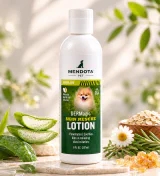
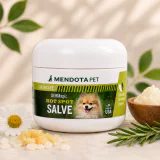
What we sell does the mechanical and barrier work. A gentle, sulphate-free wash lifts the grease, scale and surface debris without stripping a barrier that is already damaged. Skin Rescue Lotion supports that barrier while it rebuilds, and following a bath is exactly when it earns its place. Hot Spot Salve covers the raw, self-traumatised patches that flea-allergic animals chew over the tail base before they turn into hot spots.
Used properly that is a system, not a shelf of single products, and the four-step routine is how it was designed to work — wash, treat, moisturise, maintain. Each step does a different job and skipping one leaves the next with more to do.
 Start the treatment
DERMagic Skin Essentials System
Shop the full system →
Start the treatment
DERMagic Skin Essentials System
Shop the full system →
 Start the treatment
DERMagic Skin Rescue Lotion
Shop on dermagic.eu →
Start the treatment
DERMagic Skin Rescue Lotion
Shop on dermagic.eu →
 Start the treatment
DERMagic Hot Spot Salve
Shop on dermagic.eu →
Start the treatment
DERMagic Hot Spot Salve
Shop on dermagic.eu →Alongside your vet’s flea treatment, not instead of it. For the wider parasite picture see our guide to dog skin problems caused by parasites, and for the other mites that get confused with fleas, mites and mange.
Sources
Figures on this page are taken from the primary literature rather than from secondary summaries. Where we could not verify something to a primary source, we have said so in the text rather than repeating it.
- Gross TL, Halliwell WH. Lesions of experimental flea bite hypersensitivity in the dog. Vet Pathol 1985. PMID 3976134.
- McDermott MJ et al. Molecular cloning and characterization of Cte f 1. Mol Immunol 2000. PMID 11074254. (Authors affiliated with the assay manufacturer.)
- Laffort-Dassot C et al. Diagnosis of flea allergy dermatitis: comparison of intradermal testing with flea allergens and a FcεRI α-based IgE assay. Vet Dermatol 2004. PMID 15500485.
- Lee SE et al. Biochemical characterisation of major salivary allergens of Ctenocephalides felis. Vet Immunol Immunopathol 1999. PMID 10507308.
- Colombini S et al. Induction of feline flea allergy dermatitis and the incidence and histopathological characteristics of concurrent indolent lip ulcers. Vet Dermatol 2001. PMID 11420931.
- Benjamini E, Feingold BF, Michaeli D et al. Flea-bite hypersensitivity studies in guinea pigs. J Immunol 1965/1966. PMIDs 14322574, 5925707.
- Bond R et al. Survey of flea infestation in dogs and cats in the United Kingdom during 2005. Vet Rec 2007. PMID 17435095.
- Abdullah S et al. Pathogens in fleas collected from cats and dogs: distribution and prevalence in the UK. Parasit Vectors 2019. PMID 30728050.
- Hobi S et al. Clinical characteristics and causes of pruritus in cats: a multicentre study on feline hypersensitivity-associated dermatoses. Vet Dermatol 2011. PMID 21410570.
- Favrot C et al. Establishment of diagnostic criteria for feline nonflea-induced hypersensitivity dermatitis. Vet Dermatol 2012. PMID 21899606.
- Bruet V et al. Characterization of pruritus in canine atopic dermatitis, flea bite hypersensitivity and flea infestation. Vet Dermatol 2012. PMID 23013416.
- Cadiergues MC et al. Comparison of the diagnostic value of two methods for detecting flea infestation. ScientificWorldJournal 2014. PMID 25405217.
- Hensel P et al. Canine atopic dermatitis: detailed guidelines for diagnosis and allergen identification. BMC Vet Res 2015. PMID 26260508.
- Foster AP et al. Comparison of intradermal and serum testing for allergen-specific IgE using a FcεRIα-based assay in atopic dogs in the UK. Vet Immunol Immunopathol 2003;93:51–60. PMID 12753775.
- Schemmer KR, Halliwell WH. Efficacy of alum-precipitated flea antigen for hyposensitization of flea-allergic dogs. Semin Vet Med Surg Small Anim 1987;2(3):195–8. PMID 3423462. (Abstract not retrievable; cited for existence and date, not for its result.)
Flea biology and the environment
- Dryden MW. Host association, on-host longevity and egg production of Ctenocephalides felis felis. Vet Parasitol 1989;34:117–22. PMID 2588462.
- Dryden MW, Rust MK. The cat flea: biology, ecology and control. Vet Parasitol 1994;52:1–19. PMID 8030176.
- Rust MK, Dryden MW. The biology, ecology, and management of the cat flea. Annu Rev Entomol 1997;42:451–73. PMID 9017899.
- Silverman J, Rust MK, Reierson DA. Influence of temperature and humidity on survival and development of the cat flea. J Med Entomol 1981;18:78–83. PMID 7288833.
- Silverman J, Rust MK. Extended longevity of the pre-emerged adult cat flea and factors stimulating emergence from the pupal cocoon. Ann Entomol Soc Am 1985;78:763–8. (We could not read this in full, which is why no maximum dormancy figure appears above.)
- Jacobs DE, Hutchinson MJ, Ryan WG. Control of flea populations in a simulated home environment model using lufenuron, imidacloprid or fipronil. Med Vet Entomol 2001;15:73–7. PMID 11297105.
- Beugnet F et al. Use of a mathematical model to study the dynamics of Ctenocephalides felis populations in the home environment and the impact of various control measures. Parasite 2004;11:387–99. PMID 15638140. (A model, not a field study; manufacturer-authored.)
- Farrell S et al. Seasonality and other risk factors for flea infestations in domestic dogs and cats. Med Vet Entomol 2023;37(2):359–70. PMID 36621899. (Great Britain only.)
- ESCCAP Guideline 3, Control of Ectoparasites in Dogs and Cats.
Treatment
- Cavalleri D et al. A randomised, blinded, controlled field study to assess the efficacy and safety of lotilaner tablets in controlling fleas in client-owned dogs in European countries. Parasit Vectors 2017;10:526. PMID 29089065.
- Dryden MW et al. Evaluation of a topical sarolaner-selamectin combination to control flea populations on naturally infested cats in private residences. Vet Parasitol 2020;283:109172. PMID 32593057.
- Sutherland C et al. Assessment of lotilaner for control of in-home Ctenocephalides felis infestations. Parasit Vectors 2025;18:462. PMID 41239393.
- Dryden MW et al. In-home assessment of either topical fluralaner or topical selamectin for flea control in naturally infested cats. Parasit Vectors 2018;11:422. PMID 30012222.
- Stanneck D et al. Evaluation of the long-term efficacy and safety of an imidacloprid 10% / flumethrin 4.5% polymer matrix collar in dogs and cats naturally infested with fleas and/or ticks. Parasit Vectors 2012;5:66. PMID 22463745. (Manufacturer-authored.)
- Olivry T et al. Treatment of canine atopic dermatitis: 2015 updated guidelines from the ICADA. BMC Vet Res 2015;11:210. PMID 26276051.
- Esumi M et al. Preliminary evaluation of two bathing methods for the management of Malassezia overgrowth in dogs with atopic dermatitis. Vet Dermatol 2021;32(3):228–e59. PMID 33844368.
- Borio S et al. Effectiveness of a combined 4% chlorhexidine digluconate shampoo and solution protocol in MRS and non-MRS canine superficial pyoderma. Vet Dermatol 2015;26(5):339–44. PMID 26140535.
- Maynard L, Rème CA, Viaud S. Comparison of two shampoos for the treatment of canine Malassezia dermatitis: a randomised controlled trial. J Small Anim Pract 2011;52(11):566–72. PMID 21985533.
What does not work
- Eads DA et al. Evaluation of five pulicides to suppress fleas on black-tailed prairie dogs: encouraging long-term results with systemic 0.005% fipronil. Vector Borne Zoonotic Dis 2019;19(6):400–6. PMID 30620249.
- Lilly DG et al. Evidence of tolerance to silica-based desiccant dusts in a pyrethroid-resistant strain of Cimex lectularius. Insects 2016;7(4). PMID 27941664.
- Kilpinen O, Steenberg T. Repellent activity of desiccant dusts and conidia of Beauveria bassiana tested against poultry red mites. Exp Appl Acarol 2016;70(3):329–41. PMID 27631762.
- IARC Monograph 68, silica. Crystalline silica (quartz/cristobalite) Group 1; amorphous silica Group 3.
- Commission Implementing Regulation (EU) 2017/794, approving silicon dioxide Kieselguhr as an active substance for biocidal product-type 18.
- Lee KW et al. Hematologic changes associated with the appearance of eccentrocytes after intragastric administration of garlic extract to dogs. Am J Vet Res 2000;61(11):1446–50. PMID 11108195.
- Yamato O et al. Heinz body hemolytic anemia with eccentrocytosis from ingestion of Chinese chive and garlic in a dog. J Am Anim Hosp Assoc 2005;41(1):68–73. PMID 15634869.
- Maurer V, Perler E, Heckendorn F. In vitro efficacies of oils, silicas and plant preparations against the poultry red mite Dermanyssus gallinae. Exp Appl Acarol 2009;48:31–41. PMID 19229641.
- Baker NF, Farver TB. Failure of brewer’s yeast as a repellent to fleas on dogs. J Am Vet Med Assoc 1983;183(2):212–4. PMID 6885593.
- Guerrini VH, Kriticos CM. Effects of azadirachtin on Ctenocephalides felis in the dog and the cat. Vet Parasitol 1998;74:289–97. PMID 9561713.
- Koehler PG et al. Circadian rhythm of cat flea locomotion unaffected by ultrasound. J Econ Entomol 1989;82(2):516–8. PMID 2708627.
- Campos DR et al. Essential oils and bioproducts for flea control: a critical review. Insects 2025;16(12):1276. PMID 41465713.
For specific advice on a pet with persistent skin trouble, email customerservice@dermagic.eu or call +44 7425 388643.