The French Bulldog is now one of the most popular dogs in Europe — and one of the most skin-troubled. The same features that define the breed, the folds and the flat face and the screw tail, are the features that cause the problems. That is the good news and the bad news at once: it is predictable, so it is manageable.
This is a breed-specific guide. What actually goes wrong with a Frenchie’s skin, how to tell one problem from another, what your vet needs to rule out, and how to build a routine that keeps a fold-heavy dog comfortable long term.
Why French Bulldogs specifically
Most itchy-dog advice is written for a generic dog with a normal muzzle, an upright ear and no folds. Almost none of that describes a French Bulldog. Four things about the breed change the picture entirely.
The breed is built out of folds. Facial folds, the nose rope across the muzzle, and in most Frenchies a tail pocket beneath the tail. A fold is a closed, warm, dark, humid space that traps moisture, skin oils and debris. That is close to a perfect culture environment for the yeast and bacteria that already live on your dog’s skin. This is not a hygiene failing on the owner’s part — it is the anatomy.
They are strongly predisposed to atopic dermatitis. French Bulldogs sit near the top of the list of breeds affected by inherited allergic skin disease. It typically emerges between six months and three years old, and it targets the paws, belly, armpits, face and ears.
The ear canals are narrow. Brachycephalic skull shape comes with compressed, narrow ear canals that ventilate badly and hold moisture. Ear infections in this breed are common, recurrent and often the first visible sign of an allergy problem.
The coat is short and fine. There is very little coat to hide behind. Where a double-coated breed can be inflamed for weeks before an owner notices, on a Frenchie the redness, the spots and the thinning are visible almost immediately. This is genuinely an advantage — you get an early warning that other breeds do not.
The eight problems, at a glance
| Problem | Where it shows | The giveaway |
|---|---|---|
| Skin fold dermatitis | Facial folds, nose rope | Redness deep in the fold, sour or musty smell |
| Tail pocket infection | Under the base of the tail | Scooting, brown waxy residue, objects to the tail being touched |
| Atopic dermatitis | Paws, belly, armpits, face, ears | Licking and chewing, often seasonal at first |
| Food-related itching | Ears and back end especially | Non-seasonal from the start, sometimes with gut signs |
| Otitis externa | Ear canal | Head shaking, discharge, smell, pain |
| Interdigital cysts | Between the toes | Red painful swellings, constant paw licking, limping |
| Colour dilution alopecia | Trunk and flanks of blue/lilac dogs | Gradual moth-eaten thinning, scaling, broken hairs |
| Demodicosis | Face, around eyes, forelegs | Patchy hair loss in a young dog, often not very itchy |
Skin fold dermatitis
Also called intertrigo, this is the defining French Bulldog skin problem. Two surfaces of skin sit pressed together, air cannot circulate, moisture from drinking and eating and simply from the skin itself collects, and the normal surface population of Malassezia yeast and bacteria overgrows in the warmth.
The signs are redness and moist inflammation deep inside the fold rather than on the visible outer skin, a distinctive sour or musty smell, brown discolouration on a wipe, and a dog that rubs its face along the sofa. Left long enough, the skin inside the fold thickens and darkens, which makes the fold deeper, which makes the problem worse. That feedback loop is why fold dermatitis is so often described as recurrent.
The single most important thing to understand about folds is that cleaning them is only half the job. Drying them is the other half. A fold that has been wiped and left damp is worse than one that was not touched, because you have added moisture to the exact environment that was already too moist. Wipe out, then dry thoroughly with a soft dry cloth or a piece of kitchen roll, every single time.
The tail pocket — the one most owners never find
Underneath or just around the base of a screw tail, most French Bulldogs have a small recessed pocket of skin. It is easy to miss for years, and a great many owners only discover it when it becomes infected.
Find it now, before there is a problem. Lift the tail gently and feel just beneath it for a shallow indentation. It can be deeper than you expect. If your dog scoots along the floor, flinches when the tail is handled, or there is a sour smell from the back end that you cannot place, the tail pocket is the first place to look. A brown or black waxy residue on a wipe confirms it.
Clean it on the same principle as the facial folds: wipe out, dry completely, and check it every few days as routine. A tail pocket that has become raw, ulcerated or is discharging pus needs a vet — in severe recurrent cases surgical correction is sometimes recommended, but the overwhelming majority are managed with routine cleaning alone.
Atopic dermatitis and the allergic Frenchie
If your French Bulldog is licking its paws raw, chewing at its belly and armpits, rubbing its face and going through ear infections, you are most likely looking at canine atopic dermatitis rather than anything you have done wrong.
Atopy is an inherited tendency to react to ordinary environmental allergens — pollens, grasses, dust mites, moulds. The distribution is characteristic: paws, belly, armpits, muzzle, ears. It commonly starts seasonally and becomes year-round as the dog ages. There is a fuller explanation of how it differs from a simple allergic reaction in our guide to atopy versus allergy, and the three most common dog allergies covers the wider picture.
The complication specific to this breed is that atopy and fold dermatitis feed each other. An atopic dog has a compromised skin barrier and an itch it cannot resolve. Put that on a dog with folds and narrow ear canals and the secondary yeast overgrowth is close to inevitable. Very often the dramatic improvement owners see comes not from treating the allergy but from clearing the secondary yeast infection riding on top of it — which is also why so many Frenchies are treated for “allergies” for years with only partial success. Our guide to allergies and yeast together is worth reading if that pattern sounds familiar.
Ears
Recurrent ear infections deserve their own heading in this breed, because they are so common and so often treated as an isolated problem when they are not.
The narrow canal is the structural cause. The allergy is usually the trigger. If the ears flare at the same time as the paws are being licked and the belly is red, you are not looking at an ear problem — you are looking at an allergic dog whose ears are the loudest symptom.
Routine cleaning with a gentle, alcohol-free wash makes a real difference to how often these dogs flare. Alcohol stings inflamed tissue and dries the canal lining, which is counterproductive. Our full guide to dog ear care covers the cleaning technique step by step, and what should never go into an ear.
 Keep the ears clear
DERMagic Natural Ear Wash
View on Dermagic →
Keep the ears clear
DERMagic Natural Ear Wash
View on Dermagic →When to stop and call the vet instead: an ear that is hot, painful, swollen shut, or producing dark or bloody discharge, or a dog that is tilting its head or losing balance. If the eardrum has ruptured, what is safe to put in the ear changes completely, and that is not a judgement to make at home.
Paws and interdigital cysts
Constant paw licking in a Frenchie is usually allergic in origin, but the breed also gets genuine interdigital furunculosis — deep, painful red swellings between the toes. Their compact, splayed feet and short bristly hairs push hairs back into the skin, which sets up a foreign-body reaction and deep infection.
The distinction matters. Allergic paw licking is diffuse, both front feet, no discrete lumps. Interdigital cysts are discrete swellings you can feel, often on one foot, and they hurt — a dog that licks a paw and then limps on it needs examining. Deep furunculosis frequently needs systemic antibiotics from a vet; topical care supports it but will not resolve it alone. Our dog paw care guide covers the wider differential, the post-walk routine and what to apply to a foot the dog keeps licking.
Colour dilution alopecia in blue and lilac Frenchies
This one is increasingly relevant given how fashionable dilute coat colours have become, and it is poorly covered elsewhere.
Blue, lilac and isabella coats are produced by a dilution gene that changes how pigment is packaged in the hair. In affected dogs, pigment clumps inside the hair shaft, the shaft becomes structurally weak and fractures, and the follicle becomes prone to inflammation. The result is a gradual thinning that owners often describe as moth-eaten, usually over the trunk and flanks, typically beginning between six months and three years, and commonly accompanied by dry scaling and recurrent folliculitis.
Two honest points. There is no cure — the defect is in the hair shaft and it is genetic. And not every dilute dog is affected, so a blue Frenchie with a healthy coat is not a ticking clock.
What you can do is manage it as a barrier-and-infection problem rather than a hair problem: gentle sulphate-free cleansing, no harsh or medicated shampoos that strip further, and firm control of the folliculitis, which is responsible for most of the visible damage and all of the discomfort. It is worth reading our general guide to alopecia in dogs alongside this, and if the skin is also darkening, black skin disease covers a different condition that can look superficially similar.
Get a diagnosis rather than assuming. Hypothyroidism and demodicosis both produce comparable thinning and both need specific treatment.
What your vet should rule out
Skin disease in this breed is rarely one clean diagnosis, and treating the wrong thing wastes months. Before settling on a management routine, ask your vet about:
| Rule out | How | Why it matters |
|---|---|---|
| Demodex mites | Skin scrape | Common in young Frenchies; needs specific parasiticide |
| Sarcoptic mange | Scrape or trial treatment | Intensely itchy, contagious, treatable |
| Bacterial pyoderma | Cytology, sometimes culture | May need systemic antibiotics, not just topicals |
| Malassezia overgrowth | Cytology | Extremely common here and very treatable |
| Hypothyroidism | Bloodwork | Causes coat loss and recurrent infection |
| Food allergy | 8–12 week elimination diet | The only reliable test; blood and saliva tests are not |
| Flea allergy | Rigorous flea control trial | A flea-allergic dog reacts to very few fleas, so you often cannot find them |
A skin scrape and cytology are quick, inexpensive and answer most of these questions in a single consultation. If your dog has been on repeat courses of steroids for months without a scrape ever having been done, ask for one. Our guide on why to avoid relying on steroids explains the trade-off in more detail.
Bathing a French Bulldog properly
Bathing is where most owners go wrong in both directions — too often, or with the wrong product.
Frequency. Roughly every two weeks while actively treating a skin problem. More often than that strips the skin barrier, and a Frenchie’s barrier is already thin. Fold cleaning is daily; full baths are not.
Product. Avoid sulphates. Sodium lauryl sulphate is an aggressive detergent that removes the protective lipid layer along with the dirt, which on an atopic dog makes the underlying problem worse. Our article on parabens and SLS in dog shampoo covers why, and soap, shampoo or shampoo bars explains the practical differences.
Technique. Work the lather down to the skin — on a short coat that is easy — and leave it in contact for a few minutes before rinsing. Getting the lather against skin is what does the work, rather than the number of minutes — a 2026 study found three minutes performed as well as ten. Rinse completely, then dry completely, paying particular attention to every fold, the tail pocket and between the toes. A Frenchie left damp in the folds after a bath will be worse the next day, not better.
 Step 1 — Cleanse
DERMagic Skin Rescue Shampoo Bar
View on Dermagic →
Step 1 — Cleanse
DERMagic Skin Rescue Shampoo Bar
View on Dermagic →The Dermagic System for a French Bulldog
The range is built around a four-step topical protocol. Here is what each step is actually doing on this particular breed.
| Step | Product | What it does for a Frenchie |
|---|---|---|
| 1. Cleanse | Skin Rescue Shampoo Bar | Removes the oil and debris in the folds that feed yeast, without stripping an already thin barrier |
| 2. Treat | Skin Rescue Lotion | Treats the overgrowth driving the smell and the itch across folds, belly and armpits |
| 3. Target | Hot Spot Salve | Covers raw fold margins, interdigital sores and broken skin where lotion gets licked or rubbed off |
| 4. Restore | Cell Restoration Crème | Rebuilds the skin barrier so the next flare is smaller and further away |
Run all four. They are not alternatives to each other, and they compound. The cleanse is what allows the lotion to reach skin. The lotion clears the overgrowth. The salve protects the broken areas the lotion cannot stay on. The crème repairs the barrier whose weakness started the cycle. Stopping after step two is the most common reason an owner decides the protocol did not work — the itch comes back because the barrier was never restored.
 Step 2 — Treat
DERMagic Skin Rescue Lotion
View on Dermagic →
Step 2 — Treat
DERMagic Skin Rescue Lotion
View on Dermagic →On the folds specifically. Apply lotion to the fold after it has been cleaned and dried, sparingly. Reserve the salve for skin that is genuinely raw or broken — do not pack an occlusive balm into a deep damp fold that has not been dried, because you will trap moisture rather than treat it. Clean, dry, then treat, in that order, every time.
 Step 3 — Target
DERMagic Hot Spot Salve
View on Dermagic →
Step 3 — Target
DERMagic Hot Spot Salve
View on Dermagic →
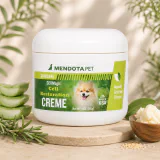 Step 4 — Restore
DERMagic Cell Restoration Crème
View on Dermagic →
Step 4 — Restore
DERMagic Cell Restoration Crème
View on Dermagic →Two additions worth making for this breed
Between baths, a fold-heavy short-coated dog benefits from something that freshens the coat without a full wash — particularly in summer, and particularly for dogs that resent bathing.
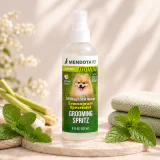 Between baths
DERMagic Skin Rescue Grooming Spritz
View on Dermagic →
Between baths
DERMagic Skin Rescue Grooming Spritz
View on Dermagic →And if your Frenchie’s problem presents mainly as dry flaking and dandruff rather than moist infection — common in dilute-coated dogs and in winter — a mineral salt exfoliant lifts the scale that ordinary shampooing leaves behind. Our guide to winter dry skin and dull coats covers the seasonal side.
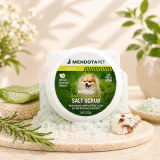 For flaking and scale
DERMagic Anti-Dandruff Salt Scrub
View on Dermagic →
For flaking and scale
DERMagic Anti-Dandruff Salt Scrub
View on Dermagic →The routine that keeps a Frenchie comfortable
| When | What |
|---|---|
| Daily | Wipe and dry facial folds and nose rope |
| Daily | Skin Rescue Lotion to affected areas, first week of treatment twice daily |
| Every 2–3 days | Check and clean the tail pocket |
| Weekly | Check ears, clean with ear wash; check between toes |
| Every 2 weeks | Full bath with the shampoo bar, a few minutes of contact time |
| Ongoing | Cell Restoration Crème to recovering skin |
| As needed | Hot Spot Salve on raw or broken skin only |
What improvement looks like
| Timeframe | What to expect |
|---|---|
| 1–2 weeks | Smell settles, itching noticeably reduced |
| 2–4 weeks | Fold redness improving, tail pocket residue much reduced |
| 4–8 weeks | Thickened, darkened skin beginning to soften and lighten |
| 3–6 months | Coat regrowth where hair was lost, following the hair cycle |
The critical point for this breed: improvement is not completion. The folds are anatomical. They do not go away, and they will re-colonise within weeks if the routine stops. Treat the intensive phase as the fix and the weekly routine as permanent.
What not to do
- Do not leave folds damp. The most common mistake by a wide margin.
- Do not over-bathe. Every two weeks while treating, not every other day.
- Do not use human products. Different skin pH; human shampoos and antiseptics are too harsh.
- Do not rely on steroids indefinitely. Useful short-term under veterinary direction; not a management strategy for an anatomical problem.
- Do not treat recurrent ear infections in isolation. They are usually telling you about an allergy.
- Do not ignore a painful paw. Diffuse licking is allergic; a discrete painful lump needs a vet.
Where to start
If your French Bulldog is itchy, smelly and uncomfortable right now, start with the complete protocol rather than piecing it together — for the reasons set out above, the steps only work properly as a set.
The Skin Essentials System bundles the first three steps: the Skin Rescue Shampoo Bar, the Skin Rescue Lotion and the Hot Spot Salve. Bought separately those three come to €72.97; as the kit they are €58.99, a saving of €13.98. Adding the Cell Restoration Crème at €45.99 completes all four steps for €104.98, against €118.96 buying each item individually.
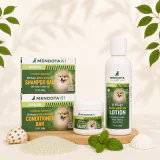 Start here — all three steps
DERMagic Skin Essentials System
View on Dermagic →
Start here — all three steps
DERMagic Skin Essentials System
View on Dermagic →Then add the ear wash if your dog has the ear pattern described above, which most Frenchies do.
A French Bulldog’s skin will never be low-maintenance, because the folds that cause the trouble are the same folds that make the breed what it is. But it is one of the most predictable skin situations in any breed — you know where the problems will be before they happen, which means you can get in front of them. A dog that is cleaned, dried and treated on a routine is a comfortable dog.
For the full background on the four-step protocol and how it applies across other breeds and conditions, see our complete guide to the Dermagic System. If you have a different breed, our Pomeranian alopecia guide and Golden Retriever skin guide cover their own particular problems.