The German Shepherd’s skin problem is not bad luck, and it is not something you did. It is written into the breed. Research on German Shepherds specifically has tied their allergic skin disease to variants in a gene that helps hold the outer layer of skin together — which means the predisposition sits in the barrier, not just the immune system. Once you understand that, nearly everything else about this breed’s skin starts to make sense.
This is a breed-specific guide. What actually goes wrong with a German Shepherd’s skin, how to tell the conditions apart, which ones genuinely need a vet, and how to build a routine that holds up over years rather than weeks.
Why German Shepherds specifically
Most itchy-dog advice is written for a generic dog. Four things about this breed change the picture.
The barrier is inherited weak. Genome-wide work in German Shepherds has associated canine atopic dermatitis in the breed with a region on chromosome 27 and with regulatory variants at the PKP2 locus — plakophilin-2, a protein involved in the junctions that hold epidermal cells to one another. A risk haplotype found in around a third of affected dogs occurs in only about a tenth of unaffected ones. Translated out of the genetics: the outer skin layer in this breed is more likely to leak. Allergens get in more easily, moisture gets out more easily, and bacteria and yeast that are meant to sit harmlessly on the surface find it easier to establish.
Skin disease is not a minor issue in this breed. In UK primary-care records covering the breed, skin disorders were the second most commonly recorded group of conditions at around 14% of dogs, with ear disorders close behind at around 11%. Ear infection alone was the single most common individual diagnosis.
The coat is dense and double. A thick undercoat is excellent insulation and poor ventilation. It holds moisture against warm skin after swimming, after rain and after bathing, and slow drying is a recognised predisposing factor for acute moist dermatitis.
They are big dogs that lie down hard. A large frame, often with orthopaedic discomfort in the hips or elbows, means a lot of weight resting on the same few points against hard floors. That produces pressure calluses, and calluses can become infected.
The problems, at a glance
| Problem | Where it shows | The giveaway | Vet? |
|---|---|---|---|
| Atopic dermatitis | Paws, elbows, chest, groin, ears | Licking and chewing from 6 months–3 years, often seasonal at first | Diagnosis yes |
| Otitis externa | Ear canal | Head shaking, discharge, odour, pain — recurrent | Yes |
| Deep pyoderma | Lower back, outer thighs, belly | Crusted nodules, draining tracts, ulcers; painful not just itchy | Always |
| Hot spots | Cheek, neck, outer thigh | A hot, wet, bald patch that appeared overnight | If spreading |
| Perianal fistula | Around the anus | Scooting, straining, pain sitting, discharge | Always |
| EPI | Whole coat | Dull scurfy coat plus weight loss and a large appetite | Always |
| Demodicosis | Face, forelegs | Patchy hair loss in a young dog, often not very itchy | Yes |
| Pressure calluses | Elbows, hocks | Thickened grey hairless pads over bony points | If cracked |
| Mucocutaneous pyoderma | Lip margins, nostrils | Crusting, swelling, loss of pigment | Yes |
| Discoid lupus | Nose | Black nose turning grey or pink, texture smoothing out | Yes |
Atopic dermatitis — the engine behind most of it
If your German Shepherd is licking its paws, chewing at its elbows and chest, rubbing its face and going through repeated ear infections, canine atopic dermatitis is the most likely explanation.
Atopy is an inherited tendency to react to ordinary environmental material — pollens, grasses, dust mites and moulds. In German Shepherds it typically emerges between six months and three years of age, and the distribution is characteristic: paws, elbows, chest, groin, and the ears. It frequently starts as a seasonal problem and becomes year-round as the dog gets older. Our guide to atopy versus allergy explains why those two words are not interchangeable, and the three most common dog allergies covers the wider picture.
What makes it different in this breed is the barrier genetics described above. In many atopic dogs the barrier damage is a consequence of scratching an immune-driven itch. In German Shepherds there is good evidence that a weaker barrier is part of the starting position. That is not a technicality — it changes what treatment should look like. A protocol that calms the itch and clears the infection but never rebuilds the barrier is leaving the original problem in place, and the dog flares again in a few months. This is the single most useful thing an owner of this breed can understand.
Very often the dramatic improvement owners notice does not come from the allergy treatment at all, but from clearing the secondary yeast overgrowth sitting on top of it. If your dog has been treated for “allergies” for years with only partial success, our guide to allergies versus something else is worth reading.
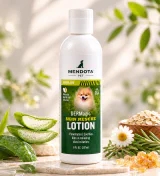 Step 2 — Treat
DERMagic Skin Rescue Lotion
View on Dermagic →
Step 2 — Treat
DERMagic Skin Rescue Lotion
View on Dermagic →Ears — the breed’s number one problem
Here is a point worth stating plainly, because the opposite is widely assumed.
German Shepherds have upright ears, and across the dog population upright ears genuinely are associated with less ear disease than pendulous or drop ears. German Shepherds do not get that benefit. In UK primary-care data the breed shows no protective effect at all compared with crossbred dogs, and ear infection is the most commonly recorded diagnosis in the breed.
The reason is that their ear disease is not a ventilation problem. It is an allergy problem. An allergic dog has inflamed ear canal lining whatever the shape of the ear, and inflamed lining produces wax, moisture and the conditions for infection. So a German Shepherd with recurrent ear infections is not telling you about its ears — it is telling you it is an allergic dog.
Treat the ears locally and the whole dog systematically. Routine cleaning with a gentle, alcohol-free wash makes a genuine difference to flare frequency; alcohol stings inflamed tissue and dries the canal lining, which works against you. Our dog ear care guide covers the technique and what should never go into an ear.
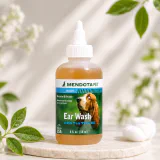 Keep the ears clear
DERMagic Natural Ear Wash
View on Dermagic →
Keep the ears clear
DERMagic Natural Ear Wash
View on Dermagic →Stop and call the vet if the ear is hot, painful, swollen shut or producing dark or bloody discharge, or if your dog is tilting its head or losing balance. A ruptured eardrum completely changes what is safe to put in the ear.
German Shepherd pyoderma
This one has the breed’s name attached to it in the veterinary literature, and it is the most serious skin condition an owner of this breed should be able to recognise.
It is a deep bacterial infection of the hair follicles that goes beyond the surface into the deeper tissue. The pattern is distinctive: it typically starts over the lumbosacral area — the lower back, just in front of the tail — then involves the outside of the thighs, then the belly. What you see is not simple redness. It is crusted nodules, small draining tracts, ulcers and hair loss, and the dog is often in genuine discomfort rather than merely itchy.
Two things matter here.
First, it is almost never a primary disease. Older writing described it as a condition in its own right. Current veterinary understanding is that there is nearly always an underlying driver — atopic dermatitis most commonly, along with flea allergy, food allergy, hypothyroidism or an immune deficit. Treating the infection without finding the driver produces a dog that relapses indefinitely.
Second, this needs a vet, and topical care alone will not resolve it. Deep pyoderma requires cytology, often culture, and typically several weeks of systemic antibiotics — frequently continued for a period beyond the point where the skin looks healed. Antibacterial washing is real, worthwhile adjunctive therapy alongside that treatment. It is not a substitute for it. Anyone selling you a bottle as a cure for deep pyoderma is misleading you.
If your dog has crusting and draining lesions over the lower back and outer thighs, close this page and book an appointment.
Hot spots and the double coat
Acute moist dermatitis — the hot spot — appears with startling speed. A dog can go to bed with normal skin and wake with a hot, wet, painful, hairless patch several centimetres across. In studied cases the commonest sites are the cheek, the neck and the outer thigh, most often in dogs under four years old, and dense-coated breeds are heavily represented.
The double coat is the reason. Wet undercoat next to warm skin, with poor air circulation, is exactly the environment surface bacteria need. The trigger is usually something that made the dog scratch or lick one spot repeatedly — an ear problem, an anal gland problem, a flea, or an allergic itch — and the coat then does the rest.
Practical prevention in this breed is mostly about drying. After swimming, after rain and after bathing, get down to the skin with a towel and dry properly rather than letting a damp undercoat sit. Keep the dead undercoat brushed out so air can move. Our full guide to hot spots and how to treat them covers first aid on a fresh lesion.
A small, early hot spot can be clipped, cleaned and treated at home. One that is spreading, deeply painful, or producing discharge needs a vet — and either way, the real question is what made the dog chew that spot in the first place.
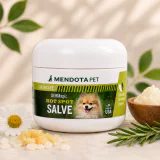 Step 3 — Target
DERMagic Hot Spot Salve
View on Dermagic →
Step 3 — Target
DERMagic Hot Spot Salve
View on Dermagic →Perianal fistula
German Shepherds account for the large majority of all reported cases of perianal fistula, also called anal furunculosis. It produces ulcerating, painful draining tracts in the skin around the anus.
You may have read that this is caused by the breed’s low, broad tail carriage pressing down over the area. That explanation is out of date and has been abandoned. Other breeds with quite different tail carriage are affected, and amputating the tail does not cure it. The current understanding is that it is immune-mediated, associated with particular immune-system gene types in the breed, with the disease process compared to Crohn’s disease in humans. It usually appears in middle-aged dogs rather than young ones.
Early signs are ones owners routinely misread: scooting along the floor, persistent licking at the back end, straining or obvious pain when passing stools, smaller stools than usual, reluctance to sit down, and discharge or blood around the anus.
This is entirely a veterinary condition. Nothing on any shelf will treat it. The reason to recognise it early is that modern medical management is effective and has largely replaced surgery as the first approach — but outcomes are better the earlier it is caught.
Exocrine pancreatic insufficiency — the one that looks like a skin problem
Read this section even if you skip others, because it is the most commonly missed explanation for a poor coat in this breed.
The German Shepherd is strongly predisposed to exocrine pancreatic insufficiency. The pancreas stops producing enough digestive enzymes, so food passes through largely unabsorbed. The dog is effectively malnourished while eating well, and the coat reports it: dry, scaling, poor quality, sometimes with hair loss, and often with an oily residue around the tail and back end from undigested fat in the stool.
The signs that tell you this is not a dermatological problem are the ones away from the skin: weight loss despite a large or increased appetite, and bulky, pale, loose stools.
Diagnosis is a straightforward blood test and management is enzyme replacement, which works well. No shampoo, lotion, oil or supplement will improve this coat, because the coat is not the problem. If your dog fits this description, the right next step is the vet, not the shop. Our guide to hair loss without itching covers the other internal causes worth ruling out.
Demodicosis in young dogs
German Shepherds are consistently listed among the breeds most overrepresented for juvenile generalised demodicosis, which stems from an inherited weakness in cell-mediated immunity rather than from poor care.
The presentation is patchy hair loss, often beginning around the face and forelegs, frequently with surprisingly little itching unless a secondary bacterial infection develops. That combination — a young dog losing hair in patches without seeming especially itchy — should always prompt skin scrapes. Our guides to mites and mange and parasitic skin problems cover the wider parasite picture.
Treatment is prescription-only and highly effective. Topical care supports the skin while it recovers but does not address the mites.
Pressure calluses on elbows and hocks
Large dogs that lie down heavily on hard surfaces develop thickened, grey, hairless pads of skin over the bony points of the elbows and hocks. German Shepherds appear on every list of predisposed breeds, and the mechanism is straightforward — body weight, hard floors, and often a degree of hip or elbow discomfort that makes a dog drop rather than lower itself.
An intact callus is cosmetic. Manage it with soft bedding, which addresses the cause, and an emollient to keep the skin supple. What matters is catching the point where it stops being intact: a callus that has cracked, is weeping, or has developed discharging spots has become callus pyoderma, and that needs veterinary treatment, often over several weeks.
 Step 4 — Restore
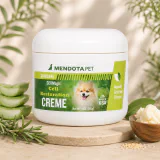
DERMagic Cell Restoration Crème
View on Dermagic →
Step 4 — Restore
DERMagic Cell Restoration Crème
View on Dermagic →Nose, lips and nails
Three less common conditions worth knowing, because the German Shepherd is a classically predisposed breed for all of them.
Mucocutaneous pyoderma is a surface bacterial infection at the junctions where haired skin meets the lips and nostrils. It shows as crusting, swelling and loss of pigment at the lip margins. It responds well to antimicrobial treatment but tends to recur, and it has to be distinguished from the next condition.
Discoid lupus erythematosus is an autoimmune disease of the nasal planum that is aggravated by sunlight. German Shepherds and their crosses make up a substantial share of reported cases. The sequence is characteristic: the black nose loses pigment and turns grey or pink, the normal cobblestone texture smooths out, and then scaling, cracking and ulceration follow. It needs a biopsy to confirm. Sun avoidance and canine sunscreen are genuine supportive care rather than an afterthought.
Symmetrical lupoid onychodystrophy causes nails to lift and slough, usually across several nails on several paws, and it is painful. German Shepherds are named among the predisposed breeds. Any dog losing multiple nails needs a vet rather than a home remedy.
One note for breeders and new puppy owners: there is a rare inherited familial cutaneous vasculopathy in German Shepherds, appearing in puppies at around four to eight weeks with swollen, depigmenting footpads and crusting at the ear and tail tips. It is a genetic defect, it is uncommon, and it needs specialist veterinary care — but a puppy with those signs should be seen quickly.
What your vet should rule out
Skin disease in this breed is rarely one clean diagnosis, and treating the wrong thing costs months.
| Rule out | How | Why it matters |
|---|---|---|
| Deep pyoderma | Cytology, often culture | Needs weeks of systemic antibiotics, not topicals alone |
| Demodex mites | Skin scrapes | Common in young Shepherds; prescription treatment |
| Sarcoptic mange | Scrape or trial treatment | Intensely itchy, contagious, curable |
| Malassezia overgrowth | Cytology | Very common secondary problem, very treatable |
| Hypothyroidism | Bloodwork | Causes coat loss and recurrent infection |
| EPI | Blood test (TLI) | Explains a poor coat with weight loss and a big appetite |
| Flea allergy | Rigorous flea control trial | A flea-allergic dog reacts to very few fleas, so you often cannot find them |
| Food allergy | 8–12 week elimination diet | The only reliable test; blood and saliva tests are not |
Cytology and a skin scrape are quick, inexpensive, and answer most of these in one consultation. If your dog has been on repeat steroid courses for months and neither has been done, ask. Our guide to why not to rely on steroids sets out the trade-off, and it applies with particular force in a breed prone to deep pyoderma.
Bathing and coat care for a double-coated dog
Don’t shave the coat for summer. It doesn’t cool the dog — dogs dissipate heat by panting, not through the skin, so taking the coat off removes protection without opening a cooling route. Summer heat is managed with shade, water and timing, not with clippers. Regrowth in a medium double coat is usually fine, and the “shaving ruins the coat forever” warning is overstated, but there’s simply nothing to gain. Clipping for a genuine medical reason — matting, surgery, a hot spot, or getting a medicated topical onto skin — is a different matter and is the right call; we’ve gone through where that line falls.
Brush the dead undercoat out properly and regularly. The honest framing here is not that brushing prevents skin disease — it is that a matted undercoat traps moisture against warm skin and slows drying, and slow drying is a real risk factor for hot spots. Brushing buys you air circulation.
Bathe roughly every two weeks while actively treating a skin problem, and less often once things are stable. Over-bathing strips the lipid layer, and this is a breed whose barrier is already compromised.
Avoid sulphates. Sodium lauryl sulphate is an aggressive detergent that removes the protective lipid layer along with the dirt — the exact opposite of what a barrier-defective breed needs. Our articles on parabens and SLS in dog shampoo and on soap, shampoo or shampoo bars explain the practical differences.
Technique matters more on this coat than on any short-coated breed. Work the lather right down through the undercoat to the skin — if the water is running off the topcoat, you are washing the outside of a raincoat. Leave it in contact for a few minutes — a 2026 study found three minutes performed as well as ten, so on this coat the effort belongs in reaching the skin rather than in waiting. Rinse until the water runs completely clear, because trapped residue in a dense coat causes its own irritation. Then dry thoroughly, down to the skin.
 Step 1 — Cleanse
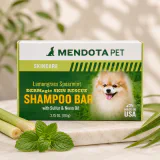
DERMagic Skin Rescue Shampoo Bar
View on Dermagic →
Step 1 — Cleanse
DERMagic Skin Rescue Shampoo Bar
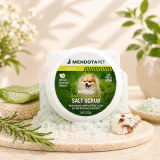
View on Dermagic →If your dog’s problem is mainly dry scale and dandruff through the coat rather than active infection — common in winter and in older Shepherds — a mineral salt exfoliant lifts the scale that ordinary shampooing leaves sitting in a dense undercoat. Our guide to winter dry skin and dull coats covers the seasonal picture.
 For flaking and scale
DERMagic Anti-Dandruff Salt Scrub
View on Dermagic →
For flaking and scale
DERMagic Anti-Dandruff Salt Scrub
View on Dermagic →The Dermagic System for a German Shepherd
The range is built around a four-step topical protocol. Here is what each step does for this specific breed.
| Step | Product | What it does for a Shepherd |
|---|---|---|
| 1. Cleanse | Skin Rescue Shampoo Bar | Gets through a dense undercoat to the skin and lifts debris without stripping an already weak barrier |
| 2. Treat | Skin Rescue Lotion | Treats the surface overgrowth driving the itch and odour across paws, elbows, chest and groin |
| 3. Target | Hot Spot Salve | Covers hot spots, cracked calluses and broken skin where lotion gets licked or rubbed off |
| 4. Restore | Cell Restoration Crème | Rebuilds the skin barrier — the step that matters most in a breed whose predisposition is a barrier defect |
Run all four. In most breeds we make this point because the steps compound. In the German Shepherd there is a sharper reason: the breed’s inherited weakness is in the barrier itself. Clearing the infection without restoring the barrier leaves the actual predisposition untouched, and the dog relapses on a cycle of a few months. That relapse pattern is the single most common complaint we hear from owners of this breed, and a half-run protocol is the most common reason behind it.
The cleanse is what lets the lotion reach skin through the undercoat. The lotion clears the overgrowth. The salve protects the broken areas where lotion cannot stay. The crème repairs the barrier that started the cycle.
 Steps 1–3 together
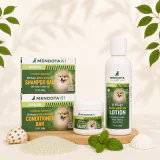
DERMagic Skin Essentials System
View on Dermagic →
Steps 1–3 together
DERMagic Skin Essentials System
View on Dermagic →Two worth adding for this breed
A dense-coated dog that cannot be bathed frequently benefits from something that freshens the coat between washes.
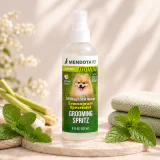 Between baths
DERMagic Skin Rescue Grooming Spritz
View on Dermagic →
Between baths
DERMagic Skin Rescue Grooming Spritz
View on Dermagic →And because barrier repair in this breed is the whole game, support it from the inside as well as the outside. A skin and coat supplement works on the same structure the topicals are rebuilding, over the same timescale as the hair cycle. Our guide to natural supplements for dogs covers what to look for.
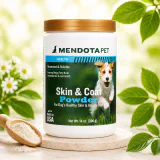 Barrier support from within
Retrieve Skin & Coat Supplement
View on Dermagic →
Barrier support from within
Retrieve Skin & Coat Supplement
View on Dermagic →The routine that holds
| When | What |
|---|---|
| Daily | Skin Rescue Lotion to affected areas — twice daily in the first week of treatment |
| Daily | Check elbows and hocks for cracking in the calluses |
| Every 2–3 days | Thorough brush-out of the dead undercoat |
| Weekly | Check ears, clean with the ear wash; check between the toes |
| Every 2 weeks | Full bath, lather down to skin, a few minutes of contact time, dry completely |
| Ongoing | Cell Restoration Crème to recovering skin and to callus sites |
| After every soaking | Dry down to the skin — rain, swimming, bathing |
| As needed | Hot Spot Salve on raw or broken skin only |
What improvement looks like
| Timeframe | What to expect |
|---|---|
| 1–2 weeks | Itching noticeably reduced, surface odour settling |
| 2–4 weeks | Redness and surface inflammation improving |
| 4–8 weeks | Thickened, darkened skin beginning to soften |
| 3–6 months | Coat regrowth, following the hair cycle in a heavy double coat |
Deep pyoderma runs to the vet’s timetable, not this one — and expect the antibiotic course to continue past the point where the skin looks healed.
What not to do
- Do not shave the coat for summer. It does not help with heat, and it removes sun and abrasion protection for nothing. Clipping for a medical reason is fine.
- Do not leave a dense coat damp. After rain, swimming or bathing, dry down to the skin.
- Do not treat draining, crusting lesions over the lower back at home. That pattern is deep pyoderma and it needs a vet.
- Do not treat recurrent ear infections as an ear problem. In this breed they are usually reporting an allergy.
- Do not assume a poor coat is a skin problem. Check the weight, the appetite and the stools first.
- Do not rely on steroids long-term. Useful short-term under veterinary direction; risky as a strategy in a breed prone to deep infection.
- Do not stop at step two. Clearing the infection without restoring the barrier is why this breed relapses.
Where to start
If your German Shepherd is itchy and uncomfortable right now — and you have ruled out the veterinary conditions above — start with the full protocol rather than assembling it piece by piece.
The Skin Essentials System bundles the first three steps: the Skin Rescue Shampoo Bar, the Skin Rescue Lotion and the Hot Spot Salve. Bought separately those three come to €72.97; as the kit they are €58.99, a saving of €13.98. Adding the Cell Restoration Crème at €45.99 completes all four steps for €104.98, against €118.96 buying each item individually. For this breed, the crème is not the optional extra — it is the step that addresses the inherited problem.
Then add the ear wash, because most Shepherds need it.
A German Shepherd’s skin will never be entirely trouble-free, because the predisposition is genetic and the coat that makes the breed what it is also holds moisture against the skin. But it is a legible breed. You know where the trouble will appear, you know the barrier is the weak point, and you know which signs mean stop and call the vet. A dog that is brushed out, dried properly, treated on a routine and whose barrier is being actively rebuilt is a comfortable dog.
For the full background on the four-step protocol, see our complete guide to the Dermagic System. If you have a different breed, our French Bulldog guide, Golden Retriever guide and Pomeranian alopecia guide cover their own particular problems.