Golden Retrievers have a reputation for skin trouble, and a great deal of what gets written about it is wrong. The breed’s strongest measured risk is its ears. Its most distinctive problem is a genetic scaling disease that spent two decades being called dandruff. And the thing it is most famous for — a wheat allergy — appears to belong to a different breed entirely.
What the evidence actually says
This guide was rewritten from the ground up in October 2026, because the version that stood here for thirteen years repeated claims that are not true.
That matters more for this breed than for most. Goldens are one of the most popular dogs in Europe, so there is an enormous amount written about them, and much of it is recycled assertion. There is also a structural problem worth knowing about: the large UK veterinary database that has produced breed-by-breed risk profiles for the Labrador, German Shepherd, French Bulldog, Pug and Cocker Spaniel has never published one for the Golden Retriever. So Golden content leans on textbooks more heavily than other breeds’ does — and textbook assertion is exactly where folklore survives.
What follows is assembled from disorder-specific studies instead. Where a number is solid, it’s here. Where the honest answer is “nobody has measured this,” that’s here too.
The problems, at a glance
| Problem | How strong is the evidence? | What it actually looks like |
|---|---|---|
| Ear disease | Strong — 2.23× the odds of a crossbreed, 5th of 16 predisposed breeds | Head shaking, scratching, odour, discharge, pain. Recurs until the underlying allergy is addressed |
| Underactive thyroid | Strong — 4.36× the odds of a crossbreed | Not itchy. Symmetrical hair loss, dull brittle coat, weight gain, lethargy, cold intolerance. Middle age |
| Ichthyosis | Strong — two genes identified, high carrier rates in Europe | Whitish scale from puppyhood, often not itchy, undersides darkened and rough |
| Atopic dermatitis | Moderate — real but geographically inconsistent; 21st in one large study | Itching with a seasonal start. Paws, face, ears, armpits, groin |
| Hot spots | Named consistently, never quantified | A fast-spreading wet, red, painful patch. Cheek, neck and outer thigh most often |
| Mast cell tumours | Crude excess real, not significant once size and age are accounted for | A lump. Could be anything; needs a needle, not an opinion |
| Food reactions | No reliable breed data exist | Itching that doesn’t follow seasons, often with gut signs. Diagnosed by diet trial only |
| Skin fold dermatitis | No — not a fold breed | Not a Golden problem. This belongs to the flat-faced breeds |
| Demodicosis | No evidence of breed predisposition | — |
Ears: the breed’s real signature problem
If you take one thing from this guide, make it this.
In UK primary-care records, the one-year prevalence of otitis externa across all dogs was 7.30%. Golden Retrievers came in at 2.23 times the odds of a crossbreed (95% CI 1.51–3.28) — the fifth highest of sixteen predisposed breeds, behind the Basset Hound (5.87), Shar Pei (3.44), Labradoodle (2.95) and Beagle (2.54).
Notably, that puts the Golden above the Labrador. We’ve written elsewhere that ear disease is the Labrador’s single most commonly recorded disorder; the Golden’s effect size is larger. This is the one place where this breed has a clean, large-database, breed-specific signal — and it isn’t the thing the breed is famous for.
What actually drives it
Allergy. Recurrent ear disease in a Golden is usually atopic dermatitis presenting in the ear canal, which is why drops clear it up and then it returns three months later. The lining of an inflamed canal produces more wax and sheds more skin, and infection follows. Treating the infection without addressing the allergy is a permanent subscription.
The water-dog explanation doesn’t hold up
Goldens swim. Goldens have drop ears. The conclusion writes itself, and it’s wrong.
When researchers measured what actually happens inside a dog’s ear canal, raising the humidity of the surrounding air by 24% produced a rise of only 2.3% inside the canal. The often-quoted figure of 89% canal humidity came from ears that were already diseased — a consequence, not a cause. A separate study found no temperature difference between breeds with different ear types, and canals with more hair in them actually ran cooler.
Ear carriage does matter, but modestly: pendulous ears carry 1.76 times the odds and V-shaped drop ears 1.84 times, compared with erect ears. Those are real effects, and nobody can fully explain the mechanism. What’s clear is that it is a smaller factor than the underlying allergy, and that drying your dog harder is not the answer.
Do not pluck the ear canal
Plucking hair from inside the canal is still widely recommended and has never been shown to help — the research literature describes it as a “proposed” need. Plucking traumatises the canal lining, and a traumatised lining is what you were trying to avoid.
Our full guide to dog ear care covers cleaning technique, when to involve a vet, and why recurrence is the signal that matters. Dermagic has no ear product and we’re not going to invent a use for one — ears need a cleaner and, when infected, a veterinary prescription.
The underactive thyroid — and why it matters that it isn’t itchy
Golden Retrievers are genuinely over-represented for hypothyroidism. In a UK database of 905,553 dogs, the breed carried 4.36 times the odds of a crossbreed (95% CI 3.48–5.45), eleventh of twenty-four predisposed breeds.
Two things keep this proportionate. First, the ranking: the Dobermann sits at 17.02, nearly four times the Golden’s risk. Second, the base rate: annual prevalence across all dogs is 0.23%, so four times a very small number is still a small number. For comparison, the Labrador sits at 1.40.
You may also see a claim that one in four Goldens develops hypothyroidism. That comes from a breed-club member questionnaire rather than a measured population, and it is wildly out of step with the primary-care data. Don’t plan around it.
The pattern to recognise
Skin changes appear in 60–80% of hypothyroid dogs, which makes this a genuinely dermatological disease. But the presentation is specific:
- Symmetrical hair loss without itching — flanks, tail (“rat tail”), backs of the thighs, bridge of the nose, underside of the neck
- A dull, dry, brittle coat; hair that regrows slowly or not at all after clipping
- Darkened skin, flaking, recurrent skin infections
- Weight gain, lethargy, reluctance to exercise, seeking out warm places
- Typically middle-aged — mean age at diagnosis around 6.8 years
Where a hypothyroid dog does itch, it’s the secondary skin infection doing it, not the thyroid.
So a thyroid test is the right move for the comfortable Golden that is losing coat symmetrically and slowing down. It is the wrong first move for a young, frantically itchy one — that dog needs a parasite, allergy and infection work-up. There’s a neat illustration of why these are different problems: the West Highland White Terrier, the breed most strongly associated with allergic skin disease, is actually protected against hypothyroidism (odds 0.40). Itch breeds and thyroid breeds are largely different sets of dogs.
Our guide to hair loss without itching works through the full differential, which matters because thyroid disease is only one of several causes that produce exactly this picture.
Ichthyosis: the breed’s own scaling disease
This is the most useful section in this guide, and almost no general dog-skin article mentions it.
Golden Retrievers carry an inherited disorder of the skin barrier called non-epidermolytic congenital ichthyosis, caused by a mutation in a gene called PNPLA1 on chromosome 11, identified in 2012. It is autosomal recessive — a dog needs two copies to be affected, and a carrier with one copy is healthy. The same gene causes a comparable condition in humans.
A second gene has since been found: ABHD5, a 14-base-pair deletion, discovered in fourteen Goldens who had obvious scaling but were not carrying two copies of the PNPLA1 mutation. ABHD5 works as a partner to PNPLA1, so both converge on the same skin-lipid pathway. The ABHD5 form appears more severe — heavier, more adherent white scale, with thick scale inside the ear flaps.
For European owners, the geography is the interesting part. The ABHD5 mutation was absent from 396 European Goldens tested and has so far turned up only in North American lines. But PNPLA1 mutation rates run higher in Europe than elsewhere: Australia 31.5%, USA 38.5%, Italy 40%, France 48.5%, Switzerland 64.5%. Among 463 Italian Goldens, 42% were clear, 37% were carriers, and 21% had the affected genotype.
What it looks like
- Juvenile onset — usually apparent before a year old
- Generalised whitish scale through the coat, from powdery to firmly stuck down
- Darkened, roughened skin on the hairless underside and limbs, fairly symmetrical
- Usually not itchy, unless a secondary infection develops
The honest caveat, which matters
Do not read “21% have the affected genotype” as “one in five Goldens has ichthyosis.” In a separate study of 48 breeding dogs, fifteen carried the affected genotype but only three of the 48 dogs showed any clinical signs — and the authors stated plainly that the mutation’s reliability in predicting clinical signs “is unclear.” They also noted their healthy-homozygote proportion was probably an overestimate, because severely affected dogs had been excluded from the group. The true rate of visible disease among genetically affected dogs is therefore unsettled, and anyone quoting a precise penetrance figure is inventing it.
One further wrinkle with practical consequences: the genotype matches the visible picture better in young dogs than in adults, and signs often become less obvious with maturity. That’s why owners are so often told their Golden “grew out of” its dandruff — and why breeding decisions need the DNA test rather than an eyeball assessment.
Encouragingly, while ichthyosis remains one of the most common inherited conditions in the breed, its frequency is falling. Testing is working.
Why this reframes “Golden Retriever seborrhoea”
The textbooks that list the Golden as a “primary seborrhoea” breed date from 1993 and 1995 — nearly two decades before the PNPLA1 gene was found. It’s a reasonable inference, though not a proven one, that a good share of those historical “primary seborrhoea” Goldens were ichthyotic dogs described before anyone could name the condition.
That changes the message completely. “Incurable seborrhoea, manage it forever” is a dead end. “Scaling with a specific inherited cause, and a DNA test available” is something you can act on.
The single most useful discriminator is this: is the dog itchy? An itchy flaky dog usually has something common and treatable. A comfortable scaling dog is being changed from the inside. A young Golden with flakes and no itch should prompt a DNA test, not a dandruff shampoo.
Flaking and scaling: what it usually is
Zooming out from ichthyosis — seborrhoea is a description, not a diagnosis. Flaky or greasy skin is a sign, and in this breed it usually has a findable cause. In rough order of likelihood:
- Endocrine — the underactive thyroid above, a classic driver of scaling
- Allergic — atopic dermatitis with secondary flaking
- Inherited — ichthyosis, specific to this breed
- Parasitic, microbial and nutritional causes behind those
Secondary causes make up the clear majority, but we won’t put a percentage on it: the “80% secondary” figure circulating online has no study behind it.
Our seborrhoea guide covers the full picture. The practical split for a Golden: dry, flaking, scaling skin is where topical care genuinely helps, and where our range is aimed. A greasy, waxy, strongly odorous coat is a different problem — it usually involves yeast overgrowth, and because those yeasts feed on skin lipids, a rich oily lotion is the wrong tool for it. That dog wants a cleansing routine and a veterinary work-up. Worth reading alongside: why does my dog smell and signs of yeast in dogs.
Atopic dermatitis: real, but not what the reputation claims
Goldens are widely described as an allergy breed. The measured picture is more modest.
| Study | What it found for the Golden |
|---|---|
| Finland, 8,643 dogs | Ranked 21st — outside the top twenty. Top five: West Highland White, Boxer, English Bulldog, Dalmatian, French Bulldog |
| Five referral centres, three continents | Predisposed in 3 of 5 practices — but absent from the paper’s overall “most predisposed worldwide” list |
| Swedish insurance data | Not among the elevated breeds. Overall incidence 1.7 cases per 1,000 dog-years; Bull Terrier highest at 21 per 1,000 |
The referral-centre finding is genuine evidence and we’re not dismissing it. But the two population-level datasets don’t place this breed anywhere near the top. The honest reading: a modest, geographically inconsistent predisposition — not a strong one. Against a baseline of roughly 10% of all dogs developing atopic dermatitis, and West Highland White figures of 18.7% in a breed-club health survey and 52% in a high-risk Swiss birth cohort, the Golden simply isn’t in that tier. It sits below the Labrador too. Both of those Westie numbers come with caveats of their own, which West Highland White Terrier skin problems works through — but it is also the breed that was on the worldwide list the Golden was absent from, across the same five referral centres.
Why say so in a guide about Golden skin? Because assuming every itch is lifelong allergy is how owners end up managing an incurable condition their dog doesn’t have, while a treatable parasite or infection goes unaddressed.
What is genuinely useful here
Work in a guide-dog population — predominantly Labradors, with some Goldens and crosses — put the heritability of atopic dermatitis at 0.47, meaning roughly half the liability is inherited. The offspring figures are the strongest “ask the breeder” argument available anywhere in canine dermatology:
- Two affected parents: up to 65% of offspring affected
- One affected parent: 21–57%
- Two unaffected parents: 11%
Treat those as retriever figures rather than Golden-specific ones.
On presentation: paws were the single most affected site in atopic dermatitis, in 62% of cases. A Golden with persistently sore, licked feet is an allergy work-up, not a breed quirk — see dog paw care.
One correction worth making, because it’s everywhere: canine itch is driven largely by IL-31 signalling, not histamine. That’s why antihistamines disappoint so consistently, and it’s covered in why is my dog so itchy. For the difference between an inherited predisposition and the symptoms themselves, see atopy vs allergy.
Food reactions, and the wheat story
The previous version of this page said Goldens are “genetically more susceptible to food allergies than many other breeds, particularly to wheat.” Both halves are wrong, and this is the correction we most wanted to make.
On breed susceptibility: the authoritative review pooling the available literature concluded, in its own words, that “there are no reliable breed predisposition data.” Only nine studies compared against a reference population, and four of those found no significant breed association at all. Where the review does name predisposed breeds, the retriever named is the Labrador — the Golden appears only inside a pooled “Labrador or Golden Retrievers” category. Being 19% of a case series means little when the breed is top-ten popular in every country those studies ran in. That’s a popularity artefact, not a risk estimate.
On wheat: it’s a real canine allergen and an unremarkable one. Across 297 dogs the culprits ranked beef 34%, dairy 17%, chicken 15%, wheat 13%, soy 6%, corn 4%. Wheat is fourth, well behind beef — and the authors caution the whole list may simply reflect what people were feeding their dogs. Nothing connects it to this breed.
Where the wheat idea probably came from. There is a genuine, well-documented inherited gluten problem in dogs — in Irish Setters. It’s a recessive condition causing an abnormal gut response to gliadin, producing partial villous atrophy, diarrhoea and weight loss from around four to seven months old. It is a gastrointestinal malabsorption disease, not a skin allergy, and the Irish Setter is the only breed with a documented, reproducible version of it. At some point “setter + gluten + genetic” became “retriever + wheat + allergy.” We repeated it for thirteen years. It’s gone now.
What is true about food and itching
Food-responsive itching exists and is worth ruling out — in a median 18% of itchy dogs (range 9–40%). We won’t be more precise than that, because the more precise figures circulating online are invented.
The genuinely discriminating feature is age, not breed: mean onset for food reactions is around 2.9 years, and 22–38% of affected dogs show signs by six to twelve months. An itchy puppy is a stronger pointer towards food than any breed label.
And the only way to diagnose it is a strict elimination diet trial — eight weeks, one novel protein, nothing else whatsoever, then a deliberate rechallenge. Blood and saliva allergy tests for food do not work. Also worth knowing: year-round itching points towards house dust mite allergy first, not food, which is the opposite of the usual assumption.
Hot spots: real, but not a wet-coat disease
The old version of this page called hot spots the breed’s signature problem and blamed the thick coat trapping moisture. Neither claim survives scrutiny.
On the breed being over-represented: in the main prospective study of pyotraumatic dermatitis — 44 cases across 14 breeds — the Rottweiler, German Shepherd and Golden Retriever were the most commonly represented breeds. But a case series has no denominator: it can show which breeds turn up, not whether they turn up more often than they should. No odds ratio or population prevalence for hot spots in Golden Retrievers exists. The breed does get them, and clinical consensus supports that. Calling it the breed’s signature problem overstates what anyone has measured — on the actual breed-level data, that title belongs to ear disease.
On the moisture mechanism, the honest answer is more interesting than either the folklore or a flat denial.
A dense coat genuinely does hold a more humid microclimate than the surrounding air. That has been measured — in Newfoundlands under a heat source, the absolute humidity of the air within the coat initially almost doubled and stayed significantly above ambient. So the premise isn’t fabricated.
What’s missing is the step that matters: nobody has shown that coat humidity causes hot spots. That study was investigating heat loss, not skin disease, and makes no disease claim. Every “dense coat traps moisture, therefore hot spots” statement traces back to clinic pages and blogs rather than to measurement.
And the case data points somewhere else entirely. In those 44 cases:
- An underlying cause was found or suspected in 31 of 44 — hot spots are overwhelmingly secondary to an itch or pain source
- No ear disease was recorded in any case, so this isn’t ear infection spilling onto the skin
- The study area was not flea-endemic, so those 31 causes aren’t simply fleas
- Lesions clustered on the cheek, neck and outer thigh, with a significant relationship between breed and lesion site — a pattern a generic “damp coat” model doesn’t predict
- 29 of 44 showed eosinophils, inflammatory cells associated with hypersensitivity, and 20 showed acute inflammation around the follicles
So a hot spot is self-inflicted trauma on top of an underlying itch or pain source, and roughly seven in ten have one waiting to be found. Coat density is a plausible aggravating condition with measured microclimate support but no measured link to the disease.
Practically, that means clearing the lesion is half the job and finding the trigger is the other half. Our hot spots guide covers the treatment protocol and, importantly, when a lesion needs a vet rather than a salve.
Lumps: the proportionate version
Goldens have a fearsome cancer reputation, and an owner who finds a lump while brushing deserves better than either false reassurance or the internet’s panic. Here is the measured picture.
Start with the number nobody mentions
UK veterinary records covering 11,506 Golden Retrievers put the breed’s median life expectancy at 13.2 years (95% CI 13.1–13.2). For context:
| Breed | Median life expectancy |
|---|---|
| Golden Retriever | 13.2 years |
| Labrador Retriever | 13.1 years |
| Crossbreed | 12.0 years |
| Large breeds, average | 11.9 years |
| Boxer / German Shepherd | 11.3 years |
| Rottweiler | 10.6 years |
| Bulldog | 9.8 years |
In UK data the Golden Retriever outlives the average crossbreed by more than a year, and sits near the top of all 155 breeds assessed. That is flatly incompatible with the doomed-breed narrative.
Where “65% die of cancer” comes from
That figure — 424 of 652 dogs — comes from post-mortem records at an American veterinary teaching hospital spanning 1989–2016. Dogs that die peacefully of old age at home do not get referred for a post-mortem at an academic centre, so the denominator is pre-selected for dogs that died of something investigable. The authors acknowledge the bias themselves.
The non-North-American picture is strikingly different: across 927 Golden deaths in primary-care practice outside North America, 20–39% of deaths were attributed to cancer, with median age at death of 11.0–12.5 years.
You’ll see this explained as European bloodlines being healthier than American ones. The numerical gap is real and consistent, but that explanation is not established — the comparison is between different study designs, not between genotyped line cohorts, and no study has compared European-line and North American-line Goldens directly. Report the contrast; don’t attribute it to bloodlines.
Mast cell tumours
The most common skin lump worth taking seriously. Two layers to this.
Breed risk is weaker than it looks. In a UK database of 168,636 dogs, overall mast cell tumour prevalence was 0.27%. The Golden’s crude prevalence was 1.39% — about five times the average. But once age and bodyweight were accounted for, the breed effect did not reach statistical significance: odds ratio 2.0, 95% CI 0.9–4.5, P=0.080. Much of the apparent excess is explained by the Golden being a large, long-lived dog rather than by the breed itself. The Boxer is the mast cell tumour breed, at odds ratio 10.7.
And a diagnosis is not a death sentence. In a study following over 3,000 Goldens, 164 dogs (5.39%) developed 234 mast cell tumours. Median survival from first diagnosis was 1,367 days — roughly 3.7 years. Only 11.59% had the tumour recorded as cause of death. And the lifespan of dogs with a mast cell tumour diagnosis was not statistically different from the rest of the group. Survival was meaningfully worse only with local recurrence, metastasis, or a high histopathological grade.
That’s the proportionate framing: most Goldens diagnosed with a mast cell tumour do not die of it. But outcome turns on grade, and grade requires a needle and a laboratory — it cannot be judged from how a lump looks or feels.
One practical detail: multiple simultaneous mast cell tumours are more common in this breed — 12.5% versus 4.4% in crossbreeds. If you find one, check the rest of the dog.
Haemangiosarcoma, honestly
Haemangiosarcoma is the breed’s most serious cancer. In that same cohort the incidence rate was 1.69 per 100 dog-years (95% CI 1.54–1.85). Outcomes are poor — around 90% of dogs die within a year, and for the skin form median survival was 19 days.
Two honesty notes. That cohort was enriched for haemangiosarcoma by design and recruited American volunteer owners, so it is not a general prevalence estimate. And the cumulative percentage circulating from it comes from a preprint whose peer-reviewed status we could not confirm, which is why we quote the incidence rate instead.
What to actually do about a lump
Feel your Golden over properly once a month — this breed’s dense coat hides things, and grooming is the best opportunity you’ll get. Note size, position and date. Anything new, growing, changing, ulcerated, or fixed to deeper tissue gets a vet appointment. Ask for a fine-needle aspirate or biopsy rather than a watch-and-wait, because the answer depends entirely on the cell type.
Do not apply anything to an undiagnosed lump, including our products. There is nothing topical to be done about a mass, and masking it wastes the only thing that matters here, which is time.
Coat, shedding, and why not to clip
Goldens are double-coated, and every summer someone suggests shaving them. The case against is real, but most of the reasons usually given for it are false.
What’s false:
- “Shaving ruins the coat permanently.” Post-clipping alopecia is a genuine named condition, but it is cosmetic with a good prognosis. The diagnostic threshold is no regrowth by three to four months; slow cases take 12–24 months. In the clearest study, 37 clipped Labradors regrew their coats in about 14 weeks, in all seasons. Where hair genuinely never returns, the clip revealed a follicular disease that was already there.
- “The undercoat grows back faster and crowds out the guard hairs.” Never measured in any study — it traces to grooming blogs. The woolly, guard-hair-poor coat it describes is actually the textbook early sign of hair cycle arrest, which should send you towards an alopecia work-up rather than blaming the groomer.
- “Shaving causes heatstroke” / “clipping halves insulation.” Never tested in dogs, and the 50% figure has no traceable source. Dogs cool by panting, not through the skin — the same coat-microclimate study found skin moisture was “not of great importance in cooling” — so shaving doesn’t unlock a cooling route.
- “Shaving reduces shedding.” It shortens the shed hairs. The same amount of coat still comes out.
What’s actually true:
- There is no measured benefit to clipping a healthy Golden. It doesn’t reduce shedding, doesn’t cool the dog, doesn’t prevent skin disease.
- The regrowth delay is a real risk — three to four months typically, occasionally far longer. Cosmetic and reversible, but genuinely annoying on a dog whose coat is rather the point.
- Sunburn risk applies to pale-skinned, thinly-coated dogs, not to a pigmented golden coat. We’re not going to inflate that to sell you something.
- “Never shave” has hardened into an absolute that causes real harm. Clipping is correct for matting (if a comb won’t pass between the mat and the skin, clip it out — don’t tear at it), for surgery, and for getting treatment onto inflamed skin. Current veterinary guidelines put topical treatment first-line for surface and superficial skin infection, and you cannot treat skin you can’t reach.
So: clip the area around a hot spot. Don’t strip the whole dog for the summer. That was the one piece of advice the old version of this page got right, even though the reason it gave was wrong.
Our full treatment of this is in should you shave a double-coated dog.
One grooming risk worth knowing
Post-grooming furunculosis is a painful deep skin infection, usually along the back, appearing 24 to 48 hours after a groom. The documented source is contaminated grooming product — and diluted products were 15.5 times more likely to be contaminated than undiluted ones.
Never decant or water down shampoo into a re-used bottle, and it’s a fair question to ask a groomer. Incidentally, it’s a genuine argument for a shampoo bar, which has no dilution step to get wrong.
What Golden Retrievers are measurably not at risk of
Useful, because it stops owners chasing the wrong diagnosis:
- Not a food-allergy breed. No reliable breed predisposition data exist. Don’t start with expensive novel-protein diets.
- Not a top-tier atopy breed. 21st in the largest study, outside the top twenty.
- Not a skin-fold breed. Overall prevalence 0.37%, and the condition belongs to the flat-faced breeds — English Bulldog at odds ratio 49.07, French Bulldog 25.92, Pug 16.27. Nothing to manage here; see French Bulldog skin problems for the breeds where it does matter.
- No evidence of a demodicosis predisposition. Worth stating, because “mange” gets blamed for a lot of Golden itching. Note that demodicosis is barely itchy while sarcoptic mange is ferocious — they are different diseases. See mites and mange.
- Not a colour dilution alopecia breed. That’s a dilute-coat condition and doesn’t belong to the retrievers.
- Longer-lived than the average crossbreed, per the table above.
One limitation worth being straight about: because no breed-wide predispositions-and-protections study exists for the Golden, we can’t give you a verified list of conditions the breed has reduced odds of. The Labrador has such a list; borrowing it would be tempting and unsupported.
What your vet should rule out
For a Golden with persistent skin trouble, the work-up worth asking for:
- A proper ear examination, including down the canal — given this breed’s odds ratio of 2.23, and because ear disease is so often the first visible sign of an allergy
- Skin scrapes and a flea comb, to exclude parasites before anything gets called allergy
- Cytology from any moist, inflamed or smelly area, to identify bacterial or yeast overgrowth rather than guess at it
- A thyroid panel — but for the non-itchy dog losing coat symmetrically, not reflexively for an itchy one
- A PNPLA1 DNA test, for any young Golden with persistent whitish scaling, especially if the dog isn’t itchy. It’s a cheek swab, and it answers a question no shampoo can
- A fine-needle aspirate of any lump, rather than monitoring it
- A strict eight-week elimination diet trial, if the itching doesn’t follow seasons — the only valid test for food reactions
- For scaling that fits none of the above, a skin biopsy
Bathing and coat care for a Golden
The dense double coat makes this breed harder to bathe properly than it looks. Most “the shampoo didn’t work” stories are application failures.
- Frequency is the variable that matters. For active skin disease: two to three baths a week while you get on top of it, dropping to once or twice weekly for maintenance. That’s what the clinical guidelines support.
- Get product to the skin. Work it in with your fingertips rather than over the top of the coat. On a Golden this takes genuine effort and more product than you’d expect.
- Give it a few minutes of real contact before rinsing. You’ll see “ten minutes” quoted; that’s overstated. A few minutes of actual skin contact is the goal, and frequency matters more than stopwatch time.
- Rinse completely. Residue left in a dense undercoat is its own irritant.
- Dry properly, especially after swimming — not because damp fur causes hot spots, but because a wet dense coat stays wet for hours and that’s uncomfortable regardless.
- Brush more than you bathe. For a dull coat in autumn, brushing out the dead undercoat beats any product. Autumn and winter coat care covers the seasonal pattern.
The Dermagic System for a Golden
Four steps, used together. They work as a sequence — cleanse, soothe, protect, restore — and the reason to run all four is that each addresses a different stage of a recovering patch of skin. Stopping partway through the course is the commonest reason owners say a routine stopped working.
Where the range genuinely fits a Golden: dry, flaking, scaling, irritated skin, and the aftermath of a hot spot once it’s clean. That happens to be exactly the presentation this breed’s inherited scaling disorder produces.
Step 1 — Cleanse
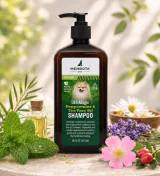
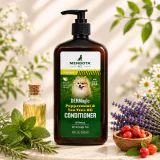
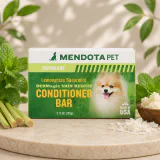
The Peppermint & Tea Tree Oil Shampoo, with the matching conditioner for a double coat, or the Skin Rescue Shampoo Bar. Both are genuinely sulphate-free, which you can read off the label. We used to add “and pH-balanced for canine skin” here and have withdrawn that — canine surface pH spans a wide range rather than sitting at one target value, so there is nothing specific to be balanced to. On a coat this dense the conditioner isn’t a luxury — it’s what lets you get a comb through afterwards without tearing at the undercoat.
 Start the treatment
DERMagic Peppermint & Tea Tree Oil Shampoo
Shop on dermagic.eu →
Start the treatment
DERMagic Peppermint & Tea Tree Oil Shampoo
Shop on dermagic.eu →
 Start the treatment
DERMagic Peppermint & Tea Tree Oil Conditioner
Shop on dermagic.eu →
Start the treatment
DERMagic Peppermint & Tea Tree Oil Conditioner
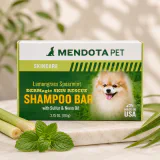
Shop on dermagic.eu →The bar is the alternative, and the one we’d pick for a Golden whose owner baths frequently — there’s no dilution step, which matters given the furunculosis point above.
 Start the treatment
DERMagic Skin Rescue Shampoo Bar
Shop on dermagic.eu →
Start the treatment
DERMagic Skin Rescue Shampoo Bar
Shop on dermagic.eu →
 Start the treatment
DERMagic Skin Rescue Conditioner Bar
Shop on dermagic.eu →
Start the treatment
DERMagic Skin Rescue Conditioner Bar
Shop on dermagic.eu →Step 2 — Soothe
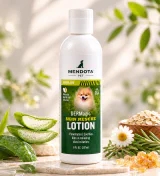
The Skin Rescue Lotion, massaged into dry, flaking or irritated skin. Sesame oil, aloe, lanolin, beeswax, shea butter, rosemary and sulphur. Sulphur has a long history in veterinary skin care for scaling specifically, and we’d rather tell you that plainly than overclaim it: there’s no controlled trial of sulphur alone in dogs, and there’s no salicylic acid in this range.
It’s aimed at the dry, scaly end of the spectrum. On a greasy, waxy, yeasty coat a rich lotion is the wrong tool, and we’d rather say so than sell you the wrong product.
 Start the treatment
DERMagic Skin Rescue Lotion
Start here — dermagic.eu →
Start the treatment
DERMagic Skin Rescue Lotion
Start here — dermagic.eu →Step 3 — Protect
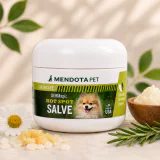
The Hot Spot Salve — the concentrated, sticky version, made to be dabbed onto a specific spot and stay there rather than licked straight off. For a Golden that means the cheek, neck and outer-thigh sites where this breed’s lesions cluster. Clip the hair around the area first; you cannot treat skin you can’t reach.
 Start the treatment
DERMagic Hot Spot Salve
Treat the spot — dermagic.eu →
Start the treatment
DERMagic Hot Spot Salve
Treat the spot — dermagic.eu →Step 4 — Restore
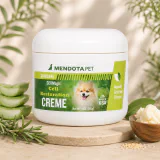
The Cell Restoration Crème, for the final stage — new, fragile skin as the coat comes back through. This is the step people skip, and it’s the one that covers the slowest part of recovery.
 Start the treatment
DERMagic Cell Restoration Crème
Shop on dermagic.eu →
Start the treatment
DERMagic Cell Restoration Crème
Shop on dermagic.eu →About the kit
The old version of this page said the System “bundles all four products at a discount.” That wasn’t accurate, so here’s the real arithmetic.
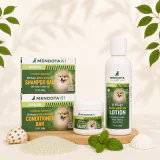
The Skin Essentials System is a three-step kit — Skin Rescue Shampoo Bar, Skin Rescue Lotion and Hot Spot Salve. At €58.99 against €72.97 for those three bought separately, it saves €13.98, about 19%. It does not include the Cell Restoration Crème or the conditioner, and there is no single kit covering all four steps.
 Start the treatment
DERMagic Skin Essentials System
Shop the kit — dermagic.eu →
Start the treatment
DERMagic Skin Essentials System
Shop the kit — dermagic.eu →Two worth adding for this breed
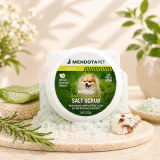
The Anti-Dandruff Salt Scrub, for heavy, adherent scale — the kind an ichthyotic Golden produces. It works mechanically, lifting scale rather than dissolving it, which is the honest description of what it does.
 Start the treatment
DERMagic Anti-Dandruff Salt Scrub
Shop on dermagic.eu →
Start the treatment
DERMagic Anti-Dandruff Salt Scrub
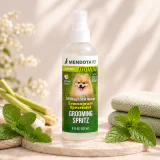
Shop on dermagic.eu →The Grooming Spritz between baths, for a breed that gets brushed far more often than it gets bathed.
 Start the treatment
DERMagic Skin Rescue Grooming Spritz
Shop on dermagic.eu →
Start the treatment
DERMagic Skin Rescue Grooming Spritz
Shop on dermagic.eu →The routine that holds
- Brush two or three times a week, more during the spring and autumn moults. This does more for a Golden’s coat than any product.
- Check the ears every week. Smell them. A change in odour is the earliest warning you get, and in this breed ears are the thing most likely to go wrong.
- Run your hands over the whole dog monthly, feeling for lumps. Write down what you find.
- Bathe to a schedule when there’s active skin disease; brush rather than bathe when there isn’t.
- Dry the coat after swimming — for comfort, not because damp fur causes disease.
- Treat small things immediately. A hot spot caught at the red-patch stage is a few days’ work. Caught at the weeping stage it’s a vet visit.
- Push for the underlying cause when anything recurs. Recurrence is information.
What improvement looks like
- First week or two: itching and odour settle; the dog stops interrupting its own sleep to scratch.
- Two to four weeks: redness fades, small lesions have closed over, flaking reduces.
- Six to eight weeks: skin texture normalises and coat quality starts to change.
- Three to four months: coat has filled back in where it was lost — though regrowth is the least predictable part of any recovery, and we won’t pretend a topical drives it.
If you’ve seen nothing at all after two to three weeks of consistent use, stop and reconsider the diagnosis rather than buying more product. That’s usually the point at which an unaddressed cause — ears, thyroid, a food trial never properly completed — is doing the real work.
What not to do
- Don’t shave the dog for summer. No measured benefit, real cosmetic risk.
- Don’t pluck the ear canals. Never shown to help, and it traumatises the lining.
- Don’t reach for a thyroid test because the dog is itchy. Reach for it because the dog is not itchy and is losing coat.
- Don’t accept “it’s just seborrhoea, manage it” for a young Golden with scaling. Ask about the DNA test.
- Don’t cycle through grain-free or novel-protein foods as a first move. There’s no breed basis for it, and an informal food swap isn’t a diet trial.
- Don’t use tea tree oil neat, or any undiluted essential oil. Concentrated tea tree oil is genuinely toxic to dogs — one ten-year review of poison-control records covers 443 cases across dogs and cats, with tremors, ataxia and CNS depression appearing 2 to 12 hours after exposure. Properly formulated rinse-off products are a different matter entirely, and we set out exactly where that line falls.
- Don’t trust apple cider vinegar or coconut oil for yeasty skin. These yeasts feed on skin lipids, so an oil works against you.
- Don’t apply anything to an undiagnosed lump.
- Don’t dilute shampoo into a re-used bottle.
- Don’t assume the American cancer statistics are your dog’s prognosis. UK median life expectancy is 13.2 years.
Where to start
If your Golden is itchy, start with the ears — that’s where the odds are, and ear disease is usually the visible end of an allergy. If your Golden is scaling and not itchy, start with a conversation about the DNA test and a thyroid panel, because that combination is being driven from the inside. If there’s a specific raw patch, clip around it, clean it, and get the salve on it today.
Start the treatment
DERMagic Skin Rescue Lotion
Start the system — dermagic.eu →Further reading
Every breed fails differently, and the cluster is worth reading across. Labrador skin problems is the closest comparison — the retriever picture overlaps substantially, though less than you’d think: the Golden’s ear odds are higher, its thyroid odds are three times the Labrador’s, and it has an inherited scaling disorder the Labrador doesn’t. German Shepherd skin problems and French Bulldog skin problems cover very different failure modes again.
On the symptom side: why is my dog so itchy is the hub, dog ear care is the one this breed most needs, and seborrhoea in dogs covers scaling in general. For hair loss, hair loss without itching and alopecia in dogs. On treatment philosophy, why we avoid steroids for temporary relief and the Dermagic System explained.
And if you’d like to see what a long recovery actually looks like in this breed, Lucy Lu’s case is a Golden who regrew her chest coat over six months — presented with the caveats it deserves.
For specific guidance on your Golden’s skin, email customerservice@dermagic.eu or call +44 7425 388643.