
In late summer and autumn, a specific presentation turns up again and again: a dog that was fine last week is now chewing its feet raw every evening, and there is a faint orange dust between the toes that brushes off. It is not dirt. It is a parasite most owners have never heard of, and almost everything written about it online is wrong in the same three ways.
Harvest mites are one of the few skin parasites you can actually diagnose by looking. They are also one of the few where the standard advice circulating online — that they burrow, that they are contagious, that your flea treatment covers them, that the house needs treating — is wrong on every count.
This guide is built on the European guideline for ectoparasite control and the published veterinary literature, and it is honest about a fact the rest of the internet skips: the evidence base for this parasite is genuinely thin. There has never been a randomised controlled trial of any product against harvest mites in dogs. Where something is well established, we say so. Where it is a reasonable assumption, we say that too.
What harvest mites actually are
Harvest mites are Neotrombicula autumnalis and closely related Neotrombicula species — and that hedge is deliberate. Every pet blog names N. autumnalis with total confidence, but a 2014 study in Parasites & Vectors found the species actually biting in northern Spain was N. inopinata, and concluded that much of the published literature naming N. autumnalis should be treated as uncertain. Nobody has established which species dominates in Ireland or the UK. It makes no practical difference to your dog. It is a fair signal of how lightly studied this parasite is.
You will also see them called chiggers, berry bugs, red bugs or autumn mites.
Only the larval stage is parasitic. This single fact explains most of what follows. The six-legged larva climbs low vegetation, waits for a passing animal, attaches, feeds for several days, then drops off. The nymphs and adults it develops into are eight-legged, live in soil, and eat the eggs of other small invertebrates. They never feed on an animal at any point in their lives.
Three consequences fall straight out of that:
- They cannot complete a life cycle on your dog. The mite is on its way to the soil, not setting up residence.
- They cannot infest your house. There is no indoor population to build, because everything after the larval stage needs soil.
- They do not pass from dog to dog, or from dog to owner. ESCCAP states it in four words: there is no transfer from animal to animal.
Female mites live over a year, and in a temperate climate there is usually one generation annually. That is why the same field is reliably bad every autumn.
The bit almost everyone gets wrong: they do not burrow
This is the myth worth dismantling first, because several bad home remedies depend on it.
Harvest mite larvae do not burrow into skin. They attach at the surface with their mouthparts and inject enzymes that break down tissue. The dog’s own tissue then coagulates into a tube — a stylostome — and the larva sits on top and feeds through it, like drinking through a straw it has caused you to build. Nothing goes under the skin. They are not, strictly, blood-feeders either; they take liquefied tissue and skin secretions.
The confusion comes from the chigoe flea, Tunga penetrans, sometimes called a jigger — a tropical parasite with a confusingly similar common name that genuinely does burrow into skin.
Why the myth is so persistent is itself interesting, and worth understanding, because it leads to the next section.
Why the itch outlasts the mite
The stylostome stays behind after the mite has gone.
The larva feeds for several days — ESCCAP puts it at five to seven on dogs — then detaches and drops off. The feeding tube it built does not leave with it. It remains in the skin as a small central dot, and the body breaks it down slowly over days to weeks.
That matters because the itching is not a reaction to being bitten. It is a hypersensitivity response to proteins in the mite’s saliva and to the stylostome sitting in the dermis as a persistent foreign protein. So:
- The itch starts late. In people it begins within hours and peaks at 24 to 48 hours. The pattern in dogs looks similar, though nobody has formally measured it. Either way, your dog will not react during the walk. It reacts that evening, or the next day.
- The itch continues after the parasite has left. The Merck Veterinary Manual is explicit that itching can persist after the larvae have gone.
- Repeat exposure makes it worse. ESCCAP notes that severe hypersensitivity reactions have been observed in dogs infested repeatedly. A dog that walks the same fields every autumn may react harder each year.
Two practical conclusions that almost no other article draws:
- Not finding orange specks does not rule harvest mites out. By the time the itching peaks, the mites may already be gone.
- Killing the mites will not stop the itch that day. Owners who expect overnight relief after treatment conclude the treatment failed. It did not. The antigen is still in the skin.
What you will actually see
On the dog: bright orange to orange-red specks, roughly 0.2 to 0.3 mm — small, but genuinely visible without magnification. In heavy infestations they cluster densely enough to look like a fine orange-red powder or crust on the skin, most often between the toes.
That visibility is the key diagnostic point. Sarcoptes and Demodex are microscopic; harvest mites are not. If you can see orange specks, you have narrowed the field enormously.
The skin: redness, small raised bumps and weals, sometimes small blisters, then crusting. Hair loss and grazing from the dog’s own chewing and scratching. Secondary infection where the skin has been broken.
The near-diagnostic sign: a small raised bump with an orange-red dot in the centre — the larva itself. Nothing else in canine skin disease looks quite like that.
Where on the dog, and why
Harvest mites turn up on whatever touches the ground or brushes through low vegetation:
- Between the toes — the classic site, and the one that produces the paw chewing
- Feet and lower legs
- Muzzle, face and around the eyes — from nosing through grass
- Ear margins and the folds of the ear flap
- Belly and lower chest
There is a neat detail in the French clinical work on this: lesion site depends on the height of the dog. The larvae quest from low vegetation and attach where they first meet the animal. A Dachshund or a Frenchie collects them on the face and belly. A Labrador or a Shepherd collects them on the feet and legs. Same field, different picture.
The same mechanic explains where you get bitten — larvae climb until they meet an obstruction, which on a person is the sock line, the waistband or a cuff.
If your dog is chewing its feet, our guide to dog paw care covers the wider set of reasons that happens and how to treat the damage. If the ear margins are involved, see dog ear care.
When: the season, and the bit about temperature
The season across Europe runs late July to October, concentrated in August and September, and can push into November in a mild autumn. ESCCAP gives July to October; clinical reports from the Netherlands centre on August to September; reports from south-west France run September to November.
But the genuinely useful fact — and the one almost nobody mentions — is that harvest mite activity is gated by weather, not by the calendar. The larvae quest in dry, sunny conditions above roughly 16°C, most actively on warm afternoons.
That converts a vague warning about autumn into something you can act on:
| Higher risk | Lower risk |
|---|---|
| Warm, dry, sunny afternoons | Cool, overcast days |
| Long grass, rough pasture, hedgerows, woodland edge | After heavy rain |
| The same fields that were bad last year | Early morning walks |
| September, in a dry spell | Pavement and hard-surface walks |
One caution: out-of-season cases are documented, including winter and early spring, and German dermatologists have reported reactions at unusually early times of year. You will see this attributed to climate change. Nobody has actually measured that for this mite, so we will say only what is true: out-of-season reports exist, and “wrong time of year” is not a safe way to rule it out.
For the wider seasonal picture, see how your dog adapts to autumn weather.
Where: habitat, and why we will not give you a hotspot list
Harvest mites are found in grassland, heathland, rough pasture, hedgerows, woodland edge, parks and gardens — anywhere with vegetation for larvae to climb.
You will very often read that they favour chalky or calcareous soils. It is worth knowing how weak that claim is. The one serious multi-factor study of harvest mite habitat, published in Experimental and Applied Acarology, tested soil chemistry, soil physics and soil fauna against mite distribution and could not explain it. Only soil porosity reached significance, and only marginally. The authors described the larvae as extraordinarily euryoecious — tolerant of a very wide range of conditions.
So the honest version is: distribution is intensely patchy and local. What matters is which fields, not which soil type. The field at the end of your road may be full of them while the one beyond it has none.
We are also not going to publish a list of Irish or UK hotspots, because no surveillance data exists for either country. The regional hotspot lists circulating online are invention. What you can do instead is far more reliable: note where your dog picked them up, and avoid that spot in the same weeks next year. With one generation a year and females living over twelve months, infested sites are stable and predictable — which is exactly why ESCCAP’s only prevention advice is framed around avoiding places where mites were found the previous year.
Orange specks do not automatically mean a suffering dog
This one contradicts almost every article on the subject, and it comes straight from the clinical trials.
Both the dog and cat studies from Toulouse state it plainly: heavy infestation can occur with no lesions and no sign of discomfort. You can find orange dust between the toes of a dog who is entirely untroubled by it.
At the same time, when dogs do react, ESCCAP describes the lesions as highly itchy, and in the treatment trial dogs scored in the moderate-to-severe range for both itch and skin damage.
So the burden of mites and the severity of the reaction are only loosely connected. Treat the dog, not the mite count. A comfortable dog with visible mites needs a wash and an eye kept on it. An uncomfortable dog needs intervention whether or not you can still find mites.
What else it could be
Harvest mite sites overlap heavily with allergic skin disease, which is the main trap. This is where it helps to know what you are separating it from.
| Condition | How it differs |
|---|---|
| Flea allergy dermatitis | Sits at the back end — tail base, lower back, backs of the thighs. That is the opposite end of the dog from the interdigital and belly pattern. Flea dirt present. |
| Sarcoptic mange | Ear margins, elbows, hocks, belly. Mites are microscopic and often missed on scrapes. Crucially: contagious, and passes to people. Harvest mites are neither. |
| Demodex | Usually not itchy unless secondarily infected. Hair loss and blackheads rather than weals. Found on a deep scrape. |
| Atopic dermatitis | The hardest one. Same sites — face, paws, belly — but chronic and relapsing rather than abrupt, and usually starting between six months and three years old. See what canine atopic dermatitis actually is. |
| Grass pollen allergy | Also peaks in late summer, also causes paw chewing after walks in grass. Genuinely confusable — and a dog can easily have both at once. See grass pollen allergy in dogs. |
| Food allergy | Not seasonal, often with digestive signs. Seasonality alone makes it unlikely. |
| Yeast overgrowth | Greasy, thickened, darkened skin with a distinctive smell. Usually a consequence of prolonged licking rather than the original cause — so it can sit on top of harvest mite damage. See the signs of yeast in dogs. |
| Grass seeds | Also an autumn problem, also causes interdigital chewing, but usually one foot and often with a discrete painful swelling. |
For the wider parasite picture, our guide to skin problems caused by parasites and what mites and mange actually are cover the others in detail.
What a vet does: often just looks. ESCCAP notes that gross examination of the lesions, plus the time of year, plus a history of countryside access, is frequently enough — the larvae can be seen without magnification. A hand lens or otoscope on the webbing between the toes settles most cases. Where few mites are present, a superficial skin scrape is used, and a tape strip identifies any secondary yeast or bacterial overgrowth that needs treating alongside.
When to see a vet
- Any dog that is very uncomfortable, regardless of what you can see
- Broken, weeping or infected skin from chewing
- No improvement after a week, or a dog getting worse
- You are not certain it is harvest mites — the sarcoptic mange differential matters, because that one is contagious and zoonotic
- Unsteadiness, weakness or wobbliness — see below
The rare one worth knowing about
A small number of published cases describe dogs with heavy harvest mite burdens developing acute neurological signs: unsteadiness, weakness in the hind legs progressing to the front, in the worst cases an inability to stand. Four dogs were reported in the Netherlands in a 2025 CDC Emerging Infectious Diseases paper, one in Spain in 2020, and two Yorkshire Terriers in Germany in 1985 carrying an estimated two thousand larvae.
All of them recovered, most within days of treatment. The mechanism is genuinely unknown.
This is a handful of cases across forty years, so it is not a reason to be alarmed about an itchy dog. It is a reason to know that wobbliness alongside a heavy infestation is a same-day veterinary call, not something to watch over the weekend.
Treatment: what actually works
Two jobs, and they are separate. Remove the mites. Then manage a reaction that will outlast them.
Removing the mites
Start with the simplest thing, because it is mechanically sound: washing. The larvae sit on the surface and do not burrow, so physically removing them works. Washing the affected areas is ESCCAP’s recommendation, and detergent applied to the paws formed part of the successful treatment protocol in the Dutch cases. It has never been formally tested as a standalone treatment, but the biology is straightforward and there is no reason not to do it.
For a dog with infested paws, washing the feet with a shampoo bar is the practical version — and washing the feet is not the same as bathing the dog, so it does not disturb a normal bathing routine.
 Wash the affected areas
DERMagic Skin Rescue Shampoo Bar
Shop on dermagic.eu →
Wash the affected areas
DERMagic Skin Rescue Shampoo Bar
Shop on dermagic.eu →Beyond washing, this becomes a veterinary conversation, and we are going to be straight about why. Very little is licensed to treat harvest mites in the UK or Ireland. Frontline Spray — the product most associated with them — names Neotrombicula autumnalis only in the pharmacology section of its datasheet, in the phrasing “may aid in the control of”, and not in its list of licensed indications. We checked the current UK and Irish datasheets directly. Everything else used for this parasite is used outside its licence.
That is legal and routine under veterinary prescribing rules, but it is a vet’s decision to make, not a shelf purchase. What the evidence looks like, briefly:
- The best-evidenced options are old topicals. A permethrin and fipronil spot-on reduced mite counts by 79% within a day and 96% by day 28 in a small controlled trial, with itching down 91%. Fipronil spray cleared 15 of 18 dogs in the original 1998 study.
- The most commonly recommended options are the least evidenced. There is no controlled trial of any modern oral isoxazoline against harvest mites in dogs. They are widely and plausibly used, and reports of rapid clearance exist, but the data is anecdotal.
- Permethrin is for dogs only. It is severely toxic to cats. In a household with both, this matters.
- Repeat application beats a single dose. ESCCAP recommends topical treatment to the paws and belly repeated every three to five days during the season, and notes this works better than infrequent spot-ons — because residual protection against this parasite is short and re-infestation is quick.
Managing the reaction
Here is the statement from ESCCAP that reframes the whole thing: in most cases, palliative treatment to reduce local skin irritation will suffice.
For the European guideline authority to say that managing the inflammation is usually enough is a much lower-intervention position than the tone of most pet content on this subject. And it follows directly from the biology — the signs are a hypersensitivity reaction to saliva and a feeding tube that persists after the mite has gone, so the skin needs support through a reaction that is already underway.
A short course of anti-inflammatory medication from your vet is reasonable for a severely affected dog, and was used in the published severe cases. That is not in tension with our long-standing position on steroids: the objection is to steroids used indefinitely as a substitute for finding the cause. Here the cause is known, identified and self-limiting. A short course to break an acute reaction is a different proposition entirely.
Antihistamines are standard for people but work poorly for itching in dogs. We would not suggest reaching for them.
Where skincare genuinely helps — and where it does not
We sell skin products, so it is worth being precise about what they are for here.
They do not repel harvest mites and they do not prevent infestation. No topical skincare product does. Any claim otherwise is ahead of the evidence.
What they do address is the part of this condition that lasts longest. The dog has broken, chewed, inflamed skin, and a reaction that continues for days to weeks after the parasite has gone. That damaged barrier is what secondary bacterial and yeast infection exploits. Supporting it is a real and defensible job.
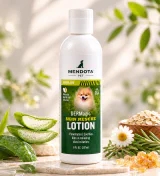 Soothe and repair the skin
DERMagic Skin Rescue Lotion
Shop on dermagic.eu →
Soothe and repair the skin
DERMagic Skin Rescue Lotion
Shop on dermagic.eu →For skin the dog has actually broken — raw patches between the toes, chewed lower legs — the Hot Spot Salve is the heavier option, and both labels tell you to simply reapply if the dog licks the product off — which is the test anything applied to a paw has to pass.
 For broken or raw skin
DERMagic Hot Spot Salve
Shop on dermagic.eu →
For broken or raw skin
DERMagic Hot Spot Salve
Shop on dermagic.eu →If the skin has been damaged over a wider area, or if your dog is one of the repeat reactors whose response gets worse each autumn, treat the barrier properly rather than spot-treating the worst patch. The full four-step routine — cleanse, soothe, protect broken skin, then restore the barrier itself — is what stops this cycling. The fourth step is the one people skip and the one that determines whether the skin is in better shape when next September arrives.
 Treat the whole barrier
DERMagic Skin Essentials System
Shop on dermagic.eu →
Treat the whole barrier
DERMagic Skin Essentials System
Shop on dermagic.eu →The complete rationale is in our guide to the Dermagic System.
Prevention: honestly, it is thin
Most articles offer a confident list of prevention steps. We are not going to, because the evidence does not support one. ESCCAP endorses exactly one preventive measure — avoiding areas where harvest mites were found the previous year — and the fact that a European guideline offers a single measure tells you how little works.
What is actually worth doing:
- Avoid the fields you know are bad, in the weeks you know are bad. This is the only measure with guideline backing, and it works because infested sites are stable year to year.
- Walk early, or after rain, or on cool days. Follows directly from the temperature and moisture thresholds. Sensible, not formally tested.
- Check the coat and paws after every walk in season. Unusually worthwhile for this parasite specifically, because unlike almost every other mite, you can actually see them.
- Rinse the paws and legs after walks through long grass. Mechanically sound given they sit on the surface. Whether it prevents attachment if done promptly has never been tested, so we will not give you a time window as if it were established.
What is not worth doing:
- Treating the house. No indoor life cycle. Nothing to treat.
- Relying on monthly flea and tick prevention. Not licensed for it, and residual protection is too short to bridge re-exposure.
- Mowing the lawn as a strategy. Short grass, lawns and parks are all listed habitat, and most dogs acquire these on walks rather than at home.
- Natural repellents. See below.
About essential oils and natural repellents
We would rather lose a sale than mislead you on this one.
There is no evidence that any essential oil repels harvest mites on dogs. Not weak evidence — none. No study has tested any oil against Neotrombicula autumnalis, and no study has tested any oil against harvest mites on a dog.
The research that gets cited is a laboratory screen of plant oils against Leptotrombidium mites — a different genus, in Asia, studied because they carry scrub typhus. Clove oil achieved full repellency at 5% and tea tree at 40% on filter paper. Extrapolating from that to your dog’s legs requires several leaps nobody has made.
And the safety problem is worse than the efficacy problem: the 40% tea tree concentration that worked in the lab is far above any level considered safe on a dog. Tea tree oil toxicity in dogs is a well-characterised clinical condition — 443 documented cases in a single ten-year review of poison-control records — and clove oil carries its own irritation and liver concerns. The dose-and-route question is set out in full in is tea tree oil safe for dogs and cats.
ESCCAP lists no repellent of any kind — natural or synthetic — as a preventative for this parasite.
We make skincare from natural ingredients and we believe in it. That belief is exactly why we are not going to stretch it into a claim it cannot support. Soothing and rebuilding damaged skin is what these products do, and they do it well. Repelling a parasite is not the same job.
Cats, and people
Cats get them too. Ear margins, face, between the toes, belly. A trial in cats in south-west France cleared 90% of mites by day 28 with a topical treatment. Cats also carry them without symptoms. The critical warning bears repeating: never use a permethrin product on a cat. If you treat a dog with one and have a cat in the house, keep them apart until it is dry.
People get bitten, typically at the sock line, waistband, behind the knees or anywhere clothing is tight. Reactions peak at 24 to 48 hours and the itching can run for up to three weeks. But you did not get them from your dog, and your dog did not get them from you. You both walked through the same ground.
What to expect
| Timeframe | What is happening |
|---|---|
| Day of the walk | Nothing visible. Larvae attach and begin feeding. |
| That evening to next day | Itching begins and builds. Orange specks may be visible. |
| 24–48 hours | Peak itching. Redness, bumps, chewing. |
| Several days | Larvae detach and drop off — but the reaction continues. |
| 1–2 weeks | Itching settling as the feeding tubes break down. Skin starting to repair. |
| 2–4 weeks | Skin damage from chewing resolving, if secondary infection has been dealt with. |
The most common source of frustration is expecting treatment to stop the itch immediately. It will not, and that is not a treatment failure — it is the nature of a hypersensitivity reaction to something the skin is still clearing.
The short version
- Harvest mites are the larval stage only. Adults live in soil and never touch an animal.
- They do not burrow. They feed at the surface through a tube made of your dog’s own tissue.
- The itch outlasts the mite, because that tube and the saliva proteins stay behind. Not finding mites does not rule them out.
- They are visible to the naked eye as orange specks — the single most useful way to tell them from mange mites.
- They are not contagious, not between dogs and not to you, and they cannot infest your house.
- They do not transmit disease in Europe.
- Your monthly flea treatment probably does not cover them.
- Season is late July to October, but activity is gated by warm, dry, sunny conditions above about 16°C — so the risk is a specific kind of afternoon, not a whole season.
- Heavy infestation can be symptom-free. Treat the dog, not the mite count.
- Prevention is genuinely weak. Avoiding known-bad ground is the only measure with guideline support.
- No natural repellent has been shown to work, and the oils most often suggested are unsafe at effective concentrations.
- Wobbliness with a heavy infestation is rare but real — same-day vet.
If your dog is chewing its feet this month, harvest mites are worth ruling in or out before you conclude it is an allergy — the treatment is completely different, and the answer may be sitting visibly between the toes. If it turns out not to be mites, our guides to dog skin allergies and paw care cover where to look next.
Not sure where to buy in your country? See where to buy Dermagic in Europe.