A hot spot is a wet, painful, infected patch of skin that can spread alarmingly fast. Here’s what triggers them, when it needs a vet rather than a salve, and how to look after a straightforward one at home.
What a hot spot is
A hot spot — pyotraumatic or acute moist dermatitis — is a patch of skin the dog has licked and chewed raw, which has then become inflamed and colonised by the bacteria already living on the surface.
The name is the explanation. Pyotraumatic: the trauma is self-inflicted. Something made one spot itch, the dog went at it, and the skin gave way. That is why a hot spot you noticed yesterday morning can look twice as bad by the evening — and why stopping the chewing is as important as anything you put on it.
The affected skin typically appears as a wet, oozing, reddened patch, often with hair loss across it. It is painful, not merely itchy: in a double-blind pilot study, dogs with this diagnosis given injectable meloxicam alongside antibiotics showed measurably more pain relief than those given antibiotics alone. If your dog will not let you near the spot, that is information, not stubbornness.
What causes hot spots — and can they be prevented?
Hot spots in dogs are caused by anything that aggravates or itches the skin. Some common triggers:
- Allergies — grasses, trees, weeds, dust mites, and other environmental allergens
- Food allergies
- Fleas and mites
- Insect bites
- Skin wounds and minor abrasions
Once the skin is broken and inflamed, bacteria move in, taking advantage of the disrupted barrier — in the one prospective study of the condition, 25 of the 27 lesions cultured grew Staphylococcus. Along with the wet, oozing appearance there is often a distinct odour.
A correction worth making carefully, because it changes what you should do. This page used to say the infection is “usually deep within the dog’s skin”. That is wrong, and it contradicted our own advice further down. An ordinary hot spot is superficial — the clinical definition is a superficial, moist, exudative dermatitis induced by self-trauma. The deep version is a different and more serious animal: pyotraumatic folliculitis, where the infection tracks down into the hair follicles. In the study above, histology found acute folliculitis in 20 of the 44 dogs, so it is not rare — and it is the form that needs systemic antibiotics from a vet rather than anything applied to the surface. If you cannot tell which you are looking at, that is a reason to have it looked at.
Prevention is largely about catching the triggers early. Stay on top of flea protection. Watch for grass and pollen sensitivity in season. Address food allergies through an elimination diet. And treat any bite, sore, or red patch the moment you see it — before it gets bad enough to call a hot spot.
When to call the vet
Most small hot spots caught early are a reasonable thing to treat at home. Some are not, and it’s worth knowing which is which before you reach for anything.
Get veterinary help if the lesion is larger than a few centimetres, spreading noticeably by the hour, very painful to touch, or discharging pus rather than clear fluid — or if the dog is unwell in themselves: lethargic, off their food, or feverish. Deep pyoderma and cellulitis can start out looking like an ordinary hot spot, and those need systemic antibiotics and proper pain relief. A topical product is not a substitute and we won’t pretend otherwise.
Hot spots that keep coming back also warrant a vet visit, for a different reason: recurrence almost always means an underlying allergy that nobody has got on top of yet.
Treating a hot spot at home
For the straightforward ones, the protocol is:
- Clip the hair over and around the spot. This is standard veterinary practice and it genuinely matters — trapped hair holds moisture against the lesion and hides how far it actually extends. Hot spots need air. Older versions of this page warned against clipping on the grounds that it “introduces more fungus”; that isn’t accurate and we’ve withdrawn it.
- Clean the area gently with the Peppermint & Tea Tree Oil Shampoo or the Skin Rescue Shampoo Bar, and let it dry properly.
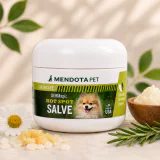
- Apply DERMagic Hot Spot Salve directly to the spot once or twice daily. It’s concentrated and made to stick, so it stays put and keeps working.
- Stop the dog licking it off with a soft t-shirt or similar cover. It works where you put it, and licking reopens the lesion. We have narrowed the line that used to be here — “nothing in the salve is harmful if ingested” — because that is a blanket safety claim we withdrew across the site as too broad to make about a whole formula. The salve is intended for topical use; cover the area rather than relying on it being fine to eat.
How long it should take, with a real number behind it. A randomised double-blind trial put 40 dogs with hot spots through exactly step 1 and step 2 above — every lesion clipped and cleaned — and then applied a topical antibiotic, a topical steroid, both, or vehicle alone. The combination resolved lesions fastest, the steroid alone did worst, and every group, including the vehicle-only controls, recovered completely within seven days.
Two honest readings of that. First, the clipping and cleaning are doing a lot of the work, which is why they are steps 1 and 2 and not an afterthought. Second, a bland protective topical over a clean lesion is a reasonable thing to be doing while the skin closes — that is the category our salve sits in, and we would rather tell you that than claim it is killing the bacteria.
So: about a week. If it has not clearly improved within a few days, or is worse at any point, stop treating at home and get it looked at.
And find the trigger
Clearing the spot is only half of it. Hot spots are usually a symptom of something else — in a prospective study of 44 cases, an underlying cause was found or suspected in 31 of them. If you treat the lesion and change nothing else, expect another one.
Allergy is the most common driver. The older version of this page named fleas and ear problems as the usual culprits, and that is worth qualifying: the same study recorded no ear disease among its cases and was carried out in an area where fleas were not endemic, so neither is the automatic answer. Check for both, but do not stop looking when they come back clear.
Worth reading alongside this: dog skin allergies, why is my dog so itchy and, if the ears are involved, dog ear care. Labrador skin problems covers the breed that most distinctively gets hot spots, including the colour difference within it. If fleas are in the frame, flea allergy dermatitis in dogs and cats is the full account.
Sources
The figures on this page come from four papers, and we would rather you could check them than take our word for it.
- Holm BR, Rest JR, Seewald W. “A prospective study of the clinical findings, treatment and histopathology of 44 cases of pyotraumatic dermatitis.” Vet Dermatol 2004;15(6):369–76. PMID 15585012. — Source of the 31-of-44 underlying cause figure, the 25-of-27 Staphylococcus cultures, the eosinophils in 29 of 44, the folliculitis in 20 of 44, the cheek/neck/thigh distribution, the absence of ear disease and the non-flea-endemic study area.
- Schroeder H, Swan GE, Berry WL, Pearson J. “Efficacy of a topical antimicrobial-anti-inflammatory combination in the treatment of pyotraumatic dermatitis in dogs.” Vet Dermatol 1996;7(3):163–70. PMID 34644985. — The 40-dog randomised double-blind trial in which all groups, vehicle-only controls included, recovered within seven days after clipping and cleaning.
- Palmer LE. “Picture This: Management of Canine Pyotraumatic Dermatitis (a.k.a., Hot Spot).” J Spec Oper Med 2018;18(2):105–9. PMID 29889965. — Source of the “superficial, moist, exudative dermatitis commonly induced by self-inflicted trauma” definition.
- Viking Höglund O, Frendin J. “Analgesic effect of meloxicam in canine acute dermatitis — a pilot study.” Acta Vet Scand 2002;43(4):247–52. PMID 12831177. — The pain finding: 12 dogs, meloxicam plus cephalexin versus placebo plus cephalexin, 28.3% versus 8.3% average pain reduction by day 2 (p = 0.026 on percentage change). A pilot study with six dogs per arm, so treat it as indicative.
 Start the treatment
DERMagic Hot Spot Salve
Treat the spot — dermagic.eu →
Start the treatment
DERMagic Hot Spot Salve
Treat the spot — dermagic.eu →For help with a particularly stubborn hot spot, email customerservice@dermagic.eu or call +44 7425 388643.