Hot spots, rashes, and skin irritations are among the most common complaints in dogs and cats. Here’s how to recognise what’s happening, what the evidence says is actually driving it, and what to do.
What a hot spot actually is
One of the most common medical complaints in dogs and cats is the familiar “hot spot” — clinically pyotraumatic dermatitis, or acute moist dermatitis.
This page used to say the common factor in every hot spot is infection. We had the causation backwards, and have corrected it. The clinical description is a superficial, moist dermatitis commonly induced by self-inflicted trauma. The sequence is: something itches, the dog licks and chews that one spot, and the skin surface breaks down — often within hours. Bacteria are then almost always found there. In the only prospective study of the condition — 44 privately owned dogs — 25 of the 27 lesions cultured grew Staphylococcus. But that is what you find on skin a dog has already chewed open, not what opened it.
Two details from the same study make the point better than we can:
- A probable underlying cause was identified in 31 of the 44 dogs.
- Eosinophils were present in 29 of 44 — a hypersensitivity signature that had never previously been recorded in hot spots, and a strong hint that allergy is doing the driving.
The lesions sat mostly on the cheek, neck and lateral thigh. That is a map of where a dog can reach, which is what you would expect if self-trauma is the mechanism.
So the bottom line is not “there’s an infection.” It’s: the surface is broken and needs protecting, and something made that spot itch — and until you find it, you will be treating hot spots again.
Why they appear “out of thin air”
Sometimes hot spots seem to come from nowhere. A few common triggers:
- Lawn grasses — many animals are very sensitive. They look physically and nutritionally normal but show signs of inflamed skin and hair loss after time outside. If the dog bites and chews at the inflamed area, it quickly becomes a hot spot.
- Minute scratches from a clipper blade — these can be enough to trigger one.
- Moisture trapped against the skin — the traditional “moist eczema” explanation, and we have downgraded it. A PubMed search for matted coat and canine dermatitis returns no records, and when the same moisture mechanism was actually measured in the ear canal it did not hold up. It is plausible that matting holds exudate against a broken surface and stops it drying — which is exactly why clipping the hair back from a hot spot is the first thing a vet does — but it is not a demonstrated cause.
Rashes and skin infections (infectious dermatitis)
Bacteria, fungi and yeasts all live on normal skin and all can overgrow on skin whose defences have been disturbed, producing infection, itching, rashes and scaling. The important qualifier — and the next section makes it — is that this is usually opportunistic rather than spontaneous.
Bacterial dermatitis
Bacterial dermatitis rarely occurs spontaneously. Normal healthy skin already has tremendous numbers of varied bacteria present at all times. If something upsets the normal balance — antibiotics wiping out one or two types — the remaining types proliferate.
Any contact with grass, plastic, an abrasion, moisture, or a parasitic invasion can bring down the skin’s defensive barriers. After that, opportunistic bacteria have their way.
Fungal infections
Fungal infections first appear as one or more small areas of hair loss that may be reddened or inflamed. As the infection progresses, crusts form on the area of hair loss, the patches increase in number and size, and large portions of the skin can become involved.
Yeast infections
The organism is Malassezia pachydermatis, and it is a surface overgrowth of skin and ear canals — not a systemic infection. Typical signs:
- Greasy, odorous, inflamed skin
- Dry flaky patches or a greasy grit on the surface
- A distinctive smell, and itching that drives biting, chewing and hair loss
“Blackening of the skin” has come off that list. Darkening is secondary hyperpigmentation associated with chronically inflamed or hairless skin, and reading it as a yeast sign sends owners down the wrong path — the full picture is in black skin disease in dogs and the signs of yeast in dogs.
Two things worth adding in its place. Yeast overgrowth is almost always secondary to an allergy rather than a diagnosis in its own right — “allergy or yeast” is a false choice, and it is usually both, in that order. And it should be confirmed by cytology at the vet, a tape strip or impression smear, rather than by seeing whether treatment seems to help.
What clears it
This section used to read: “DERMagic products kill bacteria, yeast, and most types of fungus quickly.” We have withdrawn that. It is not a claim we can support, and it is not a claim a skincare product should be making — a product presented as killing pathogens is presenting itself as a veterinary medicine, which ours are not.
What they do is keep the surface clean, protect broken skin while it closes, and support the barrier as it rebuilds. For an established infection, the answer is a vet: a diagnosis, and if needed a chlorhexidine-based topical, which has the strongest evidence of any wash in canine dermatology and which we do not sell.
There is a piece of evidence here that is better for us than the claim we withdrew, so it is worth setting out properly. In a randomised double-blind trial of 40 dogs with hot spots, every lesion was clipped and cleaned first, and the dogs then received a topical antibiotic, a topical steroid, both, or vehicle alone. The combination resolved lesions quickest and the steroid alone did worst — but every group, the vehicle-only controls included, recovered completely within seven days.
Read that honestly and it says two things. The clipping and cleaning are doing a great deal of the work. And a bland, protective topical over a clean lesion is a legitimate thing to be doing while the skin closes — which is precisely the category our products are in. We would rather stand on that than on a claim about killing bacteria.
So: for an active hot spot, the Hot Spot Salve — thick and sticky, dabbed onto the lesion, stays where you put it. For wider areas of sore or scaling skin, the Skin Rescue Lotion. We have cut “for fungal patches or yeast-driven skin disease” from that sentence: those are diagnoses, they are a vet’s to make, and the treatment for them is not a lotion of ours.
The two studies cited above — Holm 2004 on 44 cases and Schroeder 1996 on 40 — are referenced in full, with PubMed IDs, at the end of hot spots on dogs and how to treat them, along with the home-care protocol and the threshold for calling a vet.
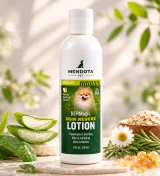 Start the treatment
DERMagic Skin Rescue Lotion
Keep the skin clean and covered — dermagic.eu →
For specific guidance on a stubborn hot spot or rash, email customerservice@dermagic.eu or call +44 7425 388643.