Spring brings pollen, blossom, fresh grass — and a wave of seasonal allergies in dogs. Here’s how to spot the flare-up early and the natural products that bring fast relief.
The seasonal pattern
Does your dog suffer from seasonal allergies — breaking out in hot spots, itchy skin, or canine dermatitis at the same time each year?
With spring here, many owners are seeing the familiar symptoms reappear after hoping they had gone for good. The trigger is usually airborne — pollens and other environmental allergens — and the time to act is before the dog has spent the season feeling miserable.
What the signs look like
Allergies in dogs typically take the form of:
- Inflamed skin
- Hot spots
- Itchy, flaky skin
The condition is collectively called allergic dermatitis. The skin becomes very itchy, the dog scratches excessively, and may bite or chew at certain areas just to relieve the irritation. Once the skin breaks, the situation escalates quickly — open sores, secondary infection, and a much harder problem to treat.
The point of intervention is as early as possible. The faster you relieve the symptoms, the less likely it is to cascade into something serious.
Hot spots — what they are
A hot spot, clinically known as acute moist dermatitis, is one of the most common skin conditions in dogs. It can appear anywhere on the body — hind leg, feet, rump area, neck — and it appears fast.
The causes vary: allergies, parasites, a single insect bite, anything that makes one patch of skin itch.
We had the causation backwards here, and have corrected it. This section used to say the common factor underneath every hot spot is infection, and that the job is to kill the infection. A hot spot is better described as self-inflicted — the clinical literature calls it a superficial, moist dermatitis commonly induced by self-trauma. Something itches, the dog chews and licks that one spot, and the surface breaks down within hours. Bacteria are then almost always present on that broken surface: in the one prospective study of the condition, 44 dogs in Sweden, 25 of the 27 lesions cultured grew Staphylococcus. But that is a surface finding on skin the dog has already damaged, not the thing that started it. The same study found a probable underlying cause in 31 of the 44 cases, and found eosinophils in 29 — a hypersensitivity signature nobody had previously recorded in hot spots.
Why the distinction matters to you: chase the infection and you will be back in three weeks. The thing to find is what was itching.
One more correction from that study, since this post is about spring. It recorded no significant seasonal incidence for hot spots — though it was run in a region without endemic fleas, which is a real limitation, because flea allergy is the classic hot spot trigger and fleas in Britain and Ireland run all year with a July-to-October peak. Spring is a genuine pollen season for an atopic dog. Hot spots specifically are not a spring phenomenon.
What helps
Skin Rescue Lotion — for the itching and early hot spots
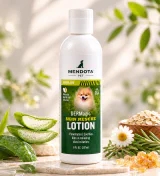
At the very first sign of itching, before the scratch becomes a sore, apply Dermagic Skin Rescue Lotion to the spot and the surrounding area, to keep the skin clean and covered before it gets scratched open.
We used to add that “the natural antimicrobials kill the opportunistic yeast, bacteria and mites that exploit broken skin, and the soothing oils calm the itch.” That has been withdrawn. We do not claim our products kill organisms — and certainly not mites, which need a prescription product from a vet. Nor can we show the essential oils have an anti-itch effect of their own.
Hot Spot Salve — for established hot spots
For a raw, weeping hot spot that’s already established, use Dermagic Hot Spot Salve — a thicker formula that stays where you put it and keeps the broken surface covered. One or two applications a day.
We have cut “dry it up” and “usually clears it within days”, neither of which we can show. What we can point at is more interesting, and it is not about our salve specifically. In a randomised double-blind trial of 40 dogs with hot spots, every lesion was clipped and cleaned before anything was applied, and then dogs received neomycin, prednisolone, the combination, or vehicle alone. The antimicrobial-plus-steroid combination worked quickest and steroid alone worked worst — but every group, including the vehicle-only controls, recovered completely within seven days.
So the clipping and the cleaning are doing a great deal of the work, and a bland topical over a clean lesion is a reasonable thing to be doing while it closes. That is the category our salve is in, and we would rather tell you that accurately than claim it is the active ingredient.
Two things that are a vet’s job, not ours. Hot spots hurt — in a double-blind pilot study, dogs with this diagnosis given injectable meloxicam alongside antibiotics showed measurably more pain relief than those on antibiotics alone, which is worth knowing if your dog will not let you near the spot. And go to a vet rather than a salve if the lesion is larger than a few centimetres, spreading by the hour, discharging pus rather than clear fluid, or the dog is unwell in themselves.
Both studies above are referenced in full, with PubMed IDs, at the end of hot spots on dogs and how to treat them.
 Start the treatment
DERMagic Skin Rescue Lotion
Calm a spring flare-up — dermagic.eu →
Start the treatment
DERMagic Skin Rescue Lotion
Calm a spring flare-up — dermagic.eu →For specific guidance on your dog’s spring allergies email customerservice@dermagic.eu or call +44 7425 388643.