We sell a dog shampoo with tea tree oil in it. Read what follows with that in mind — and then check it, because most of it comes from primary sources we have linked or named. The short version: concentration and species decide everything. Undiluted tea tree oil has poisoned hundreds of documented dogs and cats. A dilute rinse-off wash is a genuinely different proposition. Both halves of that are true at once, and the pet industry tends to tell you only the half that suits it.
The short answer
| Situation | Verdict |
|---|---|
| 100% tea tree oil on a dog’s skin | Dangerous. Hundreds of documented poisonings |
| 100% tea tree oil on a cat | Dangerous, and cats are over-represented in severe cases |
| Any undiluted essential oil, any species | Don’t |
| Dilute tea tree in a leave-on product for a cat | Avoid. Cats groom it off and swallow it |
| Dilute tea tree in a rinse-off dog shampoo | No published evidence of harm at these concentrations — which is not the same as proven safe |
| Tea tree oil as a flea treatment | No. It is not an insecticide and presenting it as one is a regulatory problem as well as a factual one |
The rest of this page is the evidence for each line, including the parts that cost us.
What the poisoning data actually shows
The single best source on this is a retrospective case series published in the Journal of the American Veterinary Medical Association in 2014: Khan, McLean and Slater, “Concentrated tea tree oil toxicosis in dogs and cats: 443 cases (2002–2012)”. It pulled ten years of incidents from the ASPCA Animal Poison Control Center database, covering 337 dogs and 106 cats exposed to 100% tea tree oil.
The findings worth knowing:
- The oil was applied deliberately in 395 of 443 cases — 89%. This is not a page about pets knocking bottles off shelves. It is overwhelmingly a record of owners applying tea tree oil to their animals on purpose, usually for fleas or a skin problem, believing it was the gentle option.
- Amounts ranged from 0.1 to 85 mL. The low end of that range is a fraction of a teaspoon.
- Route was cutaneous in 221 (50%), cutaneous and oral in 133 (30%), and oral alone in 67 (15%). Putting it on the skin was the commonest route to harm.
- Signs developed 2 to 12 hours after exposure and lasted up to 72 hours. The most common were increased salivation or drooling, CNS depression or lethargy, paresis, ataxia and tremors. That is a neurological picture, not a rash.
- Severity tracked age and weight, with major illness significantly more common in younger and lighter cats.
There is an earlier and much-quoted report — Bischoff and Guale, 1998, on tea tree oil poisoning in three purebred cats — which is where this first entered the veterinary literature. We are citing its existence only: the figures usually attached to it online trace back to secondary sources rather than the paper, and we could not verify them from the primary, so we are not going to repeat them as though we had.
Why cats are a separate question
Cats are the species to be careful with, for two reasons that stack.
The first is metabolic. Cats have an unusually limited capacity for glucuronidation, the liver pathway that tags foreign compounds with a sugar group so they can be cleared. This is well established and is the same quirk behind feline sensitivity to paracetamol and to phenols generally. EFSA’s FEEDAP Panel leaned on it explicitly in its 2024 opinion on tea tree oil, applying an additional uncertainty factor of 5 for cats on top of the standard factor of 100 — a total of 500 — “considering their unusually low capacity for glucuronidation, particularly of aromatic compounds”. The same opinion derived safe feed concentrations of 5.3 mg/kg for dogs and 0.9 mg/kg for cats: roughly a sixfold difference between the two species.
One caveat we have to flag, because we got it slightly wrong elsewhere on this site. That EFSA assessment is about tea tree oil eaten in feed. It is an oral exposure assessment, not a dermal one. The metabolic difference is real and the regulator’s reasoning is real, but applying it to something you rub on a cat’s skin is inference, not measurement. We previously described that cat factor on this site as precautionary and not mechanistically grounded; that was too generous in one direction, because EFSA names a specific mechanism. We have corrected both pages.
The second reason is simpler and does not depend on biochemistry at all: a cat grooms off whatever you put on it. Anything applied to a cat’s coat substantially becomes an oral dose within the hour. This is why our feline range is formulated without tea tree oil, and it is the only claim about that range we think is worth making.
Start the treatment DERMagic Feline Organic Shampoo Bar — Rosemary The tea-tree-free one for cats — dermagic.eu →“But ours is diluted” — the argument we are not allowed to stop at
Dilution reduces dose, and dose is most of the story. But it is worth being honest that “it’s only a small percentage” is not a complete defence, and the best illustration comes from a paper that is awkward for the natural pet care industry generally.
Genovese, McLean and Khan, writing in the Journal of Veterinary Emergency and Critical Care in 2012, reviewed 48 animals — 39 cats and 9 dogs — with adverse reactions to “natural” flea products built on essential oils. The products were at ordinary label strengths: peppermint at 0.25–3%, thyme at 1.7–5%, cinnamon and lemongrass at 1.5–4.5%. 44 of the 48 (92%) had at least one adverse effect, and — the number that matters most — 37 of the 48 (77%) had used the product exactly as the label instructed. Of the 28 animals whose outcome was known, one cat died and one cat and one dog were euthanased.
Two things must be said plainly about that paper, because it is widely mis-cited and we are not going to add to that:
- Those products did not contain tea tree oil. The oils named are peppermint, thyme, cinnamon and lemongrass. Anyone citing this study as tea tree evidence — and it happens often — is citing the wrong paper.
- They were leave-on spot-ons and sprays, not rinse-off shampoos. A product that stays on the coat for days is not the same exposure as one that is lathered and rinsed within minutes.
So it is not evidence against our shampoo. What it is, is a decisive answer to the lazy version of our own industry’s argument. “It’s natural and it’s dilute and it’s used as directed” describes every one of those 37 animals.
The study that would flatter us, and why we are not using it
There is a positive canine trial. In 2004, Reichling and colleagues published a multi-centre randomised double-blind controlled trial in Deutsche Tierärztliche Wochenschrift: 57 dogs with localised pruritic dermatitis, randomised 28 to 29, treated twice daily for 10 days with either a standardised 10% tea tree oil cream or a control skin cream. Success rates were 71% for tea tree against 41% for control (p = 0.04), with significantly faster relief of pruritus and alopecia. There was one adverse event in the tea tree arm, judged not causally related, and none in the control arm.
That is a real randomised trial with a positive result, and we could put it at the top of this page. We are not going to, for three reasons:
- The concentration is wrong by an order of magnitude. 10% in a cream, versus something far below that in our shampoo.
- The route is wrong. A cream massaged in twice daily for ten days is a leave-on therapeutic exposure. A shampoo is on the dog for a couple of minutes and then goes down the drain. You cannot transfer an efficacy result across that gap.
- Using it would make our shampoo a medicine. Citing a dermatitis trial as a reason to buy a cosmetic wash is precisely the presentation that, under Regulation (EU) 2019/6, reclassifies a product as a veterinary medicinal product. Our shampoo is not one, is not licensed as one, and we have spent a good deal of this year taking exactly that kind of claim back off this site.
What the trial is legitimately good for is tolerability. A 10% leave-on tea tree cream, applied twice a day for ten days to 28 dogs, produced one adverse event that the investigators did not attribute to it. That is a useful reassurance about the low-concentration rinse-off end of the spectrum, and it is all we are claiming from it.
What is actually in ours, and what we cannot tell you
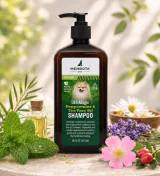
Here is the full declared ingredient list of the Peppermint & Tea Tree Shampoo, in label order:
Water, aloe barbadensis leaf juice, isostearamidopropyl ethyldimonium ethosulfate, disodium coco-glucoside citrate, sodium coco-glucoside tartrate, alcohol, glycerin, lavender flower extract, chamomile flower extract, lauryl betaine, myristyl betaine, triethanolamine, melaleuca alternifolia (tea tree) leaf oil, mentha piperita (peppermint) oil, panthenol, hydrolysed wheat protein, rosa canina fruit oil, oat kernel extract, salix nigra (willow) bark extract, jojoba seed oil, tocopheryl acetate, phenoxyethanol, tetrasodium EDTA, xanthan gum.
Tea tree is thirteenth of twenty-four, peppermint fourteenth. They are the name on the bottle, not the substance of the formula.
And here is the limit of what that tells you. Ingredient lists only have to be in descending order of weight down to 1%; below that, ingredients may appear in any order. So position thirteen is consistent with a wide range of actual percentages, and anyone — including us — who reads a concentration off a list position is guessing. We have asked for the exact figure and will publish it on this page when we have it. We are also not going to pretend the rest of the list is something it isn’t: this is a water-based product, so it contains a preservative, and that preservative is phenoxyethanol. The reasoning is in our preservative table.
 Start the treatment
DERMagic Peppermint & Tea Tree Shampoo
See the full label — dermagic.eu →
Start the treatment
DERMagic Peppermint & Tea Tree Shampoo
See the full label — dermagic.eu →What we can and cannot say about it
This is worth setting out directly, because it explains the shape of this whole page.
The laboratory literature on tea tree oil’s antibacterial and antifungal activity is large and genuine — it is why the oil interested formulators in the first place, and the 2004 trial above describes it as “well known” in its opening line. But in-vitro activity in a dish is not a claim we may make about a product on a dog. Under Regulation (EU) 2019/6, a product presented as treating or preventing disease is a veterinary medicinal product regardless of what is in it. There is no EU pet cosmetics regime to fall back on — EU cosmetics law covers the human body only — so presentation is the whole trip-wire.
The line we hold to: we may say a product makes skin cleaner and more comfortable. We may not say it kills the organism. So we will not tell you the tea tree in our shampoo treats a yeast infection, clears a bacterial one, or kills a mite, and if you find older pages on this site that did, they have been corrected this year.
Nor is tea tree oil a flea treatment. It is not an insecticide, there is no approval behind it as one, and a product sold on the basis that it repels or kills pests is a biocidal product under Regulation (EU) 528/2012, with an entire authorisation regime attached. The 48 animals in the Genovese paper were harmed by products sold on exactly that premise.
Practical guidance
- Never apply undiluted essential oil of any kind to a dog or cat. This is the single behaviour behind the great majority of the 443 cases.
- Keep tea tree oil away from cats, including the human-grade bottle in the bathroom cupboard, and do not use a dog shampoo containing it on a cat.
- If your pet has been exposed, call your vet or an animal poison line immediately — before signs appear, not after. Onset runs 2 to 12 hours. Tell them the concentration and the rough amount; both change the assessment.
- Small, young and lightweight animals are the higher-risk group, which is also the group most likely to be treated casually.
- If there is a diagnosed infection, that is a veterinary problem. The topical with the best evidence base in canine dermatology is chlorhexidine, usually with miconazole, and we do not sell one.
- If you simply want a gentler wash, the honest reason to choose one is the wash itself, not the essential oil in it. Our Certified Organic Shampoo Bars contain no tea tree oil and no water, and therefore no preservative at all.
Where this fits
If you came here because your dog is itching, tea tree oil is not the lever that will fix it — the cause is usually allergy, and what is actually driving canine itch is a more useful place to start. If you came here because of fleas or mites, read mites and mange instead, and note that the treatment is a prescription product from your vet. For how our range is meant to be used together, there is the four-step Dermagic System.
For product questions — including the tea tree percentage, once we have it — email customerservice@dermagic.eu or call +44 7425 388643.
Sources
- Khan SA, McLean MK, Slater MR. Concentrated tea tree oil toxicosis in dogs and cats: 443 cases (2002–2012). J Am Vet Med Assoc 2014;244(1):95–99. PMID 24344857
- Genovese AG, McLean MK, Khan SA. Adverse reactions from essential oil-containing natural flea products exempted from Environmental Protection Agency regulations in dogs and cats. J Vet Emerg Crit Care 2012;22(4):470–475.
- Reichling J, Fitzi J, Hellmann K, Wegener T, Bucher S, Saller R. Topical tea tree oil effective in canine localised pruritic dermatitis — a multi-centre randomised double-blind controlled clinical trial. Dtsch Tierarztl Wochenschr 2004;111(10):408–414. PMID 15568640
- Bischoff K, Guale F. Australian tea tree (Melaleuca alternifolia) oil poisoning in three purebred cats. J Vet Diagn Invest 1998;10(2):208–210. PMID 9576358
- EFSA FEEDAP Panel. Safety and efficacy of a feed additive consisting of an essential oil derived from Melaleuca alternifolia (tea tree oil) for all animal species. EFSA Journal 2024;22(10):e9026.