If you own a Labrador, the single most useful thing you can know is this: your dog’s defining skin problem is its ears — and Labrador ear disease is an allergy problem wearing a water-dog disguise. Ear infection is the most commonly recorded disorder in the breed, affecting around one in ten Labradors in any given year. Almost every owner attributes it to swimming. The evidence points somewhere else entirely, and that misdirection is why so many Labradors spend years on repeat courses of ear drops.
This is a breed-specific guide. What actually goes wrong with a Labrador’s skin, what the evidence does and does not support, which problems genuinely need a vet, and how to build a routine that holds up over the breed’s unusually long life.
Why Labradors specifically
Most itchy-dog advice is written for a generic dog. Four things about this breed change the picture.
The ears are the story. In a study of 2,074 Labradors under UK primary veterinary care, otitis externa was the single most commonly recorded disorder in the breed, at 10.4%. In a separate study sampling 22,333 dogs of all breeds, Labradors carried 1.64 times the odds of ear disease compared with crossbreds and were the most commonly represented breed among all ear cases. No other skin or coat problem in this breed comes close to that.
The ears are driven by allergy, not water. This is the reframe that changes what you actually do. In a study of 100 dogs with ear disease, the primary underlying cause was allergic skin disease in 43 of them. In 3,064 dogs, those with allergic or atopic skin symptoms carried 3.80 times the odds of ear disease. We will come back to why the swimming explanation is so much weaker than it sounds.
Size is a measured risk factor, not a vague one. Dogs of 40 kg or more carried 2.35 times the odds of ear disease compared with dogs under 10 kg, and simply being at or above the average weight for breed and sex carried 1.45 times the odds. A Labrador is a big dog that is also, very often, an overweight one — overweight status is the breed’s second most commonly recorded disorder at 8.8%.
They live a long time, so the routine has to be sustainable. Median Labrador lifespan sits at around 12.0 to 12.3 years, against roughly 11.3 for dogs generally. You are not managing a short-term problem. You are building something you can still be doing in a decade.
The problems, at a glance
| Problem | Where it shows | The giveaway | Vet? |
|---|---|---|---|
| Otitis externa | Ear canal | Head shaking, discharge, odour, pain — and it keeps returning | Yes |
| Atopic dermatitis | Paws, face, armpits, groin, ears | Licking and chewing from 6 months–3 years, often seasonal at first | Diagnosis yes |
| Hot spots | Cheek, neck, hip, flank | A hot, wet, bald patch that appeared overnight | If spreading |
| Food reaction | Variable; ears and skin together | Non-seasonal itch from the start, sometimes with digestive signs | For the diet trial |
| Hereditary nasal parakeratosis | Nasal planum only | Crusting and fissures on the nose of a dog aged 6–12 months | Yes — DNA test |
| Hypothyroidism | Whole coat, symmetrical | Dull coat plus weight gain and lethargy, not itchy | Yes |
| Lipoma and other masses | Anywhere under the skin | A soft lump that was not there before | Always check |
| Colour dilution alopecia | Diluted-colour areas | Thin ears and tail from a few months — silver and charcoal only | Yes |
| Acral lick dermatitis | Front of the wrist or ankle | A single polished, thickened patch the dog returns to | Yes |
| Pyoderma | Trunk, belly | Pustules, crusts, circular scaling patches | Yes |
Ears — the breed’s defining problem
Start here, because this is where a Labrador owner’s attention earns the most.
Ear disease in this breed is common, recurrent, and almost always secondary to something else. The practical consequence is that treating each infection as a standalone event — drops, resolution, repeat in four months — manages the symptom indefinitely without ever addressing why it keeps happening.
What the evidence says drives it. Allergy, decisively. Allergic skin disease was the primary cause in 43 of 100 ear cases; allergic or atopic skin symptoms carried 3.80 times the odds across 3,064 dogs. Bodyweight is the second measured factor, at 2.35 times the odds above 40 kg. Ear carriage is real but modest: compared with erect ears, pendulous ears carried 1.76 times the odds and V-shaped drop ears 1.84 times. Skull shape showed no substantial association.
What the evidence does not support is the mechanism everybody recites. The standard explanation — floppy ears trap moisture, trapped moisture breeds infection — turns out to be assumed rather than measured, and the measurements that do exist point the other way:
- A study of the ear canal’s internal climate found canal humidity is barely influenced by the surrounding environment. Raising ambient humidity by 24% raised canal humidity by just 2.3%.
- The same work found canal humidity was high in ears that were already diseased — averaging 89% in acute cases. That is consistent with humidity being a consequence of inflammation rather than its cause.
- A separate study found no significant temperature difference between erect and pendulous ears. Hairy canals actually ran cooler than hairless ones.
So ear carriage genuinely is a risk factor, but not for the reason given. An inflamed ear canal produces wax, moisture and the conditions for infection regardless of how well it is ventilated — and in an allergic dog, the canal lining is inflamed as a matter of course. Your Labrador’s ear shape is a minor contributor. Your Labrador’s allergic tendency is the main event.
So what about swimming?
Labradors swim. Every article about them says swimming causes their ear infections. We are going to be straight with you: that claim is much weaker than its confidence suggests.
The large population studies of canine ear disease — including the 22,333-dog study and a 321-dog veterinary dermatology case-control study — did not collect swimming or water exposure as a variable at all. They cannot support the claim in either direction. The 3,064-dog study did not examine it either.
The one piece of genuinely relevant canine evidence is a prospective study of 77 dogs looking specifically at Pseudomonas ear infections. It found a history of dog parks or pool swimming associated with roughly a 64% increase, and visiting a dog park alone with a 77% increase in the odds of being a case. Worth knowing. But the same study recovered matching bacterial strains from household water bowls and taps as well as from dogs’ and owners’ mouths — so the water route it identified was not specifically about swimming. The strong evidence linking swimming to ear infection is in humans, not dogs, and it should not be presented as canine data.
There is also a confound nobody mentions. Labradors swim and Labradors are large. Bodyweight above 40 kg is a measured 2.35-times risk. Some of what looks like a water-dog effect is simply a big-dog effect, and some of it is allergy.
What this means for you. Drying your Labrador’s ears after swimming is cheap, harmless and sensible, and we are not telling you to stop. We are telling you not to mistake it for the thing that matters. An owner who towels the ears religiously while an underlying allergy goes unaddressed will still have a dog with recurrent ear infections. Routine cleaning with a gentle, alcohol-free wash makes a genuine difference to flare frequency — alcohol stings inflamed tissue and dries the canal lining, which works against you.
 Keep the ears clear
DERMagic Natural Ear Wash
View on Dermagic →
Keep the ears clear
DERMagic Natural Ear Wash
View on Dermagic →Our dog ear care guide covers the technique properly and what should never go into an ear.
One thing not to do: do not pluck hair from your Labrador’s ear canals. The hairy-canal discussion in veterinary dermatology concerns Poodle-type coats, which Labradors do not have. And as above, hairy canals were measured running cooler, not hotter. Plucking traumatises the canal lining for no established benefit.
Stop and call the vet if the ear is hot, painful, swollen shut or producing dark or bloody discharge, or if your dog is tilting its head or losing balance. A ruptured eardrum completely changes what is safe to put in the ear. Nothing sold over the counter, ours included, treats an ear infection — that needs a vet, and ideally cytology to establish what is actually growing in there.
Atopic dermatitis — the engine behind most of it
If your Labrador is licking its paws, chewing at its flanks, rubbing its face and cycling through ear infections, canine atopic dermatitis is the most likely explanation.
Atopy is an inherited tendency to react to ordinary environmental material — pollens, grasses, dust mites and moulds. It typically emerges between six months and three years of age, targets the paws, face, armpits, groin and ears, and often starts seasonal before becoming year-round. Our guide to atopy versus allergy explains why those two words are not interchangeable, and the three most common dog allergies covers the wider picture.
The inherited component in Labradors is strong and well quantified. Work on a large population of predominantly Labrador guide dogs found a heritability of 0.47. Where both parents were affected, 65% of offspring were affected; where one parent was affected, between 21% and 57%; where neither was, 11%. That is a substantial genetic signal, and it is the best breed-specific allergy evidence that exists for Labradors.
But we are going to correct the usual framing, because accuracy matters more than drama here. Labradors are genuinely predisposed and are recognised as such internationally. They are not, however, near the top of the table:
- In UK primary-care data comparing 1,462 Labradors with 20,786 other dogs, atopic dermatitis did not appear among the Labradors’ thirty most common disorders — while it did appear among the comparison group’s.
- In a Finnish survey of 8,643 dogs, the Labrador ranked fourteenth for owner-reported allergic skin symptoms, with 21.5% of the 293 Labradors in the study affected. Golden Retrievers ranked twenty-first and Cocker Spaniels twenty-seventh. The top five were the West Highland White Terrier, Boxer, English Bulldog, Dalmatian and French Bulldog.
You will also see it stated that “over 10% of Labradors have atopic dermatitis”. That figure is the estimate for dogs of all breeds and has been misattributed. There is no validated Labrador-specific prevalence number, and we are not going to invent one.
The honest summary: within a Labrador family line, allergy is strongly heritable and worth taking seriously. Across the dog population, Labradors sit mid-table. Both things are true, and the second one should stop you concluding that your itchy Labrador’s problem must be allergy before anything else is excluded.
Very often the dramatic improvement owners notice does not come from allergy treatment at all, but from clearing the secondary yeast overgrowth sitting on top of it. If your dog has been treated for “allergies” for years with only partial success, our guide to allergies versus something else is worth reading, and why is my dog so itchy works through the whole problem by where the dog is itching.
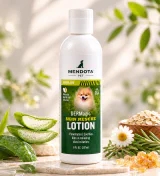 Step 2 — Treat
DERMagic Skin Rescue Lotion
View on Dermagic →
Step 2 — Treat
DERMagic Skin Rescue Lotion
View on Dermagic →The chocolate Labrador finding
This is the most surprising well-evidenced thing in this guide, and it is worth setting out carefully because it is easy to misread.
Research drawing on 33,320 UK Labradors under primary veterinary care, with disorder data from a random sample of 2,074, found clear differences by coat colour:
| Outcome | Chocolate | Yellow | Black |
|---|---|---|---|
| Ear infection | 23.4% | 17.0% | 12.8% |
| Hot spots | 4.0% | 1.6% | 1.1% |
Both differences were statistically significant. Median lifespan was 10.7 years in chocolate Labradors against 12.1 years in the rest of the breed — about 1.4 years, or roughly 10%, shorter.
An entirely separate study of 2,445 Labradors and Golden Retrievers then found, independently, that chocolate Labradors were 1.94 times more likely to have atopic dermatitis than black Labradors. Two unrelated datasets, two different skin outcomes, pointing the same way. That is a stronger evidential position than most breed claims ever reach.
Now the part that usually gets left out. The mechanism is explicitly a hypothesis, not a finding. The researchers’ own proposal is that because chocolate is a recessive colour, breeders selecting for it necessarily work within a narrower gene pool, and may unintentionally carry other disease-associated variants along with the colour. The pigment is not doing this. There is nothing about brown fur that inflames an ear canal. Note too that yellow Labradors sit between black and chocolate for ear disease, so this is not a clean chocolate-only effect.
What you should actually take from it. If you have a chocolate Labrador, nothing here is a diagnosis and nothing is destiny — the difference is in the odds, not in the individual dog. What it justifies is starting ear care earlier and keeping it more consistent, and taking the first ear infection as a signal to investigate rather than a one-off to treat. We would not change anything else.
Hot spots — the one skin disease Labradors distinctively get
Where atopic dermatitis is mid-table in this breed, hot spots are genuinely a Labrador thing.
In the UK primary-care comparison, moist dermatitis appeared among the Labradors’ thirty most common disorders and did not appear among the other 20,786 dogs’. That asymmetry is the finding. And the colour gradient above applies here too — 4.0% in chocolate Labradors against 1.1% in black.
A hot spot is a rapidly appearing patch of inflamed, moist, hairless skin, classically on the cheek, neck, hip or flank, that can go from nothing to the size of a coin overnight. It is uncomfortable and it spreads, because the dog keeps working at it.
The standard explanation is reasonable and untested. Dense undercoat holds moisture against warm skin after swimming, rain or bathing; slow drying plus warmth allows surface bacteria to establish. Every textbook says it. Nobody has measured it. We will describe the over-representation as real and the explanation as inferred, because that is what the evidence supports.
What has been measured is more useful anyway. In a prospective study of 44 hot spot cases, an underlying cause was found or suspected in 31 of them. A hot spot is usually a symptom, not an accident. The same study is worth knowing about for what it did not find: it recorded no ear disease among its cases and took place in an area without endemic fleas, which undercuts the familiar line that hot spots always trace back to fleas or ears. It also distinguished two patterns histologically — a superficial ulcerative form, and a deeper suppurative folliculitis that is a true localised pyoderma and needs systemic antibiotics rather than topical care alone.
That distinction matters to you practically. A superficial hot spot responds well to clipping the hair around it, keeping it clean and dry, and targeted topical treatment. A deeper one does not, and continuing to treat it topically while it worsens wastes time.
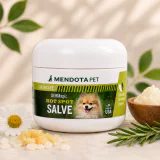 Step 3 — Target
DERMagic Hot Spot Salve
View on Dermagic →
Step 3 — Target
DERMagic Hot Spot Salve
View on Dermagic →Our guides to hot spots and how to treat them and hot spots, rashes and skin irritations cover the immediate management. See a vet if the lesion is deep, painful out of proportion, spreading despite care, or producing thick discharge — and if your Labrador gets them repeatedly in the same place, the question to ask is what is driving them, not how to treat the next one.
Hereditary nasal parakeratosis — the genuinely Labrador-specific one
Almost no owner-facing Labrador article mentions this, and it is better evidenced than most of what they do mention.
Hereditary nasal parakeratosis is caused by a single missense variant in the SUV39H2 gene, inherited recessively. The genetic study that identified it produced an extremely strong statistical signal and found the variant perfectly associated with the condition across more than 500 dogs. It is, unusually for a skin disease, DNA-testable.
Clinically it produces crusting and fissuring confined to the nasal planum — the hairless leathery part of the nose — typically appearing between six and twelve months of age. It does not involve the rest of the dog.
It is rare. Commercial testing data on an opted-in Labrador population suggests around 98% clear, under 1% carriers, and a very small fraction at risk. So this is not something to worry about generally. What it means is narrower and more useful: a persistently crusted, cracked nose in a young Labrador has a named, testable explanation, and is worth raising with your vet by name rather than treating with a succession of balms.
Softening and protecting the nose keeps an affected dog comfortable, and that is a legitimate role for topical care. It does not address the underlying defect, and nothing applied to the skin can. The other causes of a changing nose — immune-mediated disease and discoid lupus among them — need excluding properly, which means a biopsy rather than a guess.
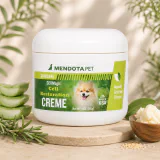 Step 4 — Restore
DERMagic Cell Restoration Crème
View on Dermagic →
Step 4 — Restore
DERMagic Cell Restoration Crème
View on Dermagic →Weight — the most underrated skin lever in this breed
This section is not padding. Bodyweight is one of the few things you fully control that has a measured effect on your Labrador’s skin.
The numbers. Being 40 kg or heavier carried 2.35 times the odds of ear disease. Being at or above the average weight for breed and sex carried 1.45 times the odds. Above-average bodyweight also carried 2.06 times the odds of hypothyroidism being recorded. Labradors carry around 1.70 times the odds of overweight status compared with crossbreds, and overweight status is the breed’s second most commonly recorded disorder at 8.8%. Neutered males are particularly affected — 11.4% against 4.1% in entire males.
And there is a real biological reason, which is worth knowing because it removes the blame. Around 12% of Labrador chromosomes carry a 14-base-pair deletion in the POMC gene, disrupting sequences involved in appetite regulation. It is associated with higher bodyweight and with measurably greater food motivation. Among other breeds it has been found only in the closely related Flat-Coated Retriever. One striking detail: its frequency was 45% in a group of Labradors used as assistance-dog breeding stock against about 12% in random Labradors — the appetite variant appears to have been inadvertently selected for, presumably because a food-motivated dog is an easily trained one.
Your Labrador’s appetite genuinely is different from other dogs’. That is not a failure of willpower, yours or the dog’s.
One claim we are going to knock down, because it gets applied to Labradors wrongly. Obesity in dogs is often linked to skin fold dermatitis. That does not apply here: Labradors were found to be protected against skin fold dermatitis, at 0.57 times the odds of crossbreds. The predisposed breeds are the English Bulldog, French Bulldog, Pug and Basset Hound — dogs that have the folds. Labradors do not. The route from weight to skin trouble in a Labrador runs through the ears, and that is reason enough.
 Barrier support from within
Retrieve Skin & Coat Supplement
View on Dermagic →
Barrier support from within
Retrieve Skin & Coat Supplement
View on Dermagic →Food reactions — what the evidence actually supports
We have to be careful here, because this subject attracts invented statistics and we have corrected some of our own in the past.
On whether Labradors are predisposed: a review of 22 studies covering 825 dogs with confirmed cutaneous food reactions found Labradors and Golden Retrievers together accounted for about 19% of affected dogs. But only 9 of 20 studies compared affected breeds against a local reference population, and in 4 of those 9 no significant breed association was found at all. Labradors showed predisposition in three reports. The honest phrasing is that Labradors appear over-represented in a minority of controlled comparisons — not that they are established as predisposed.
On how much itching is food-driven: the reviewed ranges are 9–40% of dogs with itching, 8–62% of dogs with any allergic skin disease, and 9–50% of dogs diagnosed with atopic dermatitis. These come from referral populations and are heavily selection-biased. There is no defensible single figure, and we are not going to give you one. If you have read that a specific percentage of canine itching is caused by food, that number was made up.
What is solid and useful:
- Mean age of onset is 2.9 years, but 22% of affected dogs show signs by six months and 38% by twelve months.
- Ear disease was reported in anywhere from 3% to 69% of food-reaction dogs across nine studies — so ears are genuinely part of the picture, if unpredictably.
- 61% of confirmed cases developed itching within twelve hours of food challenge. The idea that food reactions take weeks to show is wrong.
- Diagnosis requires a strict six-to-twelve week elimination diet with provocation afterwards. Historically an eight-week trial achieved remission in over 90% of genuinely affected animals.
- No blood, saliva or hair test diagnoses food allergy. We will say that plainly given how many are sold.
Suspect food more strongly when the itch is non-seasonal from the very beginning, when ears are heavily involved, or when there are digestive signs alongside.
Coat, shedding, and why you should not clip
Labradors have a short, dense, weather-resistant outer coat over a soft undercoat. All dogs have compound follicles — a central guard hair with lateral follicles producing multiple undercoat hairs — and breeds differ in density and in how many secondary hairs each follicle carries. We should be honest that no published study has actually measured Labrador follicle density or undercoat ratio, so “Labradors have a true double coat” is sound as anatomy and breed standard rather than as a measured breed figure.
The seasonal shedding is real and measured. Follicle studies in dogs found hair in the anagen (growing) phase peaked in winter and summer, hair in the telogen (resting) phase peaked in autumn and spring, and combed-hair shedding peaked in those same two seasons, matching the telogen peaks. So the twice-yearly “coat blow” has a genuine follicular basis. Our guide to how your dog adapts to autumn weather and the autumn and winter skin and coat guide cover the seasonal side.
“Labradors are heavy shedders” is owner experience, not data. No comparative measurement of shed hair mass by breed exists. It is entirely plausible — lots of secondary hairs across a large body surface — but we are not going to dress a consistent observation up as a statistic.
Do not clip or shave a Labrador, for heat or for shedding. Dogs shed heat by panting rather than through the skin, so removing coat does not open a cooling route that was previously blocked, and regrowth after clipping has been shown to be slow and variable. Our guide to whether you should shave a double-coated dog goes through this properly.
What works instead is thorough brushing that actually reaches the undercoat. That reduces loose hair in the house, and more importantly it improves air circulation and drying time at skin level — which matters in the breed that distinctively gets hot spots.
 Between baths
DERMagic Skin Rescue Grooming Spritz
View on Dermagic →
Between baths
DERMagic Skin Rescue Grooming Spritz
View on Dermagic →Two related claims to discard. Shedding volume has nothing to do with how allergenic a dog is to people — a study of 173 homes found no difference in dog allergen levels between “hypoallergenic” breeds and the rest, and a separate study concluded there is no evidence to describe any breed as hypoallergenic. And a greasy or smelly Labrador is not showing a breed trait: primary seborrhoea is a condition of American Cocker Spaniels, English Springer Spaniels, West Highland Whites and Basset Hounds, and Labradors are not on that list. A Labrador with a greasy, scaly, odorous coat has something underneath driving it — see seborrhoea in dogs and why does my dog smell.
Silver and charcoal Labradors
Colour dilution alopecia occurs only in dogs carrying two copies of the dilute variant in the MLPH gene. The defect impairs the transport of pigment granules, the granules clump, and the hair shafts become structurally weak and fracture. Black, yellow and chocolate Labradors are not dilute, so this is simply not their disease.
“Silver” and “charcoal” Labradors are genetically chocolate plus that dilute variant, and they are now being reported among affected breeds. It typically starts with sparsely haired ears and tail from a few months of age and progresses to thinning over the trunk. There is no published prevalence figure for silver Labradors — the figures that exist are for Dobermanns, where the condition affects a large majority of blue dogs. So the risk is real in principle and unquantified in practice.
Two honest cautions. Carrying the dilute variant does not guarantee the condition — some uniformly dilute breeds and lines are reportedly unaffected, so the genotype is necessary but not sufficient and the modifiers are unknown. And the origin of the dilute variant in Labradors is genuinely disputed. We are not going to assert an answer in either direction. Our guide to alopecia in dogs covers how this is distinguished from other hair loss, and hair loss without itching works through the full differential.
What Labradors are measurably protected against
This cuts the other way, and it is worth knowing because it saves owners money and worry. Labradors were found to have lower odds than crossbred dogs of three things they are widely assumed to be prone to:
- Juvenile demodicosis — 0.32 times the odds. Demodex mites are a Bulldog, Staffordshire Bull Terrier, Shar Pei and Pug problem. Our guide to mites and mange covers the breeds that genuinely are at risk.
- Skin fold dermatitis — 0.57 times the odds, as above.
- Flea infestation — 0.22 times the odds, and parasite infestation overall at 0.51. This very likely reflects Labrador owners’ preventive-care habits rather than anything biological, but it does undercut the idea that Labradors pick up parasites readily.
Ringworm belongs here too. There is no established Labrador predisposition — the breeds named in the laboratory data are Yorkshire Terriers, West Highland Whites, Miniature Pinschers, Dalmatians and Miniature Schnauzers, though that study reported p-values with no effect sizes and drew on submitted samples rather than the dog population. Ringworm is uncommon in dogs generally and routinely over-called by owners.
And hypothyroidism, which gets offered to Labrador owners constantly, is a weak association in this breed: 1.40 times the odds against a population prevalence of just 0.23%. For comparison, Dobermanns carry 17 times the odds and Golden Retrievers over 4 times. Thyroid disease produces a symmetrical, non-inflammatory, non-itchy coat loss alongside weight gain, lethargy and cold-seeking, usually in an older dog. An itchy Labrador with a poor coat is an allergy case until proven otherwise — offering thyroid as the explanation for an itchy dog is the wrong differential.
Lumps matter more than most skin conditions in this breed
This is not strictly a skin disease, but it belongs in a Labrador skin guide because it is where owner observation genuinely saves lives.
Labradors carry 2.45 times the odds of lipoma compared with other dogs, with a prevalence of 4.1%, and elevated odds of neoplasia overall at 1.89 times. Lipomas are benign fatty masses and most Labrador lumps turn out to be exactly that.
The conclusion is not “Labradors get harmless fatty lumps”. It is that a breed with a high rate of benign lumps is a breed where owners get used to finding lumps and stop checking them. Any new lump should be examined, because the only way to distinguish a lipoma from something that matters is a needle and a microscope, and that is a quick, cheap procedure.
What your vet should rule out
If your Labrador has persistent skin or ear trouble, these are the things worth asking for by name:
- Ear cytology — a swab read under a microscope, to establish whether you are dealing with bacteria, yeast, or both, and whether it is Pseudomonas. This changes treatment completely and should be done before the second course of drops, not the fifth.
- A skin swab or cytology for secondary bacterial and yeast overgrowth.
- A skin scrape — to exclude mites, even though Labradors are at low risk.
- A strict elimination diet trial of six to twelve weeks, if the itch is non-seasonal.
- A full thyroid panel — total T4, free T4 and TSH — but only if the picture is non-itchy coat loss with systemic signs.
- Fine-needle aspiration of any new lump.
- The SUV39H2 DNA test, if a young Labrador has a persistently crusted nose.
- A biopsy, where the nose or mucocutaneous junctions are involved and nothing above explains it.
Do this before concluding anything. A dog with an undiagnosed allergy does not need better ear drops; it needs the allergy managed. No topical product on earth substitutes for a diagnosis, and we would rather say so plainly.
Bathing and coat care for a Labrador
Bathing is treatment, not grooming, when the skin is in trouble. The pattern that works is two to three baths a week while getting a flare under control, easing to once or twice a week to maintain it. The instinct to wash less because washing “strips the oils” is the wrong move for skin that is scaling or carrying a microbial overgrowth — washing is what physically removes scale, surface oil and microbial load.
Three things specific to this breed:
Get the lather to skin. A dense Labrador coat sheds water, which is the point of it. Working shampoo down through the coat until it is genuinely against skin, across the whole dog, matters far more than how long you leave it on. On that: the familiar ten-minute contact rule is likely unnecessary — a 2026 study comparing three minutes against ten found no meaningful difference, though it was small work on eighteen healthy dogs and partly done on hair samples rather than live skin. Treat ten minutes as not required rather than disproven.
Dry properly. This is the one piece of conventional Labrador advice we will endorse without qualification, though for the hot spot risk rather than the ear one. Slow drying in a dense coat is the accepted predisposing factor for acute moist dermatitis, and towel-drying thoroughly after swimming, rain or bathing is free.
Brush before you bathe, not after. Getting dead undercoat out first lets water and product reach skin.
 Step 1 — Cleanse
DERMagic Skin Rescue Shampoo Bar
View on Dermagic →
Step 1 — Cleanse
DERMagic Skin Rescue Shampoo Bar
View on Dermagic →Our guides to soap, shampoo or shampoo bars and why use a natural shampoo and conditioner cover the choice of product, and dog paw care covers the paws, which in an atopic Labrador take a lot of the damage.
The Dermagic System for a Labrador
The Dermagic System is four steps, and in this breed the case for running all four is specific rather than generic.
Step 1 — Cleanse. The Skin Rescue Shampoo Bar removes scale, surface oil and microbial load. This is the step that does the physical work.
Step 2 — Treat. Skin Rescue Lotion goes onto the affected skin between baths and is the workhorse for an itchy, inflamed, overgrown surface.
Step 3 — Target. Hot Spot Salve for broken skin and localised lesions. In the breed that distinctively gets hot spots, this is not an optional extra.
Step 4 — Restore. Cell Restoration Crème rebuilds the barrier once the acute problem is clearing.
Why all four, in a Labrador specifically. Look at what this breed actually gets: recurrent ear flares, hot spots that return to the same site, seasonal itching that comes back every year. The defining feature is recurrence. And recurrence is exactly what a protocol fails at when it clears the current episode and stops there. Treating the flare without rebuilding the barrier that allowed it leaves the dog in the identical position next cycle — which is the pattern behind every owner who tells us the products worked for a month and then stopped. The four steps do different jobs and they compound.
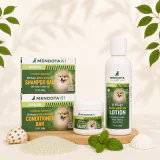 Steps 1–3 together
DERMagic Skin Essentials System
View on Dermagic →
Steps 1–3 together
DERMagic Skin Essentials System
View on Dermagic →Two worth adding for this breed
The Ear Wash, without qualification. In the breed whose most common disorder is ear infection, routine alcohol-free cleaning is the highest-value habit in this entire guide.
A salt scrub, if your Labrador’s problem presents as scaling and flaking rather than grease. Sulphur-based antiseborrhoeic care is pointed at scale rather than at an oily coat, which makes it a good fit for the dry, scurfy presentation and a poor one for the greasy end.
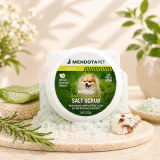 For flaking and scale
DERMagic Anti-Dandruff Salt Scrub
View on Dermagic →
For flaking and scale
DERMagic Anti-Dandruff Salt Scrub
View on Dermagic →The routine that holds
A Labrador lives around twelve years. Build something you will still do in year ten.
Weekly: check both ears — look and smell, you will know the smell. Run your hands over the whole dog for new lumps. Brush thoroughly enough to reach undercoat.
After every swim, bath or soaking: dry properly, with attention to the ears and the dense areas over the hips and neck.
Through a flare: bathe two to three times weekly, lotion between baths, salve on anything broken.
Maintaining: bathe once or twice weekly, restore the barrier, keep the ear cleaning going even when the ears look fine. That last point is the one people drop first and regret.
Every vet visit: get the weight recorded and watch the trend. In this breed that single number is doing more work for the skin than it appears to.
What improvement looks like
- Week 1–2: itching and surface odour settle. Earliest honest signal.
- Week 2–4: redness and surface inflammation improve.
- Month 2+: skin that has thickened or darkened begins to normalise.
- Month 3–6: coat genuinely looks right again, following the hair cycle.
- Ears: judge over a year, not a month. If the underlying driver is allergy, the realistic goal is fewer and milder flares, not none ever again. That is not a failure — it is what managing a tendency looks like.
What not to do
- Do not treat ear infections as isolated events. The fourth infection in two years is information, not bad luck.
- Do not pluck the ear canals. No established benefit, and the rationale is based on a coat type Labradors do not have.
- Do not clip or shave the coat, for heat or shedding.
- Do not reduce bathing frequency because you have read that washing strips oils. For skin in trouble, washing is the treatment.
- Do not buy a blood, saliva or hair test for food allergy. They do not work. The elimination diet is the only route.
- Do not accept “it’s probably his thyroid” for an itchy Labrador. Thyroid disease is not itchy and is uncommon in this breed.
- Do not stop checking lumps because the last six were fatty.
- Do not assume a chocolate Labrador is doomed. The difference is in the odds across tens of thousands of dogs, not in your dog.
- Do not keep treating a deep or spreading lesion topically. Some hot spots are a deeper folliculitis and need systemic treatment.
Where to start
If you are reading this with an itchy, ear-shaking Labrador in the room, do these three things in order.
First, get the ears swabbed and looked at properly — cytology, not just another course of drops. You need to know what is in there.
Second, ask what is driving it. In this breed the answer is usually allergy. That is a conversation about the whole dog, not the ears.
Third, start the routine. Cleanse, treat, target, restore — and get the ear cleaning into your week permanently.
Steps 1–3 together
DERMagic Skin Essentials System
View on Dermagic →And keep an eye on the weight. It is the least glamorous recommendation in this guide and one of the best supported.
Further reading
Our other breed guides: Golden Retriever skin problems — the closest comparison, where the ear odds run higher still, the thyroid odds are three times the Labrador’s, and the breed carries an inherited scaling disorder the Labrador does not. Also West Highland White Terrier skin problems — the breed that genuinely sits at the top of the allergy table, and that records the same ear-disease rate as the Labrador without the pendulous ears or the swimming. Plus German Shepherd skin problems and French Bulldog skin problems.