We sell paraben-free dog shampoo. For about a decade this page told you parabens could cause severe irritation to your dog’s skin. We went looking for the evidence behind our own claim, and there isn’t any — there is no veterinary literature on parabens in dogs at all. Here is the honest version, including the part where the ingredient the industry replaced parabens with turned out to be far worse.
Start here: we have withdrawn most of this page
This was one of the first things we ever published, and almost everything it said about parabens was either unsupported or an outright appeal to vague authority. Rather than quietly swap the text, here is what we used to claim and why each claim has gone.
- “Parabens can cause severe irritation to a dog’s skin and fur.” Withdrawn entirely. There is no canine evidence for it — not sparse evidence, none. We also wrote “fur”, and the hair shaft is dead keratin, which cannot be irritated. This claim fails by exactly the standard we used to withdraw our old “sulphur kills the scabies mite” line, and it failed in the same commercially convenient direction.
- “In view of the various scientific studies on parabens over recent years…” Withdrawn. It named no study, no finding and no magnitude. It used a true statement about what shoppers do to carry a risk claim we had not substantiated.
- “Parabens appear in many pet grooming products.” Withdrawn. No published survey of preservative use in pet shampoo exists, and the market has largely moved to phenoxyethanol and organic acids anyway. The claim was unsupported when we wrote it and is probably now simply out of date.
- The blueberry aside — “naturally occurring parabens have been found in blueberries, but the ones in your dog’s shampoo aren’t coming from a fruit.” Withdrawn as a fallacy. Methylparaben from a blueberry and methylparaben from a reactor are the same molecule. We were inviting you to infer a difference that does not exist, which is the same mistake as the “SLS is in engine degreaser” line we deleted from this page earlier.
- Two numbers about dog skin, which we added to this page while correcting it, and which were still wrong. Details in the SLS section below. Both are now withdrawn.
What survives is narrower, more technical and considerably more interesting than what we replaced.
What parabens actually are
Parabens are a family of esters of 4-hydroxybenzoic acid. Not one compound — a series, and the series matters. The common ones in order of alkyl chain length are methyl- (C1), ethyl- (C2), propyl- (C3) and butylparaben (C4), plus the branched isopropyl and isobutyl forms and the aryl benzyl and phenyl forms.
The single most useful structural fact, and the one our old page omitted: antimicrobial potency and oestrogen-receptor binding both increase with chain length, while water solubility falls. Methylparaben is the weakest on both counts. That is precisely why methylparaben survived every regulatory review and benzylparaben did not — not because one is natural and the other synthetic, but because of where they sit on the same chemical series.
They became ubiquitous because they are effective against both bacteria and fungi, stable, active across a usefully wide pH range, and cost very little. That combination is harder to replace than the marketing suggests.
“Banned in the EU” — the most misunderstood fact in the subject
Almost every consumer page about parabens gets this backwards, including the one you are reading until today.
Commission Regulation (EU) 358/2014 prohibited five parabens in human cosmetics: isopropyl-, isobutyl-, phenyl-, benzyl- and pentylparaben. People cite it constantly as proof that parabens are dangerous. Here is what the regulation itself says, in Recital 7 — the Commission explaining its own reasoning:
the SCCS noted that limited or no information was submitted by industry for the safety evaluation of isopropylparaben, isobutylparaben, phenylparaben, benzylparaben and pentylparaben. As a result, for these compounds, the human risk cannot be evaluated.
They were not banned for being harmful. They were banned because nobody paid for the safety dossier. They were commercially marginal esters, so industry declined to fund the studies, so the scientific committee could not assess them, so they were moved to the prohibited annex. “Banned in the EU” here means “never assessed”.
The parabens that were assessed are still permitted:
- Methyl- and ethylparaben: permitted at 0.4% each, 0.8% total, repeatedly reaffirmed.
- Propyl- and butylparaben: capped at a combined 0.14% by Regulation (EU) 1004/2014, and prohibited in leave-on products for the nappy area of children under three. Worth noting that the scientific committee had concluded 0.19% was safe and the Commission legislated the stricter 0.14% anyway.
In April 2025 the SCCS looked again at butylparaben and children’s aggregate exposure, and concluded it is not safe at 0.14% for children aged six months to ten years when used across many product categories simultaneously — while remaining safe in single product categories. We think both halves of that deserve stating, because the structure of the finding is that a single rinse-off product stays within the safe envelope even under the most conservative modelling available. A dog shampoo is a single rinse-off product.
And none of it applies to your dog
This is the part the pet industry does not tell you, and we were as guilty as anyone.
EU cosmetics law does not cover pet products. Regulation EC 1223/2009 defines a cosmetic product, in Article 2(1)(a), by application to the human body. There is no EU-wide pet cosmetics regime. Every paraben limit above is a human-cosmetics limit. A dog shampoo sold in the EU containing isobutylparaben at 1% breaks no paraben law, because there is no paraben law that reaches it.
Pet products are governed instead by general product safety legislation, by chemicals law, by the Biocidal Products Regulation where a product claims to kill organisms, and — most importantly for what a company is allowed to say — by Regulation (EU) 2019/6 on veterinary medicinal products, under which the way a product is presented can by itself reclassify it as an unauthorised medicine.
So when any pet brand tells you an ingredient is “EU banned”, the question to ask is whether the ban was ever about pets. Usually it was not.
There is one more thing we should say against our own interest here. The European Commission’s own technical guidance on cosmetic claims names “without parabens” as an example of a non-compliant claim, on the grounds that it denigrates a legally permitted ingredient. That guidance does not bind us, for the same reason none of the rest of it does. But it is the regulator’s published view that the claim this page was built around is an unfair one, and you are entitled to know that we know.
The endocrine question, with the numbers in
Paraben oestrogenicity is real. It is also very weak, and the size of it is the whole story.
Routledge and colleagues, 1998, first demonstrated the effect and simultaneously showed how small it was: butylparaben, the most potent of the four common esters, was roughly ten thousand times less potent than 17β-oestradiol, the body’s own oestrogen. Methyl-, ethyl- and propylparaben were weaker still. Across the wider literature the gap runs from ten thousand to a hundred thousand fold, and widens further in live-animal assays rather than cell culture.
Golden and colleagues, 2005, ran a margin-of-safety analysis and concluded that worst-case daily paraben exposure presents substantially less oestrogenic activity than ordinary dietary plant oestrogens such as the daidzein in soy. For a dog, that comparison is worth sitting with: the food bowl is a larger oestrogen-receptor exposure than any plausible shampoo residue.
The reason the cell-culture potency does not translate is metabolism. Parabens are hydrolysed by carboxylesterases in skin, gut and liver to 4-hydroxybenzoic acid, conjugated, and excreted. Biological half-life is under 24 hours, with no meaningful tissue accumulation.
Where we will not overstate it. The same reviews note that skin hydrolysis may be less efficient than once assumed, and that intact esters are detectable in plasma after whole-body application. High oral doses of propyl- and butylparaben did reduce sperm production and testosterone in young male rats in work from the early 2000s, which is what drove the Danish restrictions — though a later study could not reproduce reproductive effects even at very high dietary concentrations, attributing the null result to esterase metabolism. The honest summary is weak, rapidly metabolised, with an unresolved high-dose oral signal in rats. Not “harmless”, and nowhere near “endocrine disruptor” as that phrase is normally deployed.
The breast cancer study, and the study that answered it
Darbre and colleagues, 2004, measured parabens in twenty human breast tumour samples and found a mean total of about 20 ng per gram of tissue. It is the single most influential paper in consumer cosmetic anxiety.
What it did not do:
- No healthy control tissue and no non-tumour comparison. With no control arm it cannot establish association, let alone causation.
- No source attribution. It could not show the parabens came from cosmetics at all.
- Insufficient blank analysis to exclude contamination during handling.
- The authors explicitly disclaimed causation in the paper itself.
It was a feasibility study — can we detect these at all — reported as though it were an investigation of cause. “Parabens found in breast tumours” is a headline; “twenty samples, no controls, no causal inference” is not.
The follow-up is the part nobody repeats. Barr and colleagues, 2012, took 160 samples from forty women across the chest wall and found at least one paraben in 99% of samples. Critically, women who had never used underarm cosmetics still had parabens in their breast tissue. Whatever the source is, it is not deodorant. Parabens are a ubiquitous dietary and environmental exposure, which is a far more interesting finding than the scare it replaced.
What the patch-test data actually say
This is where the paraben story turns around completely, and it is the reason we are no longer willing to run a fear-based page.
The North American Contact Dermatitis Group has patch-tested preservatives in a very large series — around 50,000 patients between 1994 and 2016. Ranked by the proportion of tested patients who reacted:
| Preservative | Positive |
|---|---|
| Methylisothiazolinone | 12.2% |
| Formaldehyde | 7.8% |
| Quaternium-15 | 7.7% |
| MCI/MI | 3.2–3.8% |
| Diazolidinyl urea | 2.8% |
| Imidazolidinyl urea | 2.4% |
| DMDM hydantoin | 2.0% |
| Paraben mix | 1.0% |
| Benzyl alcohol | 0.3% |
| Phenoxyethanol | 0.2% |
Two details make that table much more damning than it first looks.
Paraben mix is patch-tested at 12% — roughly thirty to eighty times a typical in-use concentration — and still only 1% of patients react. Methylisothiazolinone is tested at 0.2% and 12% react. Per unit of substance applied, that is not a small difference; it is about two orders of magnitude of sensitising potency.
And paraben positivity has been falling: from about 2% in the mid-1990s to 0.6% by 2015–16. European figures run 0.5–1%.
In 2019 the American Contact Dermatitis Society named parabens "(Non)Allergen of the Year" — a category created specifically to point out that public fear of an ingredient had run far ahead of the clinical evidence.
The one real caveat, and it is a genuine one. The “paraben paradox”, described by Fisher in 1973, is that patients who react to parabens on patch testing often tolerate paraben-containing products on intact skin, while sensitisation happens readily on damaged skin. So the clinically defensible version of a paraben concern is narrow: it applies to broken, eczematous or ulcerated skin, not to a healthy coat. For a dog in an active flare — which is most dogs whose owners are reading an ingredient page — that caveat is worth having. It is also the only mechanistic footing our old claim ever had, and it does not get us anywhere near “severe irritation”.
On dogs specifically: there is no veterinary literature on parabens. Not thin, not preliminary. Absent. No case reports, no patch-test series, no challenge studies. Searching the veterinary literature for parabens and canine dermatitis returns essentially nothing. The claim circulates only in pet shampoo marketing — including, until today, ours. One competitor page asserts that “veterinary dermatology reports over the past decade have linked” parabens to contact allergy in companion animals. Those reports do not exist. We had been citing other people’s marketing as though it were evidence.
What replaced parabens was measurably worse
This is the part of the story that makes the whole paraben panic look expensive.
As parabens were driven off labels by consumer pressure, methylisothiazolinone moved in, used alone at up to 100 parts per million from around 2005. What followed was a documented European contact-allergy epidemic.
- A European prospective study found 6.0% of patients positive to MI, with centre rates up to 13%. Of those, 12.7% had widespread dermatitis, and in nearly three-quarters the allergy was currently relevant — overwhelmingly from cosmetics.
- The North American series peaked at 13.4% positivity in 2015–16. MI was the only preservative in the entire 22-year series showing a sustained significant increase.
Regulators had to intervene twice. The scientific committee concluded in 2013 that no safe leave-on concentration could be demonstrated at all. Regulation (EU) 2016/1198 banned MI in leave-on cosmetics, including wet wipes. Regulation (EU) 2017/1224 cut the rinse-off limit from 100 ppm to 15 ppm. European positivity then roughly halved within two years.
Set the two regulatory histories side by side. Five parabens were delisted for missing paperwork. Methylisothiazolinone was restricted twice because it was measurably injuring thousands of people.
And the substitution treadmill is still turning. Work published in 2025 tracking preservative allergy from 2014 to 2023 found benzisothiazolinone rising from under 0.3% to 5.0% as MI declined — while overall preservative contact allergy stayed essentially flat, 9.0% to 10.2%. The market does not reduce preservative harm. It relocates it, roughly every decade, in response to whichever ingredient consumers learned to fear last.
The formaldehyde releasers deserve a mention for the same reason: quaternium-15 at 7.7%, diazolidinyl urea 2.8%, imidazolidinyl urea 2.4%, DMDM hydantoin 2.0% — every one of them above parabens, quaternium-15 by nearly eightfold. The EU now requires products to be labelled “releases formaldehyde” above just 10 ppm.
Why “preservative-free” is not a safety claim
If a product contains water, it will grow organisms unless something stops it. This is not theoretical. European product-safety recall data show microbial contamination as a recurring cause of cosmetic recalls, with Pseudomonas aeruginosa the most frequent organism, alongside Staphylococcus aureus, E. coli, Candida albicans and Burkholderia cepacia — which is specifically resistant to many preservatives and was still forcing product recalls through 2025 and into 2026.
Under-preservation is a documented, ongoing harm. Paraben sensitisation in about 1% of patch-tested patients is not in the same category of risk.
There is also a labelling wrinkle worth knowing. Ingredients such as caprylyl glycol and ethylhexylglycerin have real antimicrobial activity but are not legally classed as preservatives. They are the mechanism behind a good number of “preservative-free” labels: the product is protected, but by substances that do not have to be declared as protecting it. That is a labelling position, not a microbiological one, and it is worth more scepticism than the word “paraben” on an ingredient list.
Water activity: the one claim we can actually defend
Here is the version of “preservative-free” that is a formulation fact rather than a fear.
Micro-organisms need available water. ISO 29621 sets out when a cosmetic product can be treated as microbiologically low risk, and the thresholds that matter are a water activity at or below 0.75, or a pH at or below 3 or at or above 10, or alcohol at 20% or more. Supporting microbiology: most bacteria need a water activity above 0.90; xerophilic fungi and osmophilic yeasts manage down to about 0.60–0.70; below 0.60 essentially nothing proliferates.
So a genuinely anhydrous product — a saponified shampoo bar, an oil-and-wax salve, a salt scrub — can legitimately require no preservative system. A soap bar usually clears the threshold twice over, on low water activity and on alkaline pH. A water-based lotion or liquid shampoo cannot, and there is no honest way around that.
Two caveats, because a formulator would otherwise take this apart. Low water activity prevents organisms proliferating; it does not sterilise, and spores and dry-tolerant moulds persist. A bar used on a wet dog and then left sitting in a puddle in the dish has a transiently wet surface that the bulk-formula argument does not cover — so rinse it and let it drain. And the argument does not transfer to leave-on products at all.
So what is actually in ours
We would rather tell you than let you infer it. These are the preservative systems in the Dermagic products whose full ingredient lists are published on the store:
| Product | Contains water? | Preservative |
|---|---|---|
| Skin Rescue Shampoo Bar | No added water | None — anhydrous |
| Skin Rescue Conditioner Bar | No | None — anhydrous |
| Anti-Dandruff Salt Scrub | No | None — anhydrous |
| Skin Rescue Lotion | Yes (aloe juice) | Potassium sorbate + citric acid |
| Peppermint & Tea Tree Shampoo | Yes (water, first listed) | Phenoxyethanol |
| Peppermint & Tea Tree Conditioner | Yes (aloe juice) | Phenoxyethanol |
Three things follow from that table, and we would rather say them ourselves.
Paraben-free does not mean preservative-free, including for us. Our water-based products are preserved, because they have to be. What we can say is that they are preserved with two of the mildest systems in use — phenoxyethanol sits at around 0.2% in those large patch-test series, against 1% for parabens and 12% for methylisothiazolinone, and sorbate is a short-chain organic acid with a long food-use history.
The bars are the genuinely strong case, and they are strong for a boring technical reason rather than an exciting one: there is no water in them, so there is nothing to preserve.
And the old line on this page — “no preservative shortcuts” — is gone. It implied the whole range was unpreserved. That was not true.
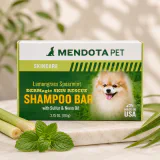 Anhydrous, no preservative system — €20.99
DERMagic Skin Rescue Shampoo Bar
View on dermagic.eu →
Anhydrous, no preservative system — €20.99
DERMagic Skin Rescue Shampoo Bar
View on dermagic.eu →
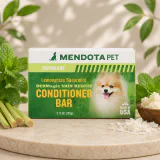 Also anhydrous — €26.99
DERMagic Skin Rescue Conditioner Bar
View on dermagic.eu →
Also anhydrous — €26.99
DERMagic Skin Rescue Conditioner Bar
View on dermagic.eu →Bought together as the bar pair, the two come to €37.99 against €47.98 separately — a saving of €9.99, about 21% at the sizes listed.
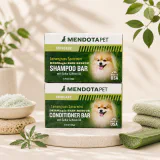 Both bars — €37.99, saving €9.99
DERMagic Shampoo + Conditioner Bar Combo
See the pair on dermagic.eu →
Both bars — €37.99, saving €9.99
DERMagic Shampoo + Conditioner Bar Combo
See the pair on dermagic.eu →Why “natural” preservatives are usually wrong for a dog
This is the one properly technical argument in favour of how we formulate, and almost nobody in the category makes it because it requires admitting that natural is not automatically better.
The fashionable paraben replacements in natural ranges are the organic acids — sodium benzoate and potassium sorbate. They share a limitation: they only work in acid. Benzoic acid is effective at roughly pH 2.5 to 4.5, sorbic acid at pH 3.5 to 6.0. Above that window the undissociated fraction that does the antimicrobial work collapses, and the preservative stops protecting the product even though it is still on the label.
Now put that against the animal. Canine skin is less acidic than human skin and much more variable — the best prospective measurement found a range of about pH 4.4 to 8.2 in adult dogs, varying by body site, sex and coat colour, with puppies markedly more acidic. A great deal of canine skin sits above pH 6, which is outside the window where benzoate and sorbate work properly.
So a leave-on product formulated to sit comfortably on a dog is often formulated outside the range where the “natural” preservative on its label is doing anything. That is a real, checkable, non-obvious problem with the natural-preservative pitch, and it is why our lotion pairs potassium sorbate with citric acid — the acid is there to hold the pH in the window where the sorbate works.
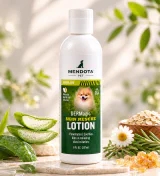 Preserved with potassium sorbate + citric acid — from €26.99
DERMagic Skin Rescue Lotion
View on dermagic.eu →
Preserved with potassium sorbate + citric acid — from €26.99
DERMagic Skin Rescue Lotion
View on dermagic.eu →Sodium lauryl sulfate
This section used to be wrong, and we have rewritten it twice. It originally reproduced a list of claims that has circulated since the 1990s — that SLS causes eye damage, depression, laboured breathing and even death, that it converts into carcinogenic nitrosamines, and that it lingers for five days in the heart, lungs, liver and brain. We should never have printed it. Why each part fails:
- The nitrosamine claim is chemically impossible. Sodium lauryl sulfate is CH₃(CH₂)₁₁OSO₃Na. It contains no nitrogen and no amine group, and forming a nitrosamine requires an amine. Nitrosamine formation in cosmetics is a real but conditional issue, and it attaches to amine-containing ingredients in the presence of a nitrosating agent such as nitrite — not to sulphates, and not unconditionally to any ingredient on its own.
- The “five days in the heart, lungs, liver and brain” line is a misreading of a 1975 rat percutaneous-absorption study.
- The catastrophic-harm list describes high-dose laboratory exposures, not a rinse-off shampoo.
On the name: the correct spelling is lauryl, not laurel, which is a tree. And SLS is not SLES — sodium laureth sulfate is the ethoxylated version, with a bigger head group and measurably less irritancy. Most pet shampoos that use a sulphate at all use laureth rather than lauryl.
What is actually true about SLS needs no exaggeration. It is a genuine, dose-dependent skin irritant — it is the substance dermatologists reach for when they need to provoke irritant dermatitis experimentally, which is both why there is so much data on it and why it is a poor choice in a leave-on. Safety panels consider it acceptable in products designed for brief use followed by thorough rinsing, and cap it at 1% in anything left on the skin.
Two numbers we got wrong while correcting this section
When we rewrote this page we replaced the folklore with what we described as the honest argument: that dog skin is thinner and more alkaline than ours. On going back to the primary sources, both halves were wrong, so they are withdrawn too.
- “A dog’s epidermis is three to five cell layers thick, ours is ten to fifteen.” The 3–6 layer figure is the living, nucleated epidermis — the wrong compartment for absorption. What governs absorption is the stratum corneum, and in the same 1982 study the canine stratum corneum averaged 47.5 cell layers, with intercellular lipid to a depth of 34 layers. That is more layers than human skin. Comparative absorption work has found total and peak absorption rates higher in humans than in dogs, with benzoic acid persisting on dog skin rather than crossing it faster — and benzoic acid is a close structural relative of the paraben metabolite, so it is about as relevant a comparison as exists. “Thinner, therefore more permeable” is not an overstatement of the evidence. It is the reverse of it.
- “Canine skin pH is 7.4–8.5.” A textbook range assembled from small heterogeneous studies. The best prospective measurement found pH 4.40–8.18 in dogs over twelve weeks and 3.97–5.70 in puppies. Less acidic than ours and far more variable is right; a tidy alkaline band is not.
What survives is bath frequency. A dog being treated for a skin condition is often washed two or three times a week — a far heavier detergent load than any human routine, on an animal whose barrier is already compromised. Choosing a milder surfactant system for that dog is a sensible formulation preference. There is no controlled trial comparing an SLS shampoo with a sulphate-free one in dogs, so that is as far as the claim goes.
We have also retired the old line “if it foams, it most likely contains SLS.” Plenty of products foam using glucosides and betaines instead — including our own liquid shampoo, which uses coco-glucosides and betaines and no sulphate at all. Read the label, including ours. There is a fuller treatment, including why sulphur and sulphates are unrelated substances, in sulphur: the healing mineral for pets.
And the awkward question about our own bars
If the argument against harsh detergents is partly about pH, a saponified soap bar sits at around pH 9 to 10 — more alkaline than the shampoos being criticised. We should address that rather than hope nobody notices.
The answer is that nominal pH matters much less for a rinse-off than contact time, buffering capacity and what the surfactant does to the barrier lipids. A bar lathered and rinsed within a couple of minutes behaves very differently from a leave-on at the same pH, and soap’s alkalinity is rapidly buffered by the skin. But it is a real tension in the argument, and anyone who tells you their alkaline soap bar is gentle because of pH has it backwards.
The dog data that does exist — and it points at the food bowl
There is real biomonitoring work on parabens in pets, and our old page used none of it.
A 2018 study measured parabens and their metabolites in pet food and urine. Dog food averaged about 1,350 ng/g; cat food slightly more at 1,550 ng/g. But dog urine averaged 7,230 ng/mL against 1,040 ng/mL in cats — roughly sevenfold more, from slightly less dietary exposure. The authors concluded that cats’ exposure was mostly dietary while dogs had substantial non-dietary sources.
Grooming products are a plausible candidate for that gap. They are not a demonstrated one: the study did not measure shampoo. We are flagging it as an open question rather than quietly converting it into support for our own range. Note also that about 99% of what was measured was already metabolite, which is strong evidence against the idea that parabens accumulate.
Cat hair studies published in 2026 detected methylparaben in virtually every cat sampled, and found indoor-only cats carried significantly more propylparaben than cats with outdoor access — consistent with indoor product sources. Those papers measured exposure only. No health outcome, no dose-response. Their own conclusions reach further than their data, and we are not going to inherit that.
One genuine interspecies concern, clearly labelled as untested. Cats are deficient in the glucuronidation pathway that handles phenolic compounds — the same deficiency behind feline sensitivity to paracetamol and phenols. The common paraben metabolite is phenolic. That makes a feline difference mechanistically plausible. It has never been tested for parabens in cats. Plausible and untested is the whole claim, and it is still more than anyone else in the category will tell you. If you are bathing a cat, our bath time for cats guide and the natural cat shampoo bar are the relevant pages.
The only documented case, and it is not what you would guess
Searching for published cases of dermatitis caused by a dog shampoo turns up essentially one report, from 2007. A woman in her forties had three episodes of acute facial swelling, each a day or two after visiting her mother’s house. Patch testing was positive to miconazole and econazole. Her mother’s dog was being bathed weekly in a miconazole antifungal shampoo.
So the only well-documented shampoo-related contact dermatitis in the literature occurred in the owner rather than the dog, and was caused by an antifungal drug rather than a preservative. That is the shape of the real-world risk, and it is almost the opposite of the story this page used to tell.
What to actually look for on a label
Less than you have been told, and different things.
- If your dog’s skin is broken or actively inflamed, the preservatives worth avoiding are the isothiazolinones — methylisothiazolinone, and increasingly benzisothiazolinone — followed by the formaldehyde releasers: quaternium-15, DMDM hydantoin, imidazolidinyl urea, diazolidinyl urea. All of them out-sensitise parabens in large human series, several by many times.
- Fragrance is a bigger allergen than any preservative, and “fragrance” includes essential oils. Natural does not mean non-sensitising — some of the better-documented contact allergens in cosmetics are botanical. That applies to our products too: our bars and liquids are scented with essential oils, and if your dog has reacted to scented products before, that is a reason for care regardless of whose bottle it is.
- A short ingredient list you can actually read is a better signal than the absence of any single ingredient.
- Ignore “chemical-free” entirely. Water is a chemical.
If the question underneath all this is simply what to wash an itchy dog with, the more useful pages are why is my dog so itchy and our comparison of soap, shampoo or shampoo bars.
Where this leaves our range
We make paraben-free, sulphate-free products, and we will go on doing it. What has changed is what we are willing to claim for it.
We cannot show you a dog that was harmed by a paraben. No such study exists, and after this review we think it unlikely that one would find much. What we can defend is narrower and real: the bars contain no water and therefore need no preservative system at all, and the organic-acid preservatives favoured in natural ranges are poorly suited to the pH at which dog skin actually sits. Those are formulation facts. They are not a reason to be frightened of anybody else’s shampoo.
For a dog with an active skin problem, the thing that matters is not which preservative is absent from the bottle but whether you are following a routine long enough to see a change. The full four-step system — wash, treat, restore, maintain — is set out in the Dermagic skincare system for dogs, and the bar version bundles all four steps together.
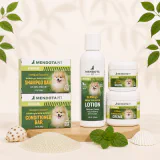 All four steps — €139.99
The DERMagic Bar System
View the full system on dermagic.eu →
All four steps — €139.99
The DERMagic Bar System
View the full system on dermagic.eu →
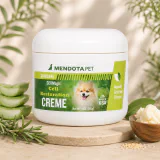 Step 3 — Restore, €45.99
DERMagic Cell Restoration Crème
View on Dermagic →
Step 3 — Restore, €45.99
DERMagic Cell Restoration Crème
View on Dermagic →
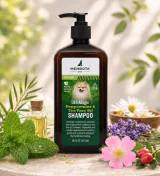 The liquid route — sulphate-free, €26.99
DERMagic Peppermint & Tea Tree Shampoo
View on dermagic.eu →
The liquid route — sulphate-free, €26.99
DERMagic Peppermint & Tea Tree Shampoo
View on dermagic.eu →A word of caution on that last one: peppermint and tea tree are not for cats. We used to justify that by saying cats “lack the enzyme pathways to clear those oils safely,” which was too loose. The accurate version: cats have an unusually limited capacity for glucuronidation, particularly of aromatic compounds, and EFSA’s FEEDAP Panel applies an extra fivefold uncertainty factor for cats on tea tree oil citing that trait by name — so this is a named mechanism rather than the bare precaution we called it in an earlier revision of this page. Two honest limits on it: EFSA was assessing the oil eaten in feed, not applied to skin, and the simpler reason to keep it off a cat needs no biochemistry at all — a cat grooms off and swallows whatever you put on its coat. What is separately established is a substantial record of tea tree poisoning in cats from concentrated oil. For cats, use the rosemary bar or the Chamomile & Sage option instead; the whole subject is set out in is tea tree oil safe for dogs and cats.
When to see a vet rather than read a label
Ingredient anxiety is a poor substitute for a diagnosis, and the reason this page exists at all is that people search for ingredients when they are worried about a symptom. If your dog is itching, losing hair, smelling different or developing sore patches, the shampoo aisle is not where that gets solved.
See a vet if there is hair loss, thickened or darkened skin, a sudden change in smell, repeated ear infections, sore weeping patches, or itching that stops the dog sleeping. Those point at allergy, parasites, yeast or hormonal disease, all of which need identifying before any topical is worth choosing. Our pages on canine atopic dermatitis and mites and mange cover what those investigations involve.
The short version
- No evidence links parabens to harm in dogs. There is no veterinary literature on the subject at all. We used to claim otherwise and we were wrong.
- The five “EU banned” parabens were delisted for missing safety dossiers, not demonstrated harm — and no EU paraben rule applies to pet products in the first place, because cosmetics law covers the human body only.
- Parabens are among the least sensitising preservatives in clinical use — about 1% positivity at a test concentration far above real-world use, against 12% for methylisothiazolinone. Dermatologists named them “(Non)Allergen of the Year” to make the point.
- The replacement was worse. MI caused a European allergy epidemic and had to be restricted twice; benzisothiazolinone is now climbing while total preservative allergy stays flat.
- Paraben-free is not preservative-free. Our bars genuinely need no preservative because they contain no water. Our lotion uses potassium sorbate with citric acid; our liquids use phenoxyethanol.
- “Natural” preservatives mostly do not work at canine skin pH, which is the one technical argument here that genuinely favours how we formulate.
- SLS is a real irritant but a marginal risk in a rinse-off, and the dog-skin-is-thinner argument we used to make for avoiding it does not survive the primary sources.
- Fragrance, including essential oil, is a bigger sensitiser than any preservative on these labels — ours included.
Further reading
- Sulphur: the healing mineral for pets — the ingredient page, and why sulphur is not a sulphate
- The Dermagic skincare system for dogs — the four-step routine
- Soap, shampoo or shampoo bars — formats compared
- Why is my dog so itchy? — start here if there is a symptom
- Bath time for cats — and why cat skin is a different problem
- Seborrhoea in dogs — flaking, greasiness and odour
For specific guidance email customerservice@dermagic.eu or call +44 7425 388643.