If you have landed here, there is a reasonable chance you have spent a while feeling vaguely guilty about your dog’s coat. The flaking that shows up on the sofa. The way the fur feels slightly tacky when you run a hand down the back. The odour that comes back a day after a bath, no matter how thoroughly you did it.
So let’s start with the reassuring part, because it is also the true part. A flaking or greasy coat is not a grooming failure. It is skin that is behaving differently at a cellular level — renewing its outer layer faster than it should and producing more oil than it should. Brushing did not cause that, and brushing alone will not switch it off. Some of the dogs with the most stubborn scaling have inherited differences in how their skin barrier is built, which is about as far from an owner’s fault as it is possible to get.
The second thing worth knowing is that the word itself is less informative than it sounds.
Seborrhoea is a sign, not a diagnosis
Seborrhoea describes what the skin is doing. It does not say why. That single sentence is the most useful thing on this page, because it changes what you go looking for.
When a vet or a dermatologist uses the word, they mean a visible state: scale coming through the coat, excess surface oil, or both together. The process underneath has a more precise name — a disorder of keratinisation, sometimes called a cornification disorder. The outer layer of skin normally renews itself on a steady schedule, shedding invisibly. In a seborrhoeic dog that schedule speeds up, so the shed cells clump into visible scale instead of disappearing. At the same time the sebaceous glands increase their output, and the composition of that oil changes.
That is a real, describable process. What it is not is an explanation. Two dogs with identical-looking flaking can have completely different things wrong with them, and the treatment that fixes one will do very little for the other.
This is where most of the frustration with flaky, greasy coats comes from. Owners treat the sign — a medicated wash, then a different medicated wash, then a supplement — and get a few good weeks each time before the coat goes back to how it was. The reason is almost always that the thing driving it was never identified.
Forget the dry-versus-greasy split
Older writing on this subject divides seborrhoea into neat categories: a dry, scaly type, an oily type, and an inflamed type. You will still find articles asking you to work out which one your dog has, as though the answer sets the treatment.
In practice most affected dogs show features of all three at once. Dry scale along the back, waxier skin in the armpits and groin, reddened irritated patches where the dog has been licking. Trying to sort a real dog into one box usually means ignoring two thirds of what is actually on the skin.
It is more useful to think of a spectrum, and to notice where your particular dog sits on it — because that does have one genuine practical consequence, which is whether you reach for something that degreases or something that softens and lifts scale. More on that further down. But you do not need to name a subtype to get started, and any guide that makes you feel you must is adding difficulty for no return.
What it looks and feels like
A rough checklist of what owners actually notice, in roughly the order they tend to notice it:
- Flaking visible in the coat, on bedding, or on dark clothing after a cuddle. It can be fine and dust-like or come away in larger plates.
- A change in how the coat feels — tacky, waxy, or slightly damp-feeling when it is dry. Hands feel faintly oily after stroking.
- A persistent odour that returns within a day or two of bathing. This is usually the symptom that finally prompts a search.
- Dull coat, sometimes with thinning, sometimes with a slightly clumped or matted quality where oil has gathered.
- Worst in the folds and the warm places — armpits, groin, neck folds, under the tail, between the toes, and inside the ears.
- Reddened or darkened skin in the areas the dog has been working at.
- Ear problems that keep recurring. The ear canal is lined with skin and carries the same oil glands, so a seborrhoeic dog very often has seborrhoeic ears. Our guide to dog ear care covers that side in detail.
- Itching — or notably little of it. Both happen, and which one you are looking at matters a great deal. We will come back to that under warning signs.
On the odour: it is worth saying that it does not mean your dog is dirty, and it does not mean you have been neglecting anything. Skin that produces more oil gives surface microbes more to live on, and their by-products are what you can smell. It is a consequence of the skin’s chemistry, and it resolves when the skin’s chemistry does. We wrote about the various sources of odour in dogs separately, because ears and skin folds account for far more of it than most owners expect.
The one distinction that actually changes the outcome
Veterinary dermatology splits seborrhoea two ways, and this split — unlike the dry-versus-greasy one — genuinely determines what happens next.
Primary seborrhoea means the skin’s keratinisation is abnormal in its own right. Usually inherited, usually breed-associated, present from a young age, and managed rather than cured.
Secondary seborrhoea means the skin is capable of behaving normally, but something else has pushed it out of pattern. Find and address that something, and the skin follows.
Secondary is far more common. That direction is well established and it is the single most important working assumption for any dog with a flaky or greasy coat: assume something is driving this, and that the something is findable.
What we cannot tell you is the proportion. You will see “eighty per cent of cases are secondary” stated with great confidence across pet websites, and it traces back to nothing — no study, no dermatology text, just repetition. We would rather say plainly that the proportion has never been properly measured than quote a number that sounds authoritative and isn’t.
What drives secondary seborrhoea
| Category | What it looks like | Notes |
|---|---|---|
| Hormonal | Scaling, dull oily coat, symmetrical thinning, weight change, often not very itchy | Underactive thyroid and overactive adrenal gland. The most commonly missed group, because the dog seems comfortable |
| Allergic | Itching first, scaling and greasiness following on | Environmental atopy and food-responsive disease. See atopic dermatitis and atopy versus allergy |
| Parasitic | Scale, irritation, sometimes a second affected pet | Surface mites, fleas, harvest mites, and mange |
| Microbial | Odour, redness, waxy build-up in folds and ears | Malassezia yeast and surface bacteria. Nearly always secondary themselves |
| Nutritional | Dull, dry, scaling coat; slow to change | Essential fatty acid or zinc shortfall. Responds on a two-month timescale, not a two-week one |
| Environmental | Seasonal or situational flaking | Low humidity, over-bathing with unsuitable products, clipping a coat that should not have been clipped |
| Immune-mediated | Crusting and pustules, often face, nose and ears | Pemphigus foliaceus and related conditions. Needs a biopsy |
| Neoplastic | Widespread scaling in an older dog, sometimes mouth involvement | Cutaneous lymphoma. See warning signs below |
| Metabolic | Crusting and ulceration at footpads and mucous membranes, unwell dog | Liver-associated skin disease. Uncommon and serious |
If your dog is scaling and you have not yet had thyroid function checked, that is often the highest-value single test on the list — particularly in a dog that is flaking without much itching.
Malassezia: real, important, and usually not the starting point
Almost every article on greasy dogs eventually says “it’s yeast.” There is something to that, and also a significant misunderstanding.
Malassezia is a normal resident of canine skin. It is there on healthy dogs. It is lipid-dependent, meaning it feeds on skin oils, which is why it concentrates in exactly the places seborrhoea shows up — folds, ears, between the toes.
When the skin starts producing more oil, the yeast has more to live on and multiplies. The inflammation that follows pushes the skin to produce still more scale and oil, which feeds the yeast further. That feed-forward loop is genuine, and it explains why seborrhoea and yeast overgrowth are found together so consistently.
But current international guidance is clear that Malassezia dermatitis is usually secondary to something else — an allergic, hormonal or keratinisation problem that opened the door. So the yeast is generally a passenger that has made itself very comfortable, not the driver.
The practical consequence: treating the yeast alone reliably produces a good few weeks followed by a return. That pattern — real improvement, then relapse — is one of the most useful clues you can bring to a vet, because it points at something underneath that has not been addressed. Our post on the signs of yeast overgrowth covers identification and confirmation.
One myth worth retiring while we are here: odour does not identify the organism. You will read that a sweet or yeasty note means yeast and something else means bacteria. Odour is a perfectly good reason to investigate — but a skin swab read under a microscope answers in minutes what a smell cannot answer at all.
When it is primary: the breed-linked keratinisation disorders
A minority of dogs have genuinely abnormal keratinisation from the start. These are worth knowing about because they change expectations: the goal becomes good long-term management rather than resolution, and topical care carries more of the weight.
Golden Retriever ichthyosis is the best characterised. It is caused by a specific gene variant, appears early, and produces large adherent scale, often with darkened skin. One point needs stating carefully: a study of Italian Golden Retrievers found roughly a fifth of tested dogs carried the affected genotype, but among breeding dogs only a small handful showed actual signs. Carrying the variant is not the same as having the disease, and anyone telling you one in five Goldens has ichthyosis has quietly swapped one for the other. We cover the breed’s wider picture in skin conditions in Golden Retrievers.
Sebaceous adenitis is an inflammatory condition that destroys the sebaceous glands themselves, seen particularly in Standard Poodles, Vizslas, Akitas, Samoyeds, Havanese, English Springer Spaniels and Dachshunds. It produces tightly adherent scale that clings to hair shafts, patchy hair loss and a dull coat. There is no definitive treatment evidence for it, but it is the one condition on this page where topical oils and emollients have the strongest rationale — the skin has lost its own oil-producing apparatus, so replacing that externally is addressing the actual deficit rather than working around it.
Zinc-responsive dermatosis comes in two quite different forms. One is an inherited absorption problem in northern breeds, notably Siberian Huskies and Alaskan Malamutes, which needs lifelong supplementation. The other appears in rapidly growing puppies on an unbalanced diet and resolves when the diet is corrected. They look similar and are managed differently.
Vitamin A-responsive dermatosis in Cocker Spaniels is frequently listed as established. In honesty it rests largely on a case report of three dogs from 1983, so it is a real possibility to raise with a dermatologist rather than a settled fact.
One correction worth making: the condition once described in West Highland White Terriers as “epidermal dysplasia” or “armadillo Westie syndrome” is increasingly regarded as severe atopic dermatitis with heavy Malassezia colonisation rather than a distinct primary disorder. Not every dermatologist agrees that the original label should be retired entirely, but the practical consequence is the useful part: allergy and yeast management is the right place to start, rather than treating the dog as having an untreatable genetic condition. Severe cases can still remain stubborn. We work through the evidence, including the published specialist dissent, in West Highland White Terrier skin problems.
What topical care genuinely does — and what it doesn’t
This is the section where we are going to undersell our own products slightly, because the alternative is telling you something that will not hold up over the next three months.
Topical therapy is the mainstay of symptomatic control. It physically removes scale, reduces surface oil, lowers microbial numbers and makes the dog more comfortable, and it does all of that faster than anything taken by mouth. For a dog that is uncomfortable now, it is the right first move.
What it is not is a treatment for seborrhoea as a condition, because in most dogs the condition is being driven by something a shampoo cannot reach. The honest description of what standard antiseborrhoeic shampoos achieve on their own is relief for a few days at a time. That is genuinely useful — it is also exactly why bathing frequency, rather than shampoo choice, turns out to be the variable that matters most.
The best trial evidence in this area, for what it is worth, is for chlorhexidine-based washes, with or without miconazole — studied in Basset Hounds in the 1990s and in a larger group of dogs in 2011. Neither is a Dermagic product. We would rather you knew that than discovered it later.
On sulphur, and where its limits are
Sulphur has a long and legitimate history in veterinary skin care, and we use it. It is recognised as antiseborrhoeic, keratolytic and keratoplastic — meaning it both loosens existing scale and helps normalise how the outer skin layer forms — and it has activity against bacteria, yeast and some parasites. Among everything in our range, it is the ingredient with the strongest claim to a real mechanism. We wrote about it at length in sulphur, the healing mineral for pets.
Three limits belong in the same paragraph as the claim:
- No controlled trial has tested elemental sulphur alone in dogs. Its standing rests on long clinical use and on combination products, classically sulphur paired with salicylic acid. The lime sulphur evidence sometimes cited in its favour is a different substance used a different way — a leave-on dip that stays on for around an hour — so it does not transfer.
- There is no salicylic acid in our range. The textbook synergy between the two is therefore not something we can offer. The willow bark extract in our peppermint shampoo is a weak natural salicylate and is not a substitute for it.
- Sulphur is pointed at scaling, not at grease. Established guidance directs sulphur-containing products at the scaly, flaking presentation; a heavily oily coat is better served by something that degreases.
So the honest positioning of what we make is: well matched to dry, flaking, scaling skin, and a weaker fit for the very greasy dog. That is also why we would steer you away from applying a rich, lipid-based lotion to a greasy coat that is colonised with yeast — the yeast is lipid-dependent, so on that particular dog a heavy oil is working against you. It is the right product on the wrong skin.
The products, matched honestly
For the flaking, scaling dog — the presentation sulphur actually suits — the wash is the place to start. Our shampoo bar is a saponified soap-based bar carrying sulphur alongside neem, aloe and vitamin E.
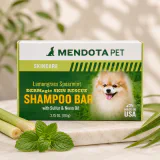 Sulphur-based wash for scaling, flaking skin
DERMagic Skin Rescue Shampoo Bar
Shop on dermagic.eu →
Sulphur-based wash for scaling, flaking skin
DERMagic Skin Rescue Shampoo Bar
Shop on dermagic.eu →One caveat we would rather state ourselves: the lemongrass and spearmint in it are there for scent and are not antiseborrhoeic actives, and essential oils carry some potential to sensitise. If your dog has reacted to scented products before, that is a reason for care.
For dry, adherent scale — and particularly for a dog whose oil glands are underperforming rather than overperforming, as in sebaceous adenitis — a leave-on emollient is the step that does the most work. This is a lipid-rich lotion with sulphur, sesame oil, lanolin, shea butter and aloe.
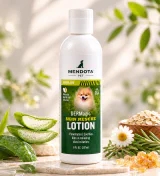 Leave-on emollient for dry, adherent scale
DERMagic Skin Rescue Lotion
Shop on dermagic.eu →
Leave-on emollient for dry, adherent scale
DERMagic Skin Rescue Lotion
Shop on dermagic.eu →For stubborn plated scale on the trunk, a mechanical exfoliant has a place before the wash. Our salt scrub is exactly that and nothing more — Epsom and Dead Sea salts, bicarbonate, diatomaceous earth. There is no keratolytic active in it; the effect is physical lifting. Worth knowing on both counts: the evidence behind Dead Sea salts concerns bathing in a salt solution rather than scrubbing granular salt onto skin, and a scrub is not appropriate on skin that is inflamed, broken or infected.
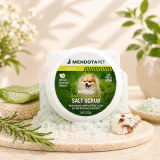 Mechanical lift for plated scale — not for broken skin
DERMagic Anti-Dandruff Salt Scrub
Shop on dermagic.eu →
Mechanical lift for plated scale — not for broken skin
DERMagic Anti-Dandruff Salt Scrub
Shop on dermagic.eu →For the greasier end of the range, a liquid shampoo lathers and rinses more thoroughly through a dense oily coat than a bar does, which is a practical rather than a pharmacological advantage.
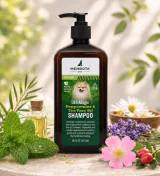 Liquid wash for oilier coats
DERMagic Peppermint & Tea Tree Shampoo
Shop on dermagic.eu →
Liquid wash for oilier coats
DERMagic Peppermint & Tea Tree Shampoo
Shop on dermagic.eu →And because increased bathing frequency is the single highest-value change most owners can make, a conditioning step afterwards stops that frequency causing a problem of its own.
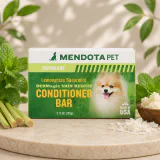 The step that makes frequent bathing sustainable
DERMagic Skin Rescue Conditioner Bar
Shop on dermagic.eu →
The step that makes frequent bathing sustainable
DERMagic Skin Rescue Conditioner Bar
Shop on dermagic.eu →Because the ears are lined with the same skin and carry the same glands, a seborrhoeic dog very often has waxy, recurring ear trouble alongside everything else, and it needs its own product rather than shampoo.
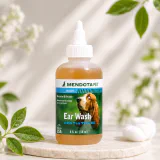 For the waxy ears that come with a seborrhoeic coat
DERMagic Ear Wash
Shop on dermagic.eu →
For the waxy ears that come with a seborrhoeic coat
DERMagic Ear Wash
Shop on dermagic.eu →If your dog is scaling and flaking, the three steps that work together — wash, leave-on lotion, and salve for the raw patches the dog has worked at — are bundled as the Skin Essentials System. Bought separately those come to €72.97 at current prices; the kit is €58.99, which is a saving of just under €14. We set out the full protocol here.
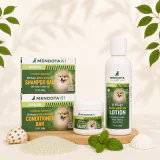 Wash, lotion and salve together — €58.99 rather than €72.97
DERMagic Skin Essentials System
Shop on dermagic.eu →
Wash, lotion and salve together — €58.99 rather than €72.97
DERMagic Skin Essentials System
Shop on dermagic.eu →A bathing routine that actually works
Three things about washing a seborrhoeic dog, and the first one is the opposite of what most owners have been told.
Wash more often, not less. The instinct that washing strips protective oils and makes things worse is intuitive, widely repeated, and wrong for this kind of skin. Washing is the treatment: it removes scale, surface oil and microbial load in a way that nothing else does. The pattern used in practice is two to three baths a week while getting on top of things, easing to once or twice a week to hold the result. If dryness follows, the answer is to add conditioning afterwards — not to reduce frequency. We corrected our own older advice on this point, and it is worth reading alongside our autumn and winter guide, which deals with the same myth in its seasonal form.
Get the product to skin, and stop watching the clock. Nearly every instruction leaflet specifies ten minutes of contact time. A 2026 study comparing three minutes against ten found no meaningful difference — small work, eighteen healthy dogs, partly conducted on hair samples rather than live dogs, so treat ten minutes as probably unnecessary rather than definitively disproven. What genuinely matters is contact: lather worked down through the coat until it is against skin, over the whole dog, rather than washed across the top of the coat and rinsed straight off. A few unhurried minutes of that beats ten distracted ones.
Dry properly. A dense coat holds water for hours, and moisture is a recognised predisposing factor for both yeast overgrowth and ear infection. Dry to the skin, not merely to the touch. If you are choosing between products, bars versus liquid shampoos covers the practical trade-offs.
One more, which is about brushing rather than washing: regular brushing does more for a scaly coat than most owners expect, because it lifts loose scale mechanically and distributes what oil there is. It will not treat the underlying condition. It will noticeably change how the dog looks and feels between baths.
Diet and supplements: modest, real, and slow
The nutritional angle is oversold almost everywhere, so here is a calibrated version.
Essential fatty acids are the reasonable general bet. The canine evidence is genuinely thin — the most cited work is a small, old study using oral sunflower oil over thirty days — so this sits at plausible rather than proven. Fatty acids are also worth taking for reasons beyond the coat, and the downside risk is low. What they are not is fast: coat quality responds to nutrition over roughly two months. Judge it at six to eight weeks, not at two.
 Six to eight weeks before you judge it
Retrieve Skin & Coat Omega 3, 6 & 9
Shop on dermagic.eu →
Six to eight weeks before you judge it
Retrieve Skin & Coat Omega 3, 6 & 9
Shop on dermagic.eu →Zinc works, but only in dogs who actually have a zinc-responsive dermatosis. In a dog with normal zinc status it does nothing for the skin. Same for vitamin A, which helps in the specific vitamin A-responsive condition and not otherwise.
And a real negative result worth knowing, because it saves money: synthetic retinoids were tested in primary seborrhoea in Basset Hounds and West Highland White Terriers and did not work. When something has been tried and failed, that is more useful information than a hopeful claim.
Things that do not help, and one that makes it worse
- “It’s just dry skin.” Sometimes it genuinely is low humidity. Often it is a keratinisation disorder with a driver behind it, and the phrase is how hormonal disease goes unnoticed for a year.
- Washing less. Covered above. This is the single most common counterproductive piece of advice on the subject.
- Olive oil or coconut oil on the coat. This one is mechanistically backwards: Malassezia is lipid-dependent, so adding oil to a colonised coat gives the yeast more of exactly what it feeds on.
- Brewer’s yeast. No evidence for seborrhoea. It persists because it sounds related to yeast infection, which it is not.
- Clipping a greasy dog. It changes how the grease looks, not how much there is, and on a double-coated dog it brings problems of its own — see whether to shave a double-coated dog.
- Washing-up liquid to cut the grease. Effective at degreasing and harsh on an already compromised skin barrier. The short-term result looks like progress.
- “Flaking means the dog is dehydrated.” Scale is a turnover phenomenon, not a hydration one. Water intake is worth watching for a different reason — a sudden increase is a hormonal warning sign.
- Assuming it is contagious. It generally is not, with the two exceptions in the next section.
- Raw feeding as a treatment. Whatever else is argued for it, there is no evidence it treats seborrhoea.
We would also gently flag that steroids are not the answer to a flaky coat, even though they often calm it impressively for a fortnight. Why we advise against reaching for them goes into the reasoning.
Warning signs: when this needs a vet, not a shampoo
Most flaky, greasy dogs are dealing with something common and manageable. A minority are not, and the signals are fairly specific.
Scaling without much itching is the single most useful red flag. An itchy, flaky dog usually has allergy, parasites or microbial overgrowth. A dog that is visibly scaling and largely comfortable is a dog whose skin is being altered from the inside — and that list is more serious.
Specifically, see a vet if you notice:
- Scaling with little or no itch, especially alongside weight change, drinking more, lethargy, or symmetrical thinning of the coat. This is the hormonal pattern.
- A whitish, adherent scale over the trunk and head in a dog that has spent time in southern Europe. Exfoliative skin disease is the most common skin sign of canine leishmaniasis — present in around three-quarters of affected dogs — it is usually not itchy, and it is answered by a blood test, not a shampoo. Hair loss around the eyes is the pattern that earned its own name, but it appears in only about a quarter to a third of cases, so its absence rules nothing out. Our guide to hair loss without itching covers the full differential and the travel history that makes testing worthwhile.
- Widespread scaling and reddening in an older dog, particularly with changes at the lips, gums or nose. Cutaneous lymphoma typically appears around eleven years of age and needs a biopsy — a swab is not enough to find it.
- Crusts, pustules or sores at the nose, lip margins, ear tips or footpads. Immune-mediated disease looks different from seborrhoea once you know to look, and it also needs a biopsy.
- A second affected pet, or an itchy rash on a person in the household. That points at Cheyletiella — the surface mite nicknamed walking dandruff, which produces large, sometimes visibly mobile scale — or at ringworm. Both spread, both are treatable, both get dismissed as ordinary dandruff.
- Ulceration at the footpads and mucous membranes in an unwell dog. Uncommon, liver-associated, and urgent.
- No clear improvement after three to four weeks of consistent, appropriate topical care. This is the most actionable line on the page. At that point the answer is not a different shampoo. It is a diagnostic work-up — skin cytology, a thyroid panel, a parasite check — and it will usually find something.
What to actually do next
- Take a photograph today, including a close-up of the skin with the coat parted. Six weeks from now you will not remember accurately, and photographs settle the question.
- Work out where your dog sits on the dry-to-greasy range. It is the one thing that changes which product to start with.
- Start washing more often, not less — two to three times a week — with a conditioning step afterwards.
- Add a leave-on emollient if the picture is dry and scaling; hold off on rich oils if the coat is heavily greasy.
- Deal with the ears separately. They will not resolve on shampoo alone.
- Book a vet appointment if there is little itch, if anything on the warning list applies, or if three to four weeks of consistent care has not moved things.
- If nutrition is part of the plan, give it six to eight weeks before forming a view.
And keep hold of the framing that makes all of this easier to manage: seborrhoea is what the skin is doing, not the reason it is doing it. The dogs who get genuinely better are the ones whose owners kept asking why.
Related reading
- Why is my dog so itchy? — the itch-first companion to this page, organised by where the dog is scratching
- Why does my dog smell? — the sources of odour, ears and folds included
- Top signs of yeast overgrowth in dogs — identifying and confirming Malassezia
- Sulphur, the healing mineral for pets — the ingredient behind most of our range
- The Dermagic skincare system for dogs — the full four-step protocol
- Dog ear care — because seborrhoeic skin usually means seborrhoeic ears
- Autumn and winter dog skin care — seasonal flaking, and the bathing myth in its winter form
- Hair loss without itching — the hormonal picture in more detail
- Where to buy Dermagic in Europe — shipping and availability
Updated September 2026. This article is general information and not a substitute for veterinary diagnosis. If your dog is scaling without itching, or is unwell in any other way, please see a vet.