Soap, liquid shampoo, or a solid shampoo bar — what’s the difference, and what should you actually use on your dog? A short history, an honest look at the ingredient lists, and a sensible answer.
What the customer wants vs. what the manufacturer wants
We want to get our pets clean without irritating or drying out their skin. We want a healthy, shiny coat. We don’t want to spend a fortune, we’d like it to be greener if possible, and we’d prefer the bottle wasn’t another piece of plastic going into landfill.
That’s the customer’s view.
The manufacturer’s view is different. Mass-market shampoo brands need production costs as low as possible, dilution ratios as high as possible, competitive price points, multiple “flavours” to occupy maximum shelf space, and high profit margins. Most shampoos on the supermarket shelf are not built around what we want or need — they’re built around what’s cheap to make and easy to sell.
So let’s go a little deeper. What’s actually in soap, what’s in shampoo, and what’s the difference?
A very short history of soap
Soap is roughly 5,000 years old. The first soap-like substance was reportedly made in Babylon from animal fat (tallow) and stored in a clay cylinder — almost certainly an accidental discovery, and one the entire world should be grateful for. (Imagine being stuck in a lift with strangers who’d never encountered soap.)
Humans, being inventive, ran with it. Over the millennia we’ve produced:
- Castile soap — made with olive oil
- Floating soap — whipped through with air bubbles
- Glycerine soap
- French-milled, scented, soap-on-a-rope, and dozens more variations
In 1865, William Shepphard patented liquid soap. It took another century to reach the mainstream — Minnetonka Corporation introduced liquid soap to consumers in 1980 and held a near-monopoly for years by buying up the entire supply of the plastic pumps needed to dispense it.
Colgate Palmolive eventually bought Minnetonka’s liquid soap business, and an industry was born: liquid hand soap, liquid dishwasher detergents, liquid shampoos, liquid cleaners of every kind. Including the bottles of dog, cat and horse shampoo lining the shelves today.
What’s actually in liquid soap?
Here’s a typical ingredient panel from a major manufacturer’s liquid soap:
Water, Ammonium C12-15 Pareth Sulfate, Magnesium Isododecylbenzenesulfonate, Lauramidopropylamine Oxide, SD Alcohol 3-A, Sodium Xylenesulfonate, Sodium Chloride, Fragrance, Pentasodium Pentetate, DMDM Hydantoin, Sodium Bisulfite, D&C Orange No. 4, Triclosan 0.12%.
Read it aloud. Does it make you want to smear it on yourself?
What’s in a typical liquid shampoo?
Here’s a popular shampoo from the same major company:
Water, Ammonium Lauryl Sulfate, Ammonium Laureth Sulfate, Sodium Chloride, Cocamide MEA, Glycol Distearate, Dimethicone, Fragrance, Panthenol, Panthenyl Ethyl Ether, Cetyl Alcohol, Polyquaternium-10, Sodium Citrate, Sodium Benzoate, Ammonium Xylenesulfonate, Disodium EDTA, PEG-7M, Citric Acid, Methylchloroisothiazolinone, Methylisothiazolinone.
You be the judge of the difference. Both are essentially synthetic detergent systems with added perfume, dye and preservative.
What’s in a good old-fashioned bar soap?
Here’s one of the top-rated traditional soaps:
Saponified Coconut and Palm oils, Sage Extract, Rosemary Extract, Ascorbyl Palmitate, Lemongrass Oil.
Bear in mind that plenty of commercial bar soaps still contain a long list of synthetic ingredients. But genuinely good-quality soaps are simple — a handful of ingredients, most of them recognisable as plants or oils.
The principle
If you’re going to put something on or in your pet, you should feel obligated to understand what those things are and what they do.
One caveat we have added to that, having since done the work. “Short list of recognisable things” is a decent heuristic for a dog shampoo, for reasons that are specific to dogs: the coat is hard to rinse clean, the dog licks what is left, and a dog with skin disease gets bathed two or three times a week rather than occasionally. What it is not is a safety test. An ingredient is not dangerous because it has four syllables, and some of the short, natural-sounding ingredient lists in this category are less well characterised than the long chemical ones. Parabens are the clearest example — we spent years listing them as something to avoid, and the evidence does not support that. Parabens and SLS in dog shampoo sets out what we got wrong and what the replacements cost.
For a dog with sensitive skin or an active skin condition, the choice is straightforward. A clean shampoo bar — or a sulphate-free liquid shampoo built on plant oils — does the cleaning job without stripping the skin’s defences. A typical supermarket dog shampoo is just a detergent in a plastic bottle.
Until next time, keep it clean.
 Start the treatment
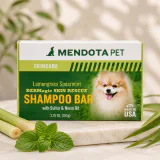
DERMagic Skin Rescue Shampoo Bar
Shop on dermagic.eu →
For help choosing the right shampoo for your dog’s skin, email customerservice@dermagic.eu or call +44 7425 388643.