Sulphur is the oldest active ingredient in skin medicine, and the most misunderstood. This page explains what it is, what it does to skin, what the evidence supports — and, in three places, what we used to say about it that was wrong.
Start here: we have corrected this page
This is the most-read page on the Dermagic Journal, which makes it the one with the least excuse for being loose. It was written in 2013 and it carried several claims that do not survive checking. Rather than quietly edit them out, here is the list:
- “Toxic to the scabies mite — direct topical kill.” Withdrawn. There is no canine evidence for it, and “direct topical kill” was an invented mechanism.
- “Pure elemental sulphur can be taken internally as a mild laxative.” Removed outright. It is obsolete Victorian materia medica and it has no place on a page that sells a sulphur lotion.
- The sulphate chemistry was wrong — it confused sulphur oxides with sulphates, described a reaction that does not happen in open air, and called sulphates caustic when most of them are inert.
- “Most pet shampoos contain SLS.” Withdrawn as unsupportable. Nobody has surveyed this, so the figure was ours to invent, and we should not have.
Everything below is what we can stand behind. Where the honest answer is “nobody has measured this in dogs”, that is what it says.
Part one: what sulphur actually is
Sulphur is element 16 — a bright yellow, brittle, crystalline solid, existing at room temperature as an eight-atom ring, S₈. It has been used on skin for at least two thousand years.
The fine yellow powder used in skin preparations has a proper name, and we have been spelling it wrong for years across this site. It is flowers of sulphur — flores sulphuris to the old apothecaries, also called sublimed sulphur — produced by subliming sulphur vapour straight to a powder without passing through a liquid phase. Several of our older posts called it “florets of sulphur”. Flowers, not florets. We have fixed those too.
Sulphur is unusual among the actives in cosmetic skincare in that it has a real, specific, long-documented interaction with skin. It is not a botanical with a hopeful mechanism. Among everything in our range, it is the ingredient with the strongest claim to doing something physical and describable.
That is also the reason it deserves a sceptical page rather than an enthusiastic one.
Part two: sulphur is not a sulphate
This is the confusion that brings most people to this page, and the old version of this page got the chemistry wrong while trying to explain it.
A sulphate is one specific ion: SO₄²⁻, the conjugate base of sulphuric acid. That is the whole definition. It is not a family of scary compounds, and it is not what you get by burning sulphur.
Three corrections to what we used to print:
Sulphur dioxide and sulphur trioxide are not sulphates. Burning sulphur in air gives SO₂, sulphur dioxide. These are oxides. Calling them sulphates was simply an error.
The reaction we printed does not happen in open air. We had 2 SO₂ + O₂ → 2 SO₃ as though it were a step in ordinary combustion. It is thermodynamically favourable but kinetically negligible without a catalyst — industrially it requires vanadium(V) oxide at 400–450 °C, which is the Contact Process for making sulphuric acid. Burning sulphur gives you essentially all SO₂ and only traces of SO₃. In the atmosphere, SO₂ becomes sulphate by a different route: oxidation by the hydroxyl radical in the gas phase, and by hydrogen peroxide and ozone inside cloud droplets. The acid rain point stands — sulphate aerosol from sulphur dioxide emissions is a genuine contributor — but the chemistry we used to explain it did not.
Sulphates are not caustic. This is the correction that actually matters, because the scare framing was doing us no favours. Sulphate salts are overwhelmingly inert and several are household objects:
| Sulphate | What it is |
|---|---|
| Magnesium sulphate | Epsom salts — people soak in it |
| Calcium sulphate | Gypsum, plaster of Paris |
| Sodium sulphate | Glauber’s salt, a detergent filler |
| Barium sulphate | Swallowed as a radiographic contrast agent |
Corrosivity belongs to concentrated sulphuric acid, not to sulphate. Sulphate itself is about as threatening as the inside of a plaster cast.
And sodium lauryl sulfate is not made by burning sulphur either. It is an organosulphate — a sulphate ester of lauryl alcohol, made by sulphating coconut- or palm-kernel-derived lauryl alcohol and neutralising with alkali. The implied lineage of “burn sulphur, get sulphates, therefore SLS” was wrong at every arrow.
The analogy our original page used was the good part, so it stays: sulphur is to sulphate roughly as the free nitrogen in the air you breathe is to the nitrate in nitric acid. Same element, different world.
So when a bottle says “sulphate-free”, it means it omits one family of detergents that happen to be built on a sulphate ester group. It is not a statement about the element sulphur, and it is not a statement about sulphate, which is harmless.
Part three: SLS — what is true, and what we were overstating
We do not use sodium lauryl sulfate. We would rather justify that properly than scare you into it.
First, the name. The correct INCI name is sodium lauryl sulfate. “Laurel” is a tree; we had it wrong, as does most of the pet trade. And SLS is not SLES: sodium laureth sulfate is the ethoxylated version, with a larger head group and measurably less irritancy. These get used interchangeably in marketing and they should not be.
Second, a line we are deleting. The old page pointed out that SLS appears in engine degreasers, floor cleaners and car wash soaps. That is literally true and logically empty. SLS is a general-purpose surfactant used anywhere from about 0.01% to 50%, so what it is in tells you nothing without the concentration. It is a concentration fallacy, it is exactly the argument we would mock if a competitor used it about one of our ingredients, and it undermines the credibility of all the true things next to it. Gone.
Third, the irritation claim, reported properly. We used to say SLS “irritates facial skin with prolonged exposure of more than an hour”. The source is Marrakchi and Maibach, 2006 — 2% aqueous SLS applied under occlusion for exactly one hour to facial sites in ten young and ten elderly volunteers. Every facial site and the neck reacted; the forearm did not. The finding is about regional and age-related differences in human facial skin in twenty people. It is not a study about shampoo, and we were dressing it up as one.
What the safety panels actually conclude is the fair thing to quote: SLS is considered safe in products designed for brief use followed by thorough rinsing, and should not exceed 1% in products intended for prolonged skin contact. It is an irritant on patch testing at 2% and above, dose-dependently. It is, in fact, the reference irritant — the substance researchers reach for when they need to provoke irritant dermatitis on purpose, which is both why there is so much data on it and why it is a poor choice in a leave-on product.
So is SLS a real risk in a rinse-off dog shampoo? Honestly: marginal, and we were overstating it. There is no controlled trial of an SLS shampoo against a sulphate-free shampoo in dogs.
A correction we have made to our own correction. This section used to make that case with two numbers about dog skin, and on going back to the primary sources, both were wrong. We are leaving the correction visible rather than quietly editing it.
- We said “a dog’s epidermis is three to five cell layers thick, ours is ten to fifteen”, with the implication that thinner skin absorbs more. The 3–6 layer figure (Lloyd and Garthwaite, 1982) is the living, nucleated epidermis — the wrong compartment. What governs absorption is the stratum corneum, and in the same study the canine stratum corneum averaged 47.5 cell layers, with intercellular lipid present to a depth of 34 layers. That is more layers than human skin, not fewer. Worse for our old argument, comparative percutaneous-absorption work found total absorption and peak absorption rates higher in humans than in dogs, with benzoic acid lingering on dog skin rather than crossing it faster. “Thinner, therefore more permeable” is not an understatement of the evidence — it is the opposite of it.
- We said canine skin pH is “7.4–8.5”. That is a textbook range assembled from small heterogeneous studies. The best prospective measurement (Schlake and colleagues, 2022, 77 client-owned dogs) found pH 4.40–8.18 in dogs over twelve weeks old and 3.97–5.70 in puppies, varying by body site, sex and coat colour. Canine skin is less acidic than ours and much more variable — which is a real difference, but not the tidy alkaline number we published.
What actually survives. One thing, and it is enough: a dog being treated for a skin problem is frequently bathed two or three times a week, which is a far higher detergent frequency than any human hair-washing routine, and the dogs on that schedule are the ones whose barrier is already compromised. Choosing a milder surfactant system for that animal is a sensible formulation preference. It is not a measured risk, there is no trial, and we are no longer going to dress it up as physiology.
One of the corrected facts actually helps a related argument — see parabens and SLS in dog shampoo, where canine skin sitting above pH 6 is the reason the fashionable “natural” preservatives work poorly on a dog.
And the claim we withdraw: “most pet shampoos contain SLS.” No published survey quantifies surfactant prevalence in pet shampoo, so any “most” figure is unsupportable in either direction. Checking real labels: Malaseb uses decyl polyglucoside and no sulphate at all; Douxo S3 SEB uses sodium laureth sulfate plus cocamidopropyl betaine; the UK mass-market medicated shampoos generally use laureth rather than lauryl. Sulphate detergents are alive at the value end, premium and veterinary lines have largely moved to glucosides and betaines, and SLS specifically is now uncommon in pet shampoo. Read the label — including ours.
Part four: sulpha drugs and sulphites
This is the strongest section on the page, in the sense that the evidence is unambiguous and it reassures people who need reassuring.
Sulpha drugs — sulphonamides — are antibacterial medications built around an R-SO₂-NH₂ group. Sulpha allergy is common and real in people. But the allergenic parts of the molecule are the N1 and N4 substituents, particularly the N4 arylamine of the antibiotic sulphonamides. The allergy is not to the sulphur.
The study that settles it is Strom and colleagues, New England Journal of Medicine, 2003. Using a large general-practice database, they found that patients with a sulphonamide-antibiotic allergy did go on to react to unrelated non-antibiotic sulphonamides at a rate of 9.9% — but patients with a penicillin allergy reacted to those same non-antibiotic sulphonamides at 14.2%. A higher rate, from an unrelated drug class. The apparent cross-reactivity is just a general allergic predisposition, and the structural argument collapses.
Sulphites are different chemistry again, with a different mechanism. Sulphite sensitivity is largely non-IgE and shows up as asthma exacerbation in roughly 4–5% of asthmatics. Allergy guidance is explicit that patients allergic to sulphonamides need not avoid sulphates, sulphites, or sulphydryl drugs.
So: a sulpha allergy does not imply sulphur sensitivity. One honest caveat, because a careful reader will find it: some human sulphur topical labels do list “hypersensitivity to sulfur or sulfonamides” as a contraindication. That is defensive labelling convention, not evidence of cross-reactivity, and we would rather say so than pretend the line is not there.
Worth adding for a dog audience: potentiated sulphonamides genuinely do cause idiosyncratic hypersensitivity in dogs — dry eye, liver injury, polyarthropathy and blood dyscrasias, with Dobermanns over-represented. If your vet has told you “no sulpha drugs for this dog”, that is a real instruction. It simply has nothing to do with a sulphur lotion.
Part five: what sulphur does on skin
Here is the mechanism, with the line between known and assumed drawn where it belongs.
The established chemistry. On contact with skin, sulphur reacts with cysteine in keratinocytes to form cystine and hydrogen sulphide. At skin pH, essentially all of it is present as H₂S. That gives a coherent, dose-dependent account:
- At low concentration, keratoplastic — the cystine formation appears to promote normal cornification, along with a direct cytostatic effect on the basal layer. In plain terms: it nudges the outer skin layer toward forming properly.
- At higher concentration, keratolytic — enough hydrogen sulphide accumulates to cleave the disulphide bonds holding dead surface cells together, so scale lifts and sheds.
The antifungal and antiparasitic activity attributed to sulphur is thought to come from its conversion to pentathionic acid by keratinocytes and skin bacteria. The antibacterial action is attributed to inactivating sulphydryl groups in bacterial enzymes.
The assumed part. All of the above is mechanistic reasoning built on in-vitro chemistry rather than measurement on living dogs. A 2025 narrative review states plainly that the antiparasitic mechanism “has not been clarified”. And critically: the concentration at which sulphur crosses from keratoplastic to keratolytic has never been determined in dogs. Nobody can tell you what a canine lotion at a given percentage is actually doing to the skin.
Which brings up something we are not going to do. We do not publish the sulphur percentage in our lotion, and until we can state it from the specification rather than estimate it, we are not going to describe our own products as keratolytic or keratoplastic. Below the keratoplastic range, a sulphur lotion is an emollient with sulphur in it. That is still useful. It is just not the same claim.
Part six: the evidence, graded honestly
The best controlled trial of sulphur on skin is Leyden and colleagues, Cutis, 1987. Forty-eight subjects with moderate-to-severe scaling, double-blind, four arms — 2% sulphur with 2% salicylic acid, 2% sulphur alone, 2% salicylic acid alone, and vehicle alone — shampooed under supervision twice weekly for five weeks, scored on clinical scaling and on corneocyte counts. The combination produced significantly greater and earlier reductions than either agent alone or vehicle. That trial is the origin of the textbook sulphur-and-salicylic-acid synergy.
Veterinary consensus points the two ingredients at a specific kind of dog: tar for the oily seborrhoeic coat, sulphur and salicylic acid for the scaly one. We have previously written that sulphur is for scaling rather than grease, and that is right about what sulphur is not — it is not a degreaser. But the standard veterinary wording covers “moderate to marked scaling and mild to marked oiliness”, so “sulphur is only for bone-dry dogs” overshoots. The accurate position: sulphur’s indication is scaling; it tolerates some greasiness alongside it; it is not the answer for a markedly greasy dog.
Three limits belong in the same breath as the claim, and they have not changed:
- No controlled trial has ever tested elemental sulphur alone as a topical in dogs. The nearest controlled evidence is human — Leyden’s sulphur-alone arm, in people, outperformed by the combination.
- There is no salicylic acid anywhere in the Dermagic range. The synergy Leyden demonstrated is therefore not something we can offer, and the willow bark in our peppermint shampoo is a weak natural salicylate rather than a substitute.
- The comparators with real canine trial data are not ours. For yeast-prone skin, international veterinary consensus awards strong evidence to 2% chlorhexidine with 2% miconazole, twice weekly. For superficial bacterial skin infection, 4% chlorhexidine shampoo has been found non-inferior to systemic antibiotics. Neither is a Dermagic product. We would rather you knew that than discovered it later.
One practical thing the texts warn about and most brands do not: keratolytic shampoos frequently make scaling look worse for the first fortnight, as loosened scale catches in the coat before it clears. That is the product working. Owners who stop at day ten because the flaking increased have stopped exactly when they should have continued.
Part seven: lime sulphur, which is probably what you were searching for
If a vet has mentioned a sulphur dip, this is the section you want. And the first thing to say is that it is not what is in our products.
What it is. Lime sulphur is made by boiling elemental sulphur with calcium hydroxide. The result — pharmacopoeially, sulphurated lime solution — is a mixture of calcium polysulphides, chiefly CaS₄ and CaS₅, plus calcium thiosulphate, at a strongly alkaline pH of about 10–11. It is a chemically different substance from elemental S₈ and it is reactive in a way that S₈ is not. That single fact is why lime sulphur’s clinical evidence belongs to lime sulphur and cannot be borrowed by a bar of soap.
What the evidence shows. Ranked properly, it is not the broad-spectrum picture the old version of this page implied:
| Indication | Strength of evidence |
|---|---|
| Ringworm (dermatophytosis), in cats | Strongest — one randomised trial plus field trials |
| Feline demodicosis | Moderate — consensus guidance, case-series |
| Sarcoptic mange | Weak and historical — superseded |
| Malassezia yeast | Weakest of the four — listed as an option, no trial |
The randomised trial is DeTar, Janke and Jacobson, 2025: 76 shelter cats with Microsporum canis across four shelters, all on oral itraconazole, randomised between lime sulphur, 2% miconazole with 2% chlorhexidine, and accelerated hydrogen peroxide. All of the lime-sulphur cats were cured by seven weeks, against 62.5% and 78.3% for the comparators, with a mean time to cure of 27 days against 37 and 36. One honest qualification: the formal non-inferiority test was inconclusive because the confidence intervals straddled the margin — so lime sulphur outperformed both comparators, which is not the same sentence as proven superior.
Three qualifiers have to travel with that result. The evidence is in cats, not dogs. It is always adjunctive to an oral antifungal, never alone. And guidance is explicit that topical therapy by itself is insufficient, because an infected animal carries infective spores on hairs that look completely normal.
Why vets still reach for a hundred-year-old dip. This is the part most competitors miss: isoxazolines have no antifungal activity whatsoever. Ringworm is a fungal disease, and the job of whole-body topical therapy is decontaminating spores across the entire coat — something no systemic drug does. That is precisely why the old dip won a randomised trial in 2025. For mites, by contrast, isoxazolines have genuinely displaced it; lime sulphur’s remaining niches there are animals too young or too small for isoxazoline licensing, concurrent ringworm, shelter economics, and feline Demodex gatoi.
How it is actually used, for readers who have been handed a bottle:
- Shampoo and rinse the animal first, then apply the diluted dip as a leave-on rinse.
- Do not rinse it off, and do not towel-dry or blow-dry it — let it air-dry. The residual film is the active part; it has demonstrable residual activity on infected hairs at 24, 48 and 72 hours, which a rinsed-off shampoo does not.
- Every five to seven days, continued to mycological cure — typically four to seven weeks alongside an oral azole.
- On dilution: the literature quotes 2%, 3% and 6.5% for what is essentially the same protocol, because sources disagree about whether the denominator is the polysulphide, the solution or the concentrate. The unambiguous figure is the label one — 4 fl oz per US gallon for routine use, up to 8 fl oz per gallon for resistant cases.
- It smells strongly of rotten eggs, it stains light coats and porous surfaces yellow, it tarnishes silver jewellery, and it is drying to skin. Ventilate the room.
- In cats: prevent grooming until completely dry, because ingestion causes nausea and oral ulceration. Reassuringly, shelter protocols nonetheless use it in kittens over two to three weeks old and in pregnant and nursing animals, which is the strongest safety signal available for sulphur chemistry on skin.
The fact that matters most for a European reader, and which our old page omitted: lime sulphur corresponds to no authorised veterinary medicine in the European Union. It is a US practice. The authorised whole-body topical with residual activity that an EU vet can actually obtain is enilconazole, diluted and applied twice weekly. We were telling European owners about a product they cannot buy without mentioning that.
Part eight: the mite question, answered plainly
Because this page used to answer it wrongly, it gets its own section.
Sulphur is a genuine human scabicide, at drug strength: 8–10% precipitated sulphur in petrolatum, applied daily for two to three weeks. The best controlled comparison, from 2017, put 10% sulphur at a 38.9% cure rate at two weeks against 100% for 5% permethrin, with all arms reaching 100% by four weeks. So it works in people — slowly, at a concentration no cosmetic carries.
For dogs, the position is simply stated: there is no canine data at all for elemental sulphur against Sarcoptes scabiei var. canis. Sarcoptic mange in dogs is treated with prescription isoxazolines, which are highly effective and which you cannot buy over the counter in the EU. Lime sulphur’s own mange evidence is historical, and where it has been compared it managed around 71% against 98–100% for the modern drugs.
There is also a tempting piece of officialdom to avoid. Elemental sulphur is an approved active substance in EU plant protection law, as a fungicide and acaricide for crops. It would be easy, and completely illegitimate, to cite that approval as official recognition that sulphur kills fungi and mites on animals. It confers nothing of the kind.
So the line we hold, which is the same line we hold on our mange and mite pages: we can help make the skin better. We cannot kill the parasite, and we will not say we can. If your dog has mange, the appointment is not optional.
Part nine: the sulphur already inside your dog
Sulphur is structural to skin and coat, and the detail is genuinely striking: cysteine is the single most abundant amino acid in dog and cat hair, at roughly 16% of hair protein. The disulphide cross-links between those cysteine residues are what give hair, claw and feather their mechanical strength. A dog’s coat is, in a real sense, held together by sulphur bonds.
Beyond that, sulphur sits in the vitamins biotin and thiamine — and the etymology is a nice detail we had half right. Thiamine, named in 1936, is thio-, from the Greek θεῖον for sulphur or brimstone, for the sulphur in its thiazole ring, plus amine for its amine group. Named for both, not just the sulphur. It is also in cysteine and methionine, in the antioxidants glutathione and thioredoxin, and in the active sites of many enzymes. One precision fix: we used to write that it is therefore “present in all proteins”. Make that nearly every protein — methionine starts translation universally but is often cleaved off afterwards, and plenty of mature proteins carry no cysteine.
Now the part that the ingredient industry leans on and that we are going to name rather than exploit. None of this means rubbing sulphur on a dog feeds its keratin. Mammals cannot assimilate elemental sulphur or sulphate into amino acids — sulphate assimilation is a plant and bacterial pathway. Dogs get their sulphur exclusively from dietary methionine and cysteine. Topical sulphur acts on the surface of the skin; dietary protein builds the coat. Using “sulphur is essential to life” to imply a lotion is therefore nourishing is a non sequitur, and any chemist reading the old version of this page would have caught it.
If your dog’s coat quality is the problem, that is a nutrition and grooming conversation before it is a topical one.
Part ten: never by mouth
The old page said elemental sulphur is non-toxic and “can even be taken internally as a mild laxative.” We have deleted it rather than softened it, for three reasons.
It is obsolete: sublimed sulphur was a nineteenth-century laxative and holds no modern pharmacopoeial indication. It is self-refuting: the laxative effect occurs because colonic sulphate-reducing bacteria convert sulphur to hydrogen sulphide, which increases intestinal secretion and peristalsis — and which is cytotoxic to colon cells at high luminal concentration. The mechanism of the effect is the mechanism of the harm. And “non-toxic to animals” is false as a blanket statement: excess dietary sulphur causes sulphur-induced polioencephalomalacia in ruminants, a documented and fatal neurological disease. Oral sulphur toxicity has never been characterised in dogs at all, which is a reason for silence rather than for reassurance.
Above all, it was a sentence inviting owners to feed sulphur to a dog, on a page selling a sulphur lotion. That is unlicensed dosing advice and it should never have been there.
Sulphur is a topical ingredient. Nothing in our range is intended to be swallowed. If your dog licks a treated patch, that is not an emergency — our products are formulated on the assumption that some licking happens. Giving sulphur by mouth is a different act entirely, and nobody can tell you the dose.
Part eleven: safety, specifically
There is no established canine concentration range for topical sulphur. That absence is itself the finding, and it is why you will not see us publish a “safe up to X%” figure for dogs.
The only numeric anchors that exist are human regulatory ones: 2–5% sulphur is permitted in over-the-counter anti-dandruff and seborrhoeic dermatitis products, and 3–10% in acne products. A 2025 review treats below 6% as potentially safe in children over two months, and in pregnancy and lactation.
What actually goes wrong is dryness, not poisoning:
- Dryness and local irritation are the commonest adverse effects, along with the smell. Sulphur is formally classed as a skin and respiratory irritant.
- Contact allergy is possible but uncommon.
- Sensitivity can develop with repeated exposure — several uneventful applications and then a reaction. A rash in week three is still a rash; it does not need to appear on day one to count.
- Avoid eyes, eyelids, lips and mucous membranes. Use caution on denuded or abraded skin. Stop on redness or rash.
- Cats have no documented sulphur-specific toxicity, but grooming is the exposure route that matters, and a cat’s limited capacity to conjugate and clear foreign compounds is a standing reason for care with anything left on the coat. Use products formulated for cats. Never put a dog product containing concentrated tea tree oil on a cat.
- Photosensitivity is not a property of topical sulphur. That is coal tar. We mention it only to say we are not claiming it either way.
Part twelve: where sulphur sits in our range
Having been that sceptical, here is the specific and checkable version of what we sell.
Sulphur is in exactly three Dermagic products, and deliberately absent from two.
| Product | Sulphur | Role |
|---|---|---|
| Skin Rescue Shampoo Bar | Yes | Sulphur wash — the cleanse step |
| Skin Rescue Lotion | Yes, fourth ingredient listed | Sulphur in a lipid-rich leave-on |
| Hot Spot Salve | Yes, second ingredient listed | Sulphur on small, broken, licked areas |
| Skin Rescue Conditioner Bar | No | Lipids and barrier — different job |
| Cell Restoration Crème | No | Lipids and barrier — different job |
That absence is a formulation decision, not an oversight. Sulphur’s described action is on surface keratin. Once you are maintaining a recovered coat rather than lifting scale off a damaged one, keratin is not the thing you are working on, and the maintenance products are built around lipids instead.
For the flaking, scaling dog — the presentation sulphur actually suits — the wash is where to start. A saponified soap-based bar carrying sulphur alongside neem oil, aloe, jojoba and vitamin E.
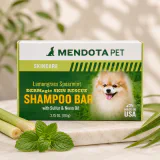 Step 1 — the sulphur wash, €20.99
DERMagic Skin Rescue Shampoo Bar
View on dermagic.eu →
Step 1 — the sulphur wash, €20.99
DERMagic Skin Rescue Shampoo Bar
View on dermagic.eu →One caveat we would rather state than have you discover: the lemongrass and spearmint in it are there for scent, they are not antiseborrhoeic actives, and essential oils carry some potential to sensitise. If your dog has reacted to scented products before, that is a reason for care.
For dry, adherent scale, a leave-on does more work than a wash. This is the lipid-rich one — sesame oil, aloe, lanolin, sulphur, beeswax, rosemary oil, shea butter and vitamin E. Two things worth knowing about it: it contains lanolin, which matters if anyone in the household reacts to wool alcohols; and because Malassezia is lipid-dependent, a rich oil-based lotion is the wrong choice on a greasy, yeast-colonised coat. Right product, wrong skin.
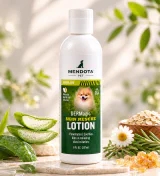 Step 2 — the sulphur leave-on, from €26.99
DERMagic Skin Rescue Lotion
View on dermagic.eu →
Step 2 — the sulphur leave-on, from €26.99
DERMagic Skin Rescue Lotion
View on dermagic.eu →For small areas of broken or licked skin, the salve is the sulphur product most people overlook — sulphur is its second ingredient, in a heavier aloe and beeswax base that stays where it is put.
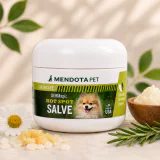 Sulphur for small broken areas, €24.99
DERMagic Hot Spot Salve
View on dermagic.eu →
Sulphur for small broken areas, €24.99
DERMagic Hot Spot Salve
View on dermagic.eu →Those three are also sold together, and since this page is about sulphur specifically, that bundle is the one that matches it exactly. The arithmetic, because we think brands should show it: €20.99 + €26.99 + €24.99 = €72.97 bought separately, against €58.99 as the kit — a saving of €13.98, about 19%, at the base sizes listed.
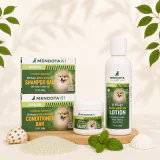 All three sulphur products — €58.99, saving €13.98
DERMagic Skin Essentials System
See the kit on dermagic.eu →
All three sulphur products — €58.99, saving €13.98
DERMagic Skin Essentials System
See the kit on dermagic.eu →Running the whole system, and why we say so
For a serious or long-running skin problem, the sulphur products are three steps of four, and we are not going to pretend the fourth is optional. The steps are not variants of each other — each one does a job the next depends on.
The cleanse is what lets anything reach skin through a greasy coat. The leave-on is where the sulphur does its work. The restorative step protects and thickens a returning coat. And the conditioning step is what stops a recovered barrier breaking down again three months later, which is the most common way these recoveries get undone. The most frequent reason owners tell us a routine did not work is that they ran part of it — lotion onto an unwashed dog, or everything stopped the week the first new fuzz appeared.
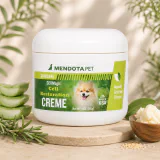 Step 3 — Restore, €45.99
DERMagic Cell Restoration Crème
View on Dermagic →
Step 3 — Restore, €45.99
DERMagic Cell Restoration Crème
View on Dermagic →
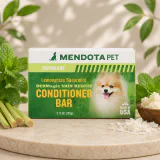 Step 4 — Maintain, €26.99
DERMagic Skin Rescue Conditioner Bar
View on Dermagic →
Step 4 — Maintain, €26.99
DERMagic Skin Rescue Conditioner Bar
View on Dermagic →
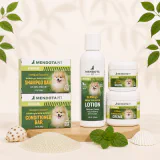 The complete four-step system — €139.99
The DERMagic Bar System
View the full system on dermagic.eu →
The complete four-step system — €139.99
The DERMagic Bar System
View the full system on dermagic.eu →And one general negative that no amount of product solves, which the veterinary literature is blunt about: antiseborrhoeic shampoos of every kind give only temporary relief, usually a few days. That is exactly why frequency, rather than product choice, is the variable that matters most — and why a routine beats a purchase. There is a full walkthrough in the Dermagic System guide.
When to see a vet instead
Sulphur is a surface ingredient for surface problems. Book the appointment if:
- The skin is broken, weeping, ulcerated or bleeding, or there are crusts with pus
- Hair loss is symmetrical on both flanks, which points at hormonal or follicular disease rather than anything topical
- There is a smell that returns within days of washing
- Your dog is systemically unwell — off food, drinking more, lethargic
- You suspect mange or ringworm, both of which need prescription treatment and one of which is contagious to you
- Scaling is severe, plated, or has been present since puppyhood, which raises primary keratinisation disorders
A sulphur wash is a reasonable thing to try on a mildly flaky dog. It is not a substitute for a diagnosis on a sick one.
The short version
- Sulphur is the element; a sulphate is the ion SO₄²⁻. They are not the same thing, and most sulphates — Epsom salts, gypsum, barium contrast — are entirely harmless.
- “Sulphate-free” refers to one family of detergents, not to sulphate and not to sulphur.
- We do not use SLS, but the reason is bath frequency — two or three washes a week on a dog whose barrier is already compromised — not the engine-degreaser line we used to run, which we have deleted, and not the skin-thickness argument, which we have now also withdrawn as wrong.
- A sulpha allergy is not a sulphur allergy. Penicillin-allergic patients react to non-antibiotic sulphonamides more often than sulpha-allergic ones do.
- Sulphur’s real action is on surface keratin — keratoplastic low, keratolytic higher — and it is pointed at the scaly dog, not the markedly greasy one. Expect flaking to look worse for a fortnight first.
- No controlled trial has tested elemental sulphur alone in dogs. The good human trial is Leyden 1987, and the combination that won it used salicylic acid, which we do not have.
- Lime sulphur is a different substance — calcium polysulphide at pH 10–11 — with real ringworm evidence in cats, adjunctive to an oral antifungal, and it is not an authorised veterinary medicine in the EU.
- Sulphur does not kill your dog’s mites, and we are not going to tell you it does.
- Never give sulphur by mouth.
Further reading
- The Dermagic System for dogs — the four-step protocol sulphur sits inside
- Seborrhoea in dogs — the flaking, scaling, odour condition sulphur is actually aimed at
- Why is my dog so itchy? — the hub, organised by where your dog itches
- What are mites and mange in dogs and cats? — why a topical cannot do this job
- Parabens and SLS in dog shampoo — the wider label question
- Aloe vera in pet skincare — the other ingredient in most of our range
- Top signs of yeast in dogs — what Malassezia overgrowth looks like
- West Highland White Terrier skin problems — the breed where this chemistry comes up most
- Dermagic Feline Skin Rescue Lotion — the cat formulation, and the cat-specific cautions
For specific ingredient questions email customerservice@dermagic.eu or call +44 7425 388643 — we genuinely like talking about this.