Mange is widely misunderstood, and the confusion starts with the word itself. It covers two unrelated diseases with opposite itch profiles and completely different outlooks. Here is what each mite actually does, why the test so often comes back negative, and what genuinely clears each one.
“Mange” is a word worth retiring
Sarcoptic mange is ferociously itchy, contagious, and passes to people. Demodicosis is usually barely itchy, is not contagious at all, and in young dogs very often resolves on its own. Using one word for both actively misleads owners — and it is the reason so many people arrive at this page having been told their dog “has mange” without being told which kind.
So take the word apart first.
The three mites that matter
Sarcoptes — scabies
Sarcoptes scabiei var. canis tunnels within the stratum corneum, the outermost layer of the skin. It is one of the most intensely itchy skin diseases in dogs.
Signs to look for:
- Relentless itching, usually out of proportion to how the skin looks early on
- Redness, papules, and crusting — particularly crusty ear margins
- Hair thinning as the self-trauma continues
- Secondary bacterial infection in the damaged skin
Distribution is the giveaway. Sarcoptes prefers thinly haired skin: ear margins, elbows, hocks and belly. That is close to the inverse of the atopic pattern, which attacks the face, the inner surface of the ear flap, paws, armpits and groin while sparing the ear rim and lower back. Our guide to why your dog is itchy maps this out in detail.
It is contagious, and it is zoonotic. The dog mite cannot complete its life cycle on human skin, so it produces a self-limiting crop of itchy papules — arms, neck, waistline — that settles in about two weeks. But reinfestation continues for as long as the dog goes untreated. If people in the house have started itching, say so at the appointment; it is a meaningful diagnostic clue, not an aside.
Demodex
Demodex mites live inside the hair follicle. Small numbers are normal — most healthy dogs carry a few and never have a problem. Demodicosis is the name for what happens when the population expands, and it comes in two quite different forms.
Localised juvenile demodicosis is the common one: a few patches of hair loss, often around the face or forelimbs, in a young dog. Around 90% resolve without treatment. That statistic is worth holding on to, because it is a trap for anyone selling a product — apply anything at all, wait, and the dog gets better regardless. We are not going to claim that win.
Generalised demodicosis is the serious one. Large areas affected, skin red and crusty, pustules, secondary infection, a distinctive odour.
What drives it is not what most pages say. The common claim is that Demodex “proliferates under stress” — meaning boarding, a house move, a new baby. That is folklore. The real picture:
- In young dogs, generalised demodicosis reflects a heritable, breed-associated defect in T-cell function. This is why affected dogs should not be bred from — a point that matters far more than any product recommendation on this page.
- In an adult dog with no history of it, generalised demodicosis is a red flag for something underneath. Hyperadrenocorticism, hypothyroidism, neoplasia — lymphoma in particular — leishmaniasis, or immunosuppressive medication including glucocorticoids, ciclosporin and oclacitinib.
Adult-onset generalised demodicosis is a diagnostic workup, not a shampoo. If your dog is over four and has suddenly developed it, the mites are the symptom and something else is the disease.
Cheyletiella — “walking dandruff”
Larger than the other two and visible under a magnifying glass. They live on the skin surface, and what looks like ordinary dandruff turns out to be the flakes moving.
Cheyletiellosis is milder than the other two but has two features owners routinely miss. It is contagious, so every in-contact cat, dog and rabbit needs treating, not just the itchy one. And the mites survive off the host for several days, so the bedding and the environment need dealing with or the infestation simply returns. It is also mildly zoonotic — a transient papular rash in owners.
Ear mites are a separate problem
Otodectes is not covered above and behaves differently — sudden, intense ear scratching, most often in puppies and cats. Our guide to dog ear care covers how to tell it apart from a yeast infection.
And if the specks are orange, it is none of these
Harvest mites are visible to the naked eye — bright orange-red specks, often clustered between the toes. Sarcoptes and Demodex are microscopic. If you can see orange, see harvest mites in dogs instead.
Why the test comes back negative
Sarcoptic mange is routinely mistaken for allergy for months at a time, and the reason is that the obvious test frequently fails.
The usual explanation — that the mites burrow too deep to reach — is wrong. Sarcoptes lives in the most superficial layer of the skin, which is exactly why a broad, shallow scraping is the correct technique. Scrapings come back negative because the mite burden is genuinely tiny, often fewer than twenty mites on an entire dog, and because the dog has scratched a good proportion of them off. Sensitivity runs at roughly 20–50%; a substantial majority of scrapings in infested dogs are false negatives.
A negative scraping does not rule out scabies. What vets use instead:
- Distribution — ear margins, elbows, hocks
- The pinnal-pedal reflex — rubbing the ear base to see if the hind leg scratches. Around 82% sensitive and 94% specific, so a negative is strong evidence against scabies while a positive is closer to a coin flip
- ELISA serology — roughly 84–92% sensitive, but there is a three-to-five week lag before a dog seroconverts, and steroids increase false negatives
- A therapeutic acaricidal trial — in practice, the confirmatory step
About the steroid question
This post used to say that cortisone makes sarcoptic mange dramatically worse. That overstated the evidence, so here is the accurate version.
There is no good evidence that anti-inflammatory-dose steroids increase the mite burden in dogs. The documented harm is diagnostic rather than parasitological: steroids partially mask the itch, can blunt serology, and buy weeks of apparent improvement while the dog remains infested and contagious to every other animal and person in the house. Genuine immunosuppressive dosing is a theoretical route to crusted scabies — well described in humans, essentially anecdotal in dogs.
The useful clue lives in that word partially. Scabies is characteristically only incompletely steroid-responsive, where atopic dermatitis generally responds well. A dog that improves somewhat on a steroid course but never quite settles, then relapses on withdrawal, deserves a second look for mites. Our post on why steroids are a poor long-term answer covers the wider case.
What actually clears each one
| Mite | First-line treatment | Notes |
|---|---|---|
| Sarcoptes | Isoxazolines — fluralaner, sarolaner, afoxolaner, lotilaner | 98–100% mite reduction, usually one or two doses. Selamectin and imidacloprid/moxidectin spot-ons are label-indicated EU alternatives |
| Demodex (generalised) | Isoxazolines | Treat to two negative scrapings a month apart, not to how the coat looks. Investigate the underlying cause in adult-onset cases |
| Demodex (localised juvenile) | Usually nothing | ~90% self-resolve. Watchful waiting is the consensus position |
| Cheyletiella | Selamectin, ivermectin, fipronil or isoxazolines | Treat all in-contact animals and the environment |
Two things to know about that table. All of these are prescription-only in the EU under Regulation 2019/6 — you cannot buy them over the counter, and the appointment is not optional. And ivermectin, though effective, is off-label for this use and genuinely dangerous in herding breeds carrying the MDR1/ABCB1 mutation — Collies, Australian Shepherds, Shelties and their crosses.
No shampoo, lotion or essential oil has published cure-rate evidence against any of these mites in dogs. Neem has real in-vitro activity and small, mostly uncontrolled in-vivo studies in pigs and rabbits; that is interesting, and it is not the same thing as a cure rate. The one topical with genuine historical support is lime sulphur dip, which is a registered acaricidal chemical rather than a cosmetic ingredient — and not something our soap can borrow credibility from. It is chemically a different substance from the elemental sulphur in a lotion, its mange evidence is historical and has been superseded, and it is not an authorised veterinary medicine anywhere in the EU; our page on sulphur sets out what it is and what it is genuinely good for.
Where Dermagic actually helps
We sell topical skincare, so we will be plain about the line: we can make the skin better, and we cannot kill the parasite.
That is not false modesty. Making a mite-killing claim for a cosmetic would convert it into a veterinary medicinal product under EU law, and it would be wrong on the evidence besides. Demodex sits inside the follicle, where a rinsed-off wash or a surface lotion never reaches acaricidal concentration — this is precisely why amitraz had to be applied as a soak dip, and why systemics displaced it.
What is left is not small. Mites wreck the skin, and killing them does not repair it. Crusts, scale, a broken barrier and secondary bacterial or Malassezia overgrowth all outlast the infestation, and that damage is what the owner is still looking at weeks later.
Step 1 — Bathe to lift crusts and scale
Bathe weekly or fortnightly during and after treatment — not more often than that. The bars are all variants of the organic shampoo bar range unless noted:
- Skin Rescue Bar (lemongrass and neem) — the one to reach for on problem skin
- Rosemary & Lavender — calming
- Chamomile & Sage — the gentlest of the range
- Peppermint & Tea Tree — deep cleansing. Dogs only (see below)
- Diatomaceous earth bar — a gently exfoliating mineral bar
We have corrected that last entry. It used to read “for flea-related problems,” which implied the bar does something about fleas. It does not, and we have withdrawn the claim across the site. Diatomaceous earth works only by drying out an insect’s cuticle, and a warm, wet, surfactant-rich bath is the one condition that abolishes that mechanism — quite apart from there being no published evidence of diatomaceous earth working against fleas on any pet, in any form. The full working is in flea allergy dermatitis in dogs and cats.
For cats, use the feline rosemary bar or Chamomile & Sage. Do not use the peppermint and tea tree bar on a cat.
We have corrected this paragraph. It used to say that tea tree and peppermint “both carry a documented feline toxicity record” and that “cats lack the enzyme needed to clear these compounds.” Two problems. There is a substantial feline case record for tea tree oil, but we could find no feline peppermint poisoning literature at all — so that half of the sentence was wrong. And the enzyme story is more specific than we made it: cats do carry an inactivating mutation in the main phenol-detoxifying enzyme, which is real and well-characterised, but whether that is the operative mechanism for tea tree’s constituents has not actually been demonstrated.
What stands: concentrated tea tree oil applied to skin has caused ataxia and tremors in both cats and dogs — documented across 443 cases in a ten-year veterinary review — and European regulators do apply an additional fivefold safety margin for cats with this oil.
A second correction to that regulatory point, made after checking the source. We described the fivefold cat factor as precautionary and “not a proven mechanism”. That undersold it: EFSA’s FEEDAP Panel applies the factor “considering their unusually low capacity for glucuronidation, particularly of aromatic compounds” — a specific, named and well-characterised feline metabolic trait, not a shrug. But we also implied it was a judgement about putting oils on a cat, and it is not: that opinion assesses tea tree oil eaten in feed. So the mechanism is firmer than we said and the route is narrower. Extending it to dermal use is reasonable inference, not measurement. The full account is in is tea tree oil safe for dogs and cats.
The advice is unchanged either way: use the feline range on cats.
Step 2 — Skin Rescue Lotion on the damaged skin
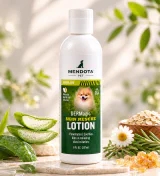
Massage into the affected areas and cover the dog with a t-shirt to keep it in place. Twice daily for the first week, then once daily for a second week. It supports the barrier while the skin rebuilds — it is not treating the mites, and the acaricide from your vet is doing that job in parallel.
 Start the treatment
DERMagic Skin Rescue Lotion
Shop on dermagic.eu →
Start the treatment
DERMagic Skin Rescue Lotion
Shop on dermagic.eu →Step 3 — Hot Spot Salve on the raw patches
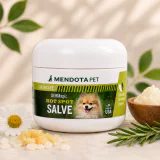
Applied daily to open, self-traumatised areas until they close. Also useful for minor wounds, insect bites and localised irritated patches.
 Start the treatment
DERMagic Hot Spot Salve
Shop on dermagic.eu →
Start the treatment
DERMagic Hot Spot Salve
Shop on dermagic.eu →When to go to the vet rather than the bathroom
- Intense itching with crusty ear margins, elbows or hocks — sarcoptic mange until proven otherwise, and the people in the house are exposed too
- An adult dog with sudden generalised hair loss and pustules — work up the underlying disease
- A negative skin scraping that hasn’t ended the itching — a negative result means very little for scabies
- Any dog that got partially better on steroids and then relapsed
For guidance on using the products alongside your vet’s treatment, email customerservice@dermagic.eu or call +44 7425 388643.