A smelly dog is not a dirty dog. Odour is produced by living organisms on the skin, not by dirt — which is why bathing removes the smell for two days and then it comes back. Where the smell is coming from tells you what’s actually wrong.
If you’ve found this page, there’s a reasonable chance you’ve already tried the obvious thing: washing the dog more often. And a reasonable chance it didn’t work, or made things worse.
Here’s why, and what to do instead.
Dog smell is biology, not dirt
Healthy dog skin carries a population of yeast and bacteria. That’s normal and it’s supposed to be there. Those organisms feed on sebum — the oil the skin produces to protect itself — and the by-products of that process are what you smell.
A little of this is just how dogs smell. The problem starts when the population overgrows, which happens when the skin’s barrier is compromised, when there’s excess oil to feed on, or when moisture gets trapped somewhere it shouldn’t.
This is the bit that changes how you approach it:
A bath removes the organisms on the surface. It does not remove the ones in the follicle. So the coat smells clean for a day or two while the surface is depleted — then the follicular reservoir repopulates it, and you’re back where you started. The smell returning three days after a bath isn’t a sign the bath failed. It’s a sign the smell is coming from somewhere a bath doesn’t reach.
The over-bathing trap
This is where a lot of owners accidentally make it worse, and it’s worth understanding properly.
Washing frequently with a harsh or sulphate-based shampoo strips sebum aggressively. The skin’s response to being stripped is not to produce less oil — it’s to produce more, to re-establish the barrier it just lost. Meanwhile that damaged barrier is easier for yeast to colonise than intact skin was.
So the cycle runs:
- Dog smells → owner bathes with a strong shampoo
- Barrier is stripped; skin rebounds with more oil
- Yeast recolonises a weakened barrier, faster than before
- Smell returns sooner and stronger
- Owner bathes more often
Every turn of that loop makes the next one worse. If your dog smells worse now than a year ago despite more frequent washing, this is very likely why. We’ve written about which ingredients drive this in parabens and SLS in dog shampoo.
The way out isn’t washing less or washing more. It’s washing properly — with something that doesn’t strip the barrier, left on long enough to actually kill what’s there — and then treating the reservoir the shampoo can’t reach.
First: locate the smell
Before treating anything, find out where it’s coming from. Get close and actually sniff — ears, paws, folds, belly, rear. Owners routinely treat the coat for months when the smell was coming from one ear the whole time.
| Where | What it smells like | What it usually is | What to do |
|---|---|---|---|
| Ears | Sweet, yeasty | Yeast-driven ear infection (otitis) | Clean regularly; vet if painful or discharging |
| Paws | Corn chips, Fritos, popcorn | Malassezia + bacteria between the toes | Normal if faint; treat if strong or staining |
| Skin folds | Stale, musty | Intertrigo — trapped moisture in folds | Clean and dry daily; treat the skin |
| Whole coat | Musty, greasy, “wet dog” that never fades | Seborrhoea or generalised yeast overgrowth | Full topical protocol |
| Mouth | Persistent bad breath | Dental disease | Vet — this is not a skin problem |
| Rear end | Sharp and distinctive | Anal glands | Vet or groomer — no shampoo will fix it |
Two of those six aren’t skincare problems at all, and we’d rather say so than sell you something that won’t help. A sharp, distinctive rear-end odour is usually the anal glands, and they need expressing. Bad breath is dental, and it’s worth taking seriously — there’s more in our guide to looking after your dog’s teeth and gums, and the Wag & Bright dental range we stock for daily brushing.
The other four are all yeast and barrier problems, and they all respond to the same approach. Ears are the most commonly missed of the four — if that is where the smell is coming from, our guide to dog ear care covers how to clean an ear properly and why the infections keep returning.
Ears: the most commonly missed source
If your dog smells and you can’t work out where from, check the ears first. They’re the single most overlooked source of whole-dog odour, because owners sniff the coat and never lift the ear flap.
The ear canal is warm, dark, humid and — in a floppy-eared or heavily coated breed — poorly ventilated. That is close to a perfect incubator for yeast.
What to look for alongside the smell:
- Brown or waxy discharge
- Head shaking or repeated ear scratching
- Head tilting, or rubbing the ear along furniture
- Redness inside the flap
- A dog that suddenly objects to having its head touched
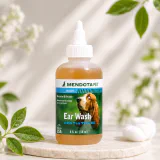
Mild waxy build-up with a faint yeasty smell responds well to regular cleaning with a proper ear wash — used on a routine basis, it keeps the canal from becoming the reservoir that reinfects everything else.
 Start the treatment
DERMagic Ear Wash
Shop on dermagic.eu →
Start the treatment
DERMagic Ear Wash
Shop on dermagic.eu →Two important limits, and please don’t skip these. Do not put anything into an ear that is painful, heavily discharging, bleeding, or where the dog has a sudden head tilt or loss of balance — those can indicate a ruptured eardrum or a deeper infection, and flushing fluid into that ear can do real harm. And never use cotton buds down the canal. In those cases the answer is a vet appointment, not a bottle.
Paws: the corn chip smell
This one has a name — “Frito feet” — and it’s one of the most-searched dog smells there is.
The smell comes from organisms living between the toes and around the nail beds: usually Malassezia yeast, often alongside bacteria like Proteus and Pseudomonas. Paws are permanently warm, frequently damp, in contact with the ground, and licked regularly. Of course they grow things.
A faint corn-chip smell on an otherwise healthy dog is completely normal. No treatment needed. Don’t let anyone sell you something for it.
It becomes a genuine problem when you also see:
- The smell becoming strong or sharp rather than faint
- Rusty-brown or pink staining of the fur between the toes — this is saliva staining from licking, and it’s the clearest early warning sign
- Pink, puffy or thickened skin between the pads
- Persistent licking or chewing at the feet
- The dog leaving damp paw prints
That combination is a yeast overgrowth, and it’s usually self-perpetuating: yeast makes the paw itch, the dog licks, licking keeps the paw wet, wet paws grow more yeast. Breaking the moisture cycle is half the treatment — dry the feet thoroughly after walks, especially between the toes, and particularly on a dog with hairy feet.
Persistent paw licking also has non-yeast causes worth ruling out, chiefly environmental allergies. Our guide to dog skin allergies covers the difference, and our dog paw care guide works through the full differential and the treatment routine.
Skin folds: the stale smell
Any fold that traps moisture will eventually turn stale. This is intertrigo, and it affects the breeds you’d expect — French Bulldogs, English Bulldogs, Pugs, Shar Pei, Mastiffs — plus the tail pocket, the vulvar fold, and the lip folds on heavy-jowled dogs.
The smell is distinctly different — stale and musty rather than sweet or yeasty.
The mechanics are simple. Skin touching skin, no airflow, moisture from sweat, saliva or tears, and a warm body. It doesn’t take long.
The fix is equally simple in principle and requires consistency in practice: clean the fold, then dry the fold, every single day. Drying is the half people skip, and it’s the half that matters — a damp clean fold is no better than a dirty one. Then treat the skin itself so the overgrowth clears rather than simply being wiped off the top.
Breed-specific detail for flat-faced dogs, including tail pockets, is in our French Bulldog skin problems guide.
The whole-coat musty smell
If the smell isn’t localised — if the dog just smells, all over, all the time — you’re most likely looking at seborrhoea or generalised yeast overgrowth.
Signs that fit:
- Coat feels greasy, waxy or oily to the touch
- Flaking or scale, sometimes with a dull coat
- Skin may look pink, grey or darkened
- Smell returns within days of a bath
- Often some itching, though not always
Generalised yeast rarely arrives on its own. It’s usually secondary to something that damaged the barrier first — an allergy, a hormonal condition such as hypothyroidism, or a follicular disorder. Our top signs of a yeast infection in dogs covers how to recognise it, and if there’s hair loss alongside the smell, hair loss without itching walks through what a vet should rule out.
Seborrhoea is worth reading about in its own right, because it is the part of this picture most often treated as a grooming problem rather than a medical one. Our full guide to flaky, greasy coats and persistent odour explains why the word describes a sign rather than a diagnosis, what tends to be driving it, and the warning signs that mean a vet visit rather than another bath.
Treat the yeast to make the dog comfortable now — but if it keeps returning, ask what’s letting it in.
When the smell means see a vet
Most skin and coat odour is safe to treat topically. Get a vet appointment promptly if you see:
- Pain, heat or swelling anywhere
- Open, weeping or bleeding skin
- Heavy dark ear discharge, sudden head tilt, or loss of balance
- Fever, lethargy, or a dog that’s off their food
- A sharp, distinctive odour from the rear (anal glands)
- Persistent bad breath (dental)
- Smell alongside sudden hair loss, heavy thirst or weight change — that combination suggests a hormonal cause
Smell that’s simply persistent, yeasty, greasy or musty, on a dog who’s otherwise well, is the kind you can tackle at home.
What actually clears it
Three things, in order. Skipping any one of them is why smells come back.
1. Wash properly — not just more often. If the smell is a diagnosed Malassezia overgrowth, the shampoo with the best evidence is a chlorhexidine-based one, usually with miconazole, and you get it from your vet — we do not sell one. We used to write this line as “use a sulphate-free antimicrobial shampoo”, which let a reader assume we meant ours. We don’t, because ours isn’t one. What a sulphate-free wash like ours contributes is the mechanical half of the job: it lifts the grease and scale the organisms live in, without stripping a barrier that is already damaged. That is worth doing either way, and it is not a substitute for the medicated wash if your vet has prescribed one. Work it down to the skin in sections rather than lathering the surface, and leave it on for a few minutes before rinsing. A thirty-second lather-and-rinse is essentially a rinse. You do not need to stand there for ten minutes, though — a 2026 study found three minutes performed just as well as ten, so what matters is that the lather is genuinely against skin rather than how long you hold it there. Then rinse thoroughly, and — critically — dry the dog properly, especially folds, ears and between the toes. A damp dog is a yeast incubator.
2. Don’t stop at bath day. This is the step that separates a smell that stays gone from one that returns on Thursday. A bath is a single event; the conditions that produced the smell are still there on Tuesday. Something has to be applied to the skin in between, and a leave-on product is how you get continuous rather than twice-weekly contact.
We have reworded this step. It used to be headed “treat the follicle, not the surface”, and said the odour-producing organisms “live down in the follicle where shampoo doesn’t reach” and “need something that stays on the skin and keeps working”. The follicular reservoir is a real thing in canine dermatology and it is a real reason topical therapy has to be repeated — but we were using it to imply that our lotion reaches down there and keeps killing things, and we cannot show either half of that.
3. Repair the barrier. An intact skin barrier is what stops the overgrowth re-establishing — make the skin a worse place to live rather than relying on clearing it out again every fortnight.
The Dermagic System
Four steps — cleanse, treat, target, restore. No steroids, nothing systemic.
| Step | Product | What it does for a persistent odour |
|---|---|---|
| 1. Cleanse | Skin Rescue Shampoo Bar or Peppermint & Tea Tree Shampoo | Washes off the grease and scale the odour lives in, without stripping the barrier — sulphate-free, so it breaks the over-bathing cycle rather than feeding it. |
| 2. Treat | Skin Rescue Lotion | The step people skip. It is what gets onto the skin on the days there is no bath. |
| 3. Target | Hot Spot Salve | For paws licked raw, sore folds and any broken skin, where lotion would be licked straight off. |
| 4. Restore | Cell Restoration Crème | Rebuilds the barrier so the overgrowth has nothing to return to. This is the anti-recurrence step. |
Run all four. They’re not alternatives — they do different jobs and they compound. The cleanse is what lets the lotion reach skin at all; applied to a greasy unwashed coat it never gets there. The lotion clears the reservoir regenerating the smell. The salve handles the raw patches. The crème repairs the barrier that let the yeast in to begin with — which is precisely why smells treated with shampoo alone keep coming back.
 Start the treatment
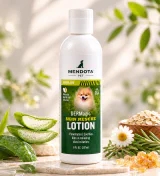
DERMagic Skin Rescue Lotion
The step that stops it returning — dermagic.eu →
Start the treatment
DERMagic Skin Rescue Lotion
The step that stops it returning — dermagic.eu →Full step-by-step instructions, including how to adapt it for cats, are in the complete guide to the Dermagic System.
Two useful additions
For a flaky, scaly, dandruffy coat alongside the smell, the Anti-Dandruff Salt Scrub lifts scale before you shampoo, so the wash reaches skin rather than sitting on a layer of dead cells.
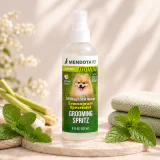
For keeping a dog fresh between baths — particularly useful while you’re deliberately not over-washing — the Skin Rescue Grooming Spritz freshens the coat without stripping it. It’s not a substitute for treatment, but it stops owners reaching for another bath.
 Start the treatment
DERMagic Skin Rescue Grooming Spritz
Between baths — dermagic.eu →
Start the treatment
DERMagic Skin Rescue Grooming Spritz
Between baths — dermagic.eu →How often to bathe while you’re clearing it
| Phase | Frequency |
|---|---|
| Weeks 1–3, active overgrowth | Twice weekly, a few minutes of contact time |
| Weeks 4–8, improving | Weekly |
| Maintenance | Every 2–4 weeks |
Lotion goes on daily throughout the first phase, regardless of bath days — that’s what’s doing the work between washes.
What to expect
| Timeframe | What you should notice |
|---|---|
| Days 3–7 | Smell noticeably reduced. Often the first thing owners report. |
| Weeks 2–3 | Greasiness clears, coat feels normal rather than waxy. Paw staining stops spreading. |
| Weeks 4–6 | Smell stays gone between baths — the real marker of success. Skin colour improving. |
| Months 2–3 | Barrier repaired. Bathing frequency drops to maintenance. |
The smell going is fast and easy. The smell staying gone is the actual goal, and that’s the barrier repair — which is why stopping the moment your dog smells nice again is the most reliable way to be back here in a month.
Where to start
- Find the source. Ears, paws, folds, coat, mouth, rear. Sniff each one.
- Rule out the two that aren’t skincare — rear-end odour (anal glands) and bad breath (dental) both need a vet.
- Stop over-bathing with harsh shampoo. You’re feeding the cycle.
- Wash properly — sulphate-free, a few minutes of contact, then dry thoroughly.
- Treat the follicle daily and repair the barrier. This is the part that makes it permanent.
- Give it six weeks before judging it, and don’t stop at week two because the smell went.
Can’t work out where the smell is coming from? Get in touch — tell us your dog’s breed, where you think the smell is strongest, what it smells like, and how quickly it returns after a bath. We’ll tell you honestly what we think you’re dealing with, including when the answer is a vet rather than a product.