
Every guide to this question gives you the same thing: a list of possible causes. Fleas, allergies, food, mites, dry skin, anxiety. The list is not wrong and it is not useful, because your dog matches six items on it and you are no closer to knowing what to do on Monday morning.
Here is the more useful question. Where does your dog itch? Not what is causing it — where. Because the three most common causes of chronic itching in dogs occupy different parts of the dog, and that is something you can observe this evening without a single test.
Start with where, not what
A dog cannot tell you what is wrong, but it tells you where it hurts every time you look at it. Veterinary dermatologists lean on this heavily, and the international diagnostic guidelines for canine atopic dermatitis are built around lesion distribution rather than lesion appearance — because inflamed skin looks much the same whatever caused it, while the map differs by disease.
That is the spine of this article. We will work through the map first, then the mechanism, then what genuinely helps and what is sold to you and does nothing.
One thing before the map. “Itchy” covers a lot of behaviours, and owners under-report most of them. Scratching with a hind foot is the obvious one. But licking and chewing at paws, rubbing the face along furniture or carpet, scooting the rear along the ground, head-shaking, and rubbing an ear against your leg are all pruritus. So is a dog that has started waking in the night. If you are trying to judge whether things are improving, count episodes of all of those rather than watching for scratching alone.
The itch map
| Where your dog itches | Most likely cause | Corroborating signs |
|---|---|---|
| Face, inner ear flaps, ear canals, paws, armpits, groin, belly — lower back spared | Environmental atopic dermatitis | Started between 6 months and 3 years; relapsing; recurrent ear infections; often worse in one season |
| Lower back, tail base, backs of the thighs | Flea allergy dermatitis | Flea dirt in the coat; the dog may gnaw rather than scratch; front half relatively clear |
| Ear margins, elbows, hocks, belly — intensely itchy | Sarcoptic mange | Crusty edges to the ear flaps; contagious; humans in the house may itch too |
| Skin folds, ear canals, between the toes, under the neck — greasy, thickened, darkened, smelly | Malassezia overgrowth | Usually sitting on top of another problem rather than being the original one |
| Feet and lower legs, head and ears — sudden, in late summer or autumn | Harvest mites | Visible orange-red specks between the toes |
| Paws and belly after walks, seasonal | Pollen contact and environmental allergy | Worse after grass, better in winter |
| Rear end only, scooting | Anal sac problems, not skin disease | Licking at the base of the tail, scooting on carpet |
| Hair loss with little or no itching | Hormonal, not allergic | Symmetrical thinning on both flanks; a different investigation entirely |
Two patterns are worth memorising, because they discriminate better than anything else on the list.
Atopic dermatitis spares the ear margins and the lower back. It attacks the concave inner surface of the ear flap and the ear canal, but the rim of the ear is left alone. If the rim is crusty and damaged, think sarcoptic mange. If the lower back is the worst-affected area, think fleas. The guidelines are explicit that the dorsolumbar region is not an atopic site.
There are breed exceptions, and they are not trivial. German Shepherds tend to involve the elbows, hindlimbs and chest — one reason German Shepherd skin problems get misread for years. West Highland White Terriers can involve the lower back and break the rule outright, which is one concrete reason Westies get managed as flea cases for years. Use the map as a strong prior, not a law.
Fleas: not necessarily the most common cause, but the first to rule out
You will read that fleas are the single most common cause of itching in dogs. The textbooks do say something close to that, but it is an authority statement rather than a measured finding, and Merck’s own manual notes that prevalence “depends on geographic location” and ranges from the most commonly diagnosed allergic skin disease to not occurring at all in places without fleas. For a European dog on year-round parasite prevention, treating it as the default answer is lazy.
What is true is that it is the first thing to rule out, because it is the cheapest and most fixable. No dermatologist will investigate anything else until parasite control is watertight.
Two practical points:
- A flea-allergic dog reacts to very few bites. You are not looking for an infestation. You are looking for evidence that any fleas have been present at all.
- Look for flea dirt, not fleas. Comb the lower back and tail base over a damp white cloth. Flea faeces smear reddish-brown because they are digested blood. A dog that grooms efficiently swallows the adults and leaves the dirt behind.
We now have UK figures with denominators for this. In 31 first-opinion practices, lesions compatible with flea allergy were found in 3.32% of 2,653 dogs and 8.02% of 1,508 cats — modest in absolute terms, and two to three times commoner in cats. Our flea allergy dermatitis guide has the rest, including why the detection methods are unreliable and which home remedies have actually been tested.
Skin problems caused by parasites covers the wider picture, including ticks and the mites below.
Atopic dermatitis: the big one, and the one that lasts
Canine atopic dermatitis is the most common cause of chronic, lifelong itch. The current international definition calls it a hereditary, typically itchy, predominantly T-cell driven inflammatory skin disease involving an interplay between skin barrier abnormality, allergen sensitisation and microbial imbalance — a definition that was revised in 2023 and notably no longer hinges on IgE antibodies at all.
How common is it? Honestly, nobody knows. You will see 10–15% quoted everywhere. That range is in the literature, but the international task force has stated plainly that those percentages are not based on reliable epidemiological data, and the largest actual measurement — 31,484 dogs across 52 practices — found 4.7%. The defensible statement is “somewhere between about 3% and 15%, and the real figure is not established.” We would rather tell you that than pick the impressive number.
What is much better established is the clinical picture:
- Age of onset between six months and three years in the great majority. A minority present later, so late onset does not rule it out — but a first-ever itch in a nine-year-old dog should make you think about something else.
- Relapsing, not constant. Flares and quieter periods, sometimes seasonal, sometimes year-round with seasonal worsening.
- Recurrent ear infections are part of the disease, not a separate problem. A dog with a third ear infection in a year very often has undiagnosed atopy. Our guide to dog ear care goes into the mechanics.
- Allergens get in mainly through the skin, not the nose. The older “inhalant allergy” framing has been largely abandoned in favour of percutaneous exposure — allergen crossing a compromised skin surface. This matters practically, because it is the reason topical and bathing care are rational interventions rather than cosmetic ones.
For the fuller picture, see what canine atopic dermatitis actually is and the difference between atopy and allergy, which is a distinction most articles blur.
A word on the “leaky barrier” story
You will read that atopic dogs have a defective skin barrier which lets allergens in, and that this is the root of the disease. The barrier abnormality is real and reproducible — reduced ceramides, altered filaggrin, increased water loss through the skin. Whether it is the cause or the consequence is genuinely unsettled: laboratory-grown skin from atopic dogs only develops the defect after inflammatory cytokines are added, which points to the defect being downstream of inflammation rather than the starting gun.
We sell barrier-support products, so we will be careful here. The honest version is that barrier dysfunction and inflammation reinforce each other. That is a sound reason to support the barrier. It is not a licence to claim you are fixing the root cause.
Sarcoptic mange: the one you must not miss
Sarcoptic mange is worth its own section because it is treatable, contagious, transmissible to you, and routinely mistaken for allergy for months.
It is one of the most intensely itchy skin diseases in dogs. Distribution is the giveaway: ear margins, elbows, hocks and belly, with papules, redness and crusting. You will notice that is nearly the inverse of the atopic map.
The pinnal-pedal reflex is a test you can understand even though your vet performs it. Rub the base of the ear flap firmly for about five seconds and watch whether the hind leg on the same side comes up to scratch. In 588 dogs with skin disease, it was positive in 82% of scabies cases and only 6.2% of other skin diseases — sensitivity 82%, specificity 94%. The useful nuance is the predictive values: a negative result is strong evidence against scabies, while a positive result is only about a coin-flip for it. It narrows things; it does not diagnose.
And if someone in your house has become itchy, take that seriously. Sarcoptes scabiei var. canis cannot complete its life cycle on human skin, so it produces a self-limiting crop of itchy papules — typically on the arms, neck and waistline — that settles in about twelve to fourteen days. But reinfestation continues for as long as the dog is untreated. Dogs are the most frequently reported source of human infestations worldwide. Treating the dog resolves the human problem.
Note also that “mange” is a word worth retiring. It covers two unrelated diseases with opposite itch profiles: sarcoptic mange is ferociously itchy, while demodicosis is usually barely itchy at all unless a secondary bacterial infection has set in. Using one word for both actively misleads.
Malassezia: itchy, but rarely the original problem
Malassezia pachydermatis is a yeast that lives on normal dog skin and overgrows when conditions favour it — warmth, moisture, folds, and inflamed allergic skin. When it overgrows it is itself a significant source of itch, and it favours skin folds, ear canals, the spaces between the toes, claw folds, armpits, groin, the underside of the neck and the muzzle.
It is greasy, thickened, darkened skin with a smell people recognise long before they recognise the cause — see why does my dog smell and the signs of yeast in dogs.
The important framing: it is usually a consequence, not the cause. It sits on top of allergy, or moisture, or a fold that never dries. Treating the yeast without addressing what let it flourish buys you a few good weeks. And it is a surface organism that overgrows — not a systemic condition, not a “yeast overload,” and not something a dog is riddled with internally.
What about food?
This is where the internet does the most damage, so we are going to be blunt.
“90% of dog allergies are food allergies” is false, and it is inverted. There is no source for it. The actual numbers, from a systematic review of the entire literature:
| Population | Share with a cutaneous adverse food reaction |
|---|---|
| All dogs presented to a vet | 1–2% |
| Dogs with any skin disease | median 6% (range 0–24%) |
| Dogs with itching | median 18% (range 9–40%) |
| Dogs with allergic skin disease | median 20% (range 8–62%) |
| Dogs already diagnosed atopic | median 29% (range 9–50%) |
So roughly one itchy dog in five has a food component. That is worth investigating — and it is the smallest of the three common allergic causes, not the largest. Anyone who tells you a confident three-way percentage split between fleas, environment and food is inventing it; no study supports one.
The modern term is cutaneous adverse food reaction, because in most cases nobody has demonstrated an immune mechanism, which is what the word “allergy” implies.
The common culprits are beef, dairy, chicken and wheat. Note what that list is mostly made of: animal proteins, and specifically the animal proteins that appear in most commercial dog food. It reflects what dogs are exposed to rather than anything intrinsically dangerous about beef.
Which makes the grain-free pitch incoherent. Grains are among the least common canine food allergens — wheat is the only one on the list above, and the other three are animal-derived. There is no evidence that grain-free food reduces itching. There is, separately, an ongoing FDA investigation into an association between grain-free pulse-heavy formulations and dilated cardiomyopathy. So it is a claim with no upside and a possible downside.
Seasonality: the cheapest clue you have
| Pattern | What it suggests |
|---|---|
| Worse spring and summer, better in winter | Pollen and other seasonal environmental allergens |
| Sudden onset late summer to autumn, feet and head | Harvest mites — look for orange specks |
| All year round, fairly steady | House dust mite atopy first; other non-allergic causes; food last |
| All year, with seasonal spikes | Very common in atopy — a baseline allergy plus a seasonal load on top |
Note the ordering in row three, because most articles get it backwards. A year-round itchy dog is much more likely to be a non-seasonal atopic than food-allergic, simply because environmental atopy is far more common than food reaction. Jumping straight to a diet trial recreates the 90% error by implication.
One correction to a claim you will see everywhere, including in places that should know better: the idea that dust mite allergy flares in autumn and winter because of indoor heating is an unsupported import from human allergy medicine. A longitudinal study of allergen reactivity in atopic dogs found modest seasonal variation in pollen responses but no significant seasonal difference for house dust or storage mites. Year-round dust mite itch is real. The heating explanation is a hypothesis.
Spring is its own topic — see helping your dog’s skin allergies in spring and grass pollen allergy in dogs.
Why it keeps getting worse: the mechanism, correctly
Almost every consumer article on this subject says histamine. That is the human hay fever model, and in dogs it is wrong.
Canine itch is driven predominantly by interleukin-31 signalling through the JAK pathway, within a wider type-2 inflammatory response involving IL-4 and IL-13. This is not an academic detail. It is the entire reason the two drugs that transformed canine dermatology target JAK1 and IL-31 respectively — and the reason antihistamines, which work reasonably well in people, perform poorly in dogs. If you have tried an antihistamine and seen nothing, the drug was not failing. It was aimed at the wrong target.
Layered on top of that is the itch–scratch–infect cycle, which is what turns a mild allergy into a miserable dog:
- Inflammation makes the skin itch.
- Scratching, licking and chewing damages the skin surface.
- Staphylococcus pseudintermedius and Malassezia exploit the damage and overgrow.
- Both of those organisms are themselves itchy — and S. pseudintermedius also amplifies the allergic state immunologically.
- The dog itches more than the original allergy alone would cause.
The most important practical consequence
Secondary infection is the single most common reason a previously stable allergic dog suddenly gets much itchier. And it changes not just the intensity but the distribution — which means it can break the map at the top of this article. A dog whose pattern fits nothing may well be a dog with infection layered over allergy.
This is also why the veterinary antipruritic guidelines are explicit about sequence: deal with parasites, bacterial infection and yeast overgrowth first, before reaching for symptomatic itch control. Suppressing the itch signal while an infection runs underneath it is treating the alarm rather than the fire.
That ordering, incidentally, is the strongest honest argument for topical and cleansing care having a genuine role here — considerably stronger than any “natural soothing” pitch.
If your dog is losing hair but not itching
Different problem, different investigation. Non-itchy, roughly symmetrical hair loss on both flanks points towards hormonal causes — hypothyroidism and Cushing’s disease being the common two. Endocrine skin disease accounts for around 8.6% of dermatology appointments, and the classic presentation is chronic non-itchy symmetrical alopecia.
When those dogs do itch, it is usually because a secondary skin infection has developed on top, not because the hormonal disease itself causes itching. Full detail in dog losing hair but not itching and alopecia in dogs.
What a vet actually does
There is no single test for atopic dermatitis
This surprises owners, and it is worth stating plainly: canine atopic dermatitis is diagnosed clinically, by meeting a pattern of criteria and excluding the things that mimic it. There are no pathognomonic signs and no confirmatory laboratory test. The MSD manual is explicit that diagnosis rests on history, signalment, clinical signs and exclusion — not on laboratory tests.
So a work-up looks like: rigorous parasite control, skin scrapes for mites, tape strips or cytology for bacteria and yeast, treating whatever infection is found, and — if the history warrants it — a diet trial. Slow, unglamorous and correct.
The tests that do not work
Hair and saliva “intolerance” tests are not valid. This is the most thoroughly demolished claim in the field. Researchers submitted samples to a commercial hair-and-saliva testing service from a dog with confirmed allergies, a healthy dog, a piece of fake fur, and plain water. The result distributions were indistinguishable from random chance, and resubmitting the same sample produced poorly-agreeing results. A separate European study found 20–30% of healthy dogs returned strong positives and a further 53% weak positives.
Blood tests cannot diagnose food allergy either. In one study, none of eight dogs with clinically proven food reactions tested positive on serum IgE testing.
The elimination diet, done properly
If a diet trial is warranted, do it once and do it correctly, because a botched trial costs eight weeks and answers nothing.
- Eight weeks minimum. Signs had normalised in over 85% of food-reactive dogs by five weeks and over 95% by eight weeks. Fewer than 5% needed up to thirteen. Four-week trials — the length most owners actually manage — miss real cases.
- One novel or hydrolysed protein, and nothing else. No treats, no flavoured chews, no table scraps, no flavoured medication. One lapse invalidates the trial.
- Then provoke. This is the step almost everyone skips. Re-feed the original food and watch for the signs to return. Without it you cannot distinguish a food reaction from a pollen season ending, or from the flea treatment you happened to start the same week. A diet trial without a challenge is a suggestion, not a diagnosis.
What allergen testing is actually for
Intradermal and serum allergen testing has a real, legitimate place — it is just not diagnosis. Its function is to identify which allergens to include in allergen-specific immunotherapy for a dog already diagnosed clinically. As the guidelines put it, allergy testing reflects exposure and sensitisation, not disease.
A better name for it is an allergen sensitisation test, which prevents the most common owner misunderstanding at the point of reading the result.
Prescription options, characterised honestly
We sell skincare, not medicine, and we are not going to pretend a shampoo competes with these. For a dog in real distress, this is the tier that works.
| Option | What it is | How fast |
|---|---|---|
| Oclacitinib (Apoquel) | Oral JAK1 inhibitor, blocking IL-31, IL-4 and IL-13 signalling | Measurable itch reduction in ~1.5–4 hours; controlled within a day |
| Lokivetmab (Cytopoint) | Injected caninised antibody that neutralises IL-31 directly. Not metabolised by the liver | 1–3 days; about 4 weeks per injection |
| Ciclosporin (Atopica) | Oral calcineurin inhibitor / immunomodulator | 4–6 weeks to full effect — maintenance, not rescue. GI upset in around 46% |
| Allergen-specific immunotherapy | Desensitisation using the dog’s own identified allergens | Months — but it is the only option that modifies the disease rather than suppressing the itch |
Immunotherapy is the one most commercial articles omit, and it is the one with the most interesting long-run proposition.
On steroids
Our position on steroids has not changed and is set out in why we avoid steroids for temporary relief. It is worth being precise about what the objection is.
A short course to break a severe acute flare is reasonable medicine. The objection is to steroids used indefinitely as a substitute for finding the cause. The side-effect burden of long-term oral corticosteroids is well documented: excessive drinking in 39.2% and excessive urination in 28.4%, weight gain, increased infection susceptibility, gastrointestinal ulceration, and iatrogenic Cushing’s disease. In one long-term study 68% of dogs developed a urinary tract infection, which is why the guidelines recommend periodic urinalysis and urine culture for dogs on chronic oral steroids. The same guidelines say long-acting injectable steroids should be avoided wherever possible.
What skincare genuinely does — and what it does not
Here is where we have a commercial interest, so here is the evidence, including the parts that are inconvenient.
What topical care does not do: it does not cure atopic dermatitis, eliminate a parasite, or replace veterinary treatment for an infection. Any product claiming to treat, prevent or cure a skin disease is making a medicinal claim, and we are not making one.
What it does do is better supported than most people realise. The international treatment guidelines state that “the intensity and frequency of bathing may be the most important factor in relieving pruritus.” That is a strong sentence from a cautious body, and it is the single most useful thing on this page for an owner with a budget.
Bathing: the specifics that matter
- Weekly is the guideline frequency — weekly to fortnightly in general practice. Frequency matters more than which product you choose.
- Give it contact time, but not as much as you have been told. A few minutes of genuine skin contact rather than a lather-and-rinse — most owners under-do this by a wide margin. The ten minutes that appears on almost every instruction leaflet is probably longer than necessary: a 2026 study comparing three minutes against ten found no meaningful difference. It was small work, so treat ten minutes as unnecessary rather than disproven, and spend the effort on getting lather down to skin instead of on the stopwatch.
- Lukewarm water, never hot. This is the guideline’s own wording. Cooling the skin is one of the proposed mechanisms by which bathing raises the threshold at which a dog feels itchy.
- Be honest about the mechanism. The popular explanation is that bathing physically washes allergens off the coat. That is plausible and probably contributes, but it has not been demonstrated; the better-supported mechanisms are cooling and moisturising. The benefit is evidenced. The reason is partly assumed.
- A drying or irritating shampoo can make an atopic dog worse. The guidelines warn about this directly. Harsh degreasing products are the wrong tool for dry inflamed skin.
Our guides to soap, shampoo or shampoo bars and parabens and SLS in dog shampoo cover formulation. On the much-repeated pH argument: dog skin genuinely is less acidic than human skin — averaging around 7.0 to 7.5 against roughly 4.7 to 5.5 in people — so a dog-formulated product is a sensible default. But there is no single canine norm (reported values run from 5.5 to 9.1 depending on site, age and body condition) and no trial showing human shampoo causes dermatitis in dogs. The direction of that argument is right; the usual strength of it is overstated.
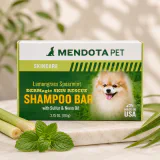 Step one — cleanse
DERMagic Skin Rescue Shampoo Bar
Shop on dermagic.eu →
Step one — cleanse
DERMagic Skin Rescue Shampoo Bar
Shop on dermagic.eu →Soothing and supporting the barrier
Once the skin is clean, the inflamed and self-traumatised areas need support. This is the step where the dog visibly gets more comfortable, and it is the one to apply where the map told you to look — paws, groin, armpits and belly for an atopic dog.
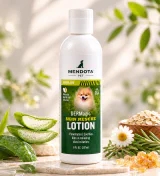 Step two — soothe and support
DERMagic Skin Rescue Lotion
Shop on dermagic.eu →
Step two — soothe and support
DERMagic Skin Rescue Lotion
Shop on dermagic.eu →For skin the dog has actually broken — raw patches between the toes, a chewed flank, the beginnings of a hot spot — the salve is the heavier option, and its label tells you to simply reapply if the dog licks it off — which is the test anything applied to a paw has to pass.
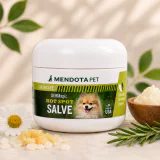 Step three — broken or raw skin
DERMagic Hot Spot Salve
Shop on dermagic.eu →
Step three — broken or raw skin
DERMagic Hot Spot Salve
Shop on dermagic.eu →A note on scaling and greasy seborrhoeic skin: sulphur and salicylic acid do have real activity — sulphur is both keratolytic and keratoplastic, and salicylic acid is mildly antipruritic at 1–2% and keratolytic at 3–6%, with the two working synergistically. See sulphur, the healing mineral. But these are primarily antiseborrhoeic agents, antipruritic second, and they are the wrong choice for dry atopic skin, where they can provoke a flare. Match the tool to the skin in front of you. If scaling and greasiness are the main complaint rather than the itch, seborrhoea in dogs is the page to read — and note that a dog scaling without much itch is a different and more urgent conversation.
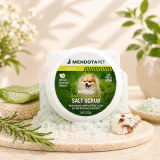 For scaling and greasy, seborrhoeic skin
DERMagic Anti-Dandruff Salt Scrub
Shop on dermagic.eu →
For scaling and greasy, seborrhoeic skin
DERMagic Anti-Dandruff Salt Scrub
Shop on dermagic.eu →Do not forget the ears and the feet
The atopic map puts ear canals and paws at the centre of the disease, and they are the two places owners treat last. Recurrent otitis is part of atopy rather than a separate nuisance, and interdigital skin is where a dog does most of its self-damage. Dog ear care and dog paw care go into the routine.
 For routine ear cleaning
DERMagic Natural Ear Wash
Shop on dermagic.eu →
For routine ear cleaning
DERMagic Natural Ear Wash
Shop on dermagic.eu →Treat the barrier, not the worst patch
If your dog has been itchy for months rather than days, spot-treating the angriest area is not the job. The whole four-step routine is — cleanse, soothe, protect broken skin, then restore the barrier itself. The fourth step is the one people skip, and it is the one that determines what condition the skin is in when the next flare arrives.
Given that barrier dysfunction and inflammation reinforce each other, working on only one side of that loop is why so many owners describe treatment that “helps for a fortnight.”
 The complete four-step routine
DERMagic Skin Essentials System
Shop on dermagic.eu →
The complete four-step routine
DERMagic Skin Essentials System
Shop on dermagic.eu →The full rationale for the sequence is in the Dermagic System, and what’s in the Skin Essentials kit breaks down the individual steps. For badly damaged skin, the restoration step has a heavier option.
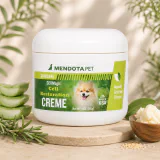 Step four — restore the barrier
DERMagic Cell Restoration Crème
Shop on dermagic.eu →
Step four — restore the barrier
DERMagic Cell Restoration Crème
Shop on dermagic.eu →Supplements: modest, slow, and not a treatment
We would rather set your expectations properly than sell you a quick win.
Omega-3 fatty acids — EPA and DHA — have a real but modest anti-itch effect in atopic dogs, and the guidelines are deliberately cool about them: the degree of improvement expected makes them unsuitable as a sole treatment. The timing matters most. The benefit, if any, may not appear before two months of supplementation. Individual trials have shown significant reductions in itching at six weeks at doses of 40–100 mg/kg/day of combined EPA and DHA.
Oral fatty acids do measurably normalise the lipid profile of the skin barrier, detectable after around two months. But “measurable change in skin lipids” and “the dog is less itchy” are two different claims, and only the first is solid.
So: worth starting, worth starting early, worth giving two months before you judge it, and not a substitute for anything.
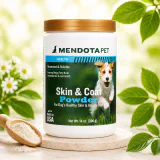 Omega support — allow two months
Retrieve Skin & Coat Supplement
Shop on dermagic.eu →
Omega support — allow two months
Retrieve Skin & Coat Supplement
Shop on dermagic.eu →Home remedies, audited
We get asked about these constantly. Four of the most popular do not survive contact with the evidence.
Apple cider vinegar — no. This has been tested directly in dogs, which is rare enough to be worth respecting. Atopic dogs under controlled allergen challenge received a daily 50/50 vinegar-and-water spray or water alone: no significant difference in dermatitis severity, skin pH or water loss through the skin. Even undiluted vinegar held the pH down for under four hours. The authors concluded that other strategies should be tried. And on excoriated skin, it stings.
Coconut oil — no. There is no clinical research in dogs at all; the positive data is from human children. Two mechanistic problems: coconut oil is almost devoid of omega-6 fatty acids, making it a poor barrier lipid, and Malassezia is lipophilic with a preference for triglycerides — so you may be feeding the yeast that is contributing to the itch.
Colloidal oatmeal — yes, modestly. The mechanism is real; avenanthramides have documented anti-inflammatory activity and colloidal oatmeal contributes lipids and proteins to barrier repair. Canine trial evidence specific to oatmeal is thin, and the guidelines rate antipruritic shampoos overall as fair rather than strong. Short-term soothing relief, useful as an adjunct, rarely enough alone.
Tea tree oil — genuinely dangerous, and we mean that. A review of 443 dogs and cats in the ASPCA poison control database found that concentrated tea tree oil applied to the skin caused drooling, lethargy, central nervous system depression, weakness, unsteadiness and tremors — with a few drops sufficient to produce signs. Onset two to twelve hours, effects lasting up to seventy-two. Vomiting, collapse, coma and raised liver enzymes were also reported. Do not put neat essential oil on a dog for any reason, and be sceptical of any home recipe that tells you to.
Antihistamines — no. Covered above: the mechanism is wrong for dogs and the guidelines do not endorse them for flares.
One last thing. “Hypoallergenic” is not a regulated or defined term on either shampoo or dog food. It means whatever the company printing it wants it to mean.
Red flags: when to stop and see a vet
Not a padded list. Each of these is either a mimic of allergy, a systemic sign, or a lesion type that will not respond to anything you can buy.
- A rapidly spreading, hot, painful, oozing patch. Pyotraumatic dermatitis can double in size in a day and usually needs clipping, cleaning and systemic treatment.
- Any systemic sign alongside the itch — lethargy, fever, poor appetite, weight loss, drinking and urinating more. Itch plus systemic illness is not an allergy presentation.
- Pustules, crusting, ulceration or draining tracts, particularly if spreading. Deep pyoderma, immune-mediated disease or a drug reaction. Not a shampoo problem.
- Facial or eye-area swelling, hives, or any breathing difficulty. Same day, or emergency.
- Self-trauma you cannot interrupt — bleeding, disrupted sleep, a dog that has to be physically stopped. Uncontrolled itching is a welfare emergency in its own right.
- Ear disease with a head tilt, wobbliness, facial weakness or pain on handling. That suggests the middle or inner ear, not a simple outer-ear infection.
- Ear margins, elbows and hocks affected in an intensely itchy dog — or humans in the household itching. Sarcoptic mange: treatable, contagious, zoonotic.
- First-ever itch in an older dog, especially with non-itchy symmetrical hair loss, or ulcerated or nodular plaques. Onset outside six months to three years is itself a flag.
- No improvement after two to three weeks of sensible home care, or steady worsening.
We have deliberately left out the padding that appears on most such lists — excessive licking, dandruff, head-shaking, smelly ears. Those are ordinary presenting signs. Including them in a red-flag list makes the list useless.
What to expect
Set your expectations by mechanism and you will not be disappointed by the wrong things.
- Prescription itch control works in hours to days. That is what it is for.
- Treating a secondary infection often produces the biggest single improvement, and it can be dramatic — because the infection was contributing more of the itch than anyone realised.
- Bathing and topical care work over weeks, and their benefit is cumulative and frequency-dependent. Judge them at four to six weeks, not four days.
- Omega supplementation needs two months.
- A diet trial needs eight weeks plus a challenge.
- Atopic dermatitis is managed, not cured. The realistic goal is a dog that is comfortable most of the time with flares that are shorter, milder and further apart.
Breed matters too, in predisposition and in pattern — see French Bulldog skin problems, German Shepherd skin problems, Labrador skin problems and Golden Retrievers and skin conditions.
The short version
- Look at where your dog itches before you buy anything. Face, ears, paws, armpits and belly with the lower back spared points to environmental atopy. Lower back and tail base points to fleas. Ear margins, elbows and hocks points to sarcoptic mange.
- Rule out fleas first regardless of what you believe, because it is cheap and fixable. Look for flea dirt, not fleas.
- Food is about one itchy dog in five, not nine in ten. Investigate it, but not first, and grain-free is not a dermatological intervention.
- Ignore hair and saliva allergy tests. Fake fur and tap water score the same as a real dog.
- Secondary bacterial and yeast infection is usually why a stable dog suddenly gets worse — and it must be treated before symptomatic itch control, not after.
- Canine itch is IL-31 driven, not histamine driven. That is why antihistamines disappoint and why Apoquel and Cytopoint do not.
- Bathing has better guideline support than almost any other home measure — weekly, a few minutes of genuine skin contact, lukewarm water, a product that does not dry the skin.
- Treat the whole barrier, not the worst patch, if this has been going on for months.
- Skip the apple cider vinegar and the coconut oil, and never put neat tea tree oil on a dog.
- A dog that cannot stop, is breaking skin, or is unwell as well as itchy needs a vet today — not a better shampoo.
Not sure where to start, or not sure which of these your dog is? Ask us — we would rather point you at a vet than sell you the wrong thing.