Most Pomeranian hair loss comes down to one of three things: a normal coat process, an itchy skin problem, or a stalled hair follicle. The fastest way to tell them apart is to look at the skin under the missing coat. Pale and healthy means a coat process. Red, irritated or scratched means a skin problem. Grey or black means Alopecia X, and that one does not resolve on its own.
Pomeranians lose hair for a lot of reasons, and the internet jumps straight to the frightening one. Most of the time it isn’t that. But a meaningful proportion of the time it is, and the difference is not hard to spot once you know what you’re looking at.
This page is the triage step: work out what you’re dealing with before you spend money on the wrong answer. If you already know it’s Alopecia X, go straight to the Pomeranian alopecia treatment guide.
Start with where the hair is going
Pattern tells you more than anything else. Before you read the list of causes, find your dog in this table.
| Where the loss is | What it usually points to |
|---|---|
| Ruff / collar and trousers first, both sides equally | Alopecia X — the classic Pomeranian presentation |
| Tail, then hindquarters, spreading forward | Alopecia X, or a sex-hormone imbalance |
| All over, diffuse, undercoat coming out in handfuls | A seasonal coat blow |
| Patchy and uneven, dog aged 4–10 months | Puppy uglies — a normal coat transition |
| Base of the tail and rear back | Fleas, or flea allergy dermatitis |
| Belly, armpits, groin, paws — with licking | Allergies, or yeast overgrowth |
| Around the eyes, muzzle and front legs | Demodectic mange |
| Single defined bald patch, crusted or circular | Ringworm, a healed injury, or a localised infection |
| Everywhere clipped, and only where clipped | Post-clipping alopecia |
| Symmetrical, with weight gain or increased thirst | Hypothyroidism or Cushing’s disease — see a vet |
Two questions worth answering while you’re there. Is the dog itchy? Hair loss with scratching is usually a skin problem; hair loss without it is usually follicular or hormonal. And what colour is the skin? That single observation resolves more Pomeranian cases than any other.
The 9 causes of Pomeranian hair loss
1. Alopecia X (Black Skin Disease)
The one Pomeranian owners are most often searching for, and the one the breed is genuinely predisposed to. Alopecia X clusters in the Nordic spitz breeds — Pomeranians, Chow Chows, Keeshonds, Samoyeds, Alaskan Malamutes — with the Pomeranian at the top of the list.
The follicle stops re-entering its growth phase and stays stalled. Current veterinary descriptions of the condition are consistent: progressive, usually symmetrical, non-inflammatory hair loss that spares the head and front legs, with the exposed skin gradually darkening.
What it looks like: the coat loses its plush texture first, then the ruff, trousers and tail thin out on both sides equally. The dog ends up looking like it’s wearing a fluffy hat and boots. Skin turns grey, then black, and thickens. Usually starts between one and three years old.
What it is not: painful, contagious, or the dog’s fault. It is also not a diagnosis anyone should reach without ruling other things out first.
Full detail in our complete guide to Black Skin Disease in dogs.
2. A normal coat blow
Pomeranians shed heavily, twice a year, and it can be dramatic enough that owners genuinely believe something is wrong. Handfuls of undercoat, tufts on the furniture, a dog that looks noticeably slimmer.
Tells that it’s normal: the loss is diffuse rather than patchy, the skin underneath is pale and healthy, the hair is loose and brushes out easily, and new coat is already visible coming through. It runs its course in a few weeks.
An undercoat rake and a fortnight of patience is the whole treatment. If you’re still seeing bare skin two months later, it wasn’t a coat blow.
3. Puppy uglies
Between roughly four and ten months, a Pomeranian puppy drops its soft puppy coat before the adult coat arrives. The overlap is unflattering — patchy, scruffy, sometimes near-bald across the back and flanks.
It is entirely normal and needs nothing done about it. The skin underneath stays pale, and the adult coat comes in on its own. It is also the single most common reason a worried Pomeranian owner ends up reading about Alopecia X at two in the morning.
There’s a proper comparison further down this page, because getting this one wrong in either direction causes real problems.
4. Post-clipping alopecia
If your Pomeranian was clipped or shaved and the coat never came back properly, this is almost certainly what happened.
Double-coated breeds are the ones it affects. Clipping takes the guard coat and undercoat off together, and in some dogs the follicles fail to restart afterwards. The coat may return slowly over a year, come back patchy or woolly with the texture wrong, or not return at all. Nobody can predict in advance which dogs it will happen to.
This is why the standing advice for a Pomeranian is don’t clip. There’s more on this below, because it deserves its own answer.
5. Allergies
Environmental allergies (atopic dermatitis), food allergies and flea allergy dermatitis all produce hair loss in Pomeranians — but indirectly. The allergy makes the dog itchy; the scratching, licking and chewing takes the hair out.
Tells: the dog is visibly itchy. Loss concentrates on the belly, armpits, groin, paws and face. Paws get licked until the fur stains rusty-brown. Ears are often involved. Symptoms may be seasonal.
Allergic hair loss almost always comes with irritated skin, which is the main thing distinguishing it from Alopecia X. See dog skin allergies and why allergies and yeast usually go together.
6. Yeast and bacterial overgrowth
Both a cause of hair loss in its own right and — importantly — a complication of nearly every other cause on this list.
Skin that has lost its coat loses its barrier. Yeast and bacteria that live harmlessly on every dog multiply into the follicles, and the resulting inflammation both causes hair to fall and prevents new hair from growing. It also produces the musty odour and the greasy, thickened skin that owners describe.
Tells: a persistent odour, skin that feels waxy or greasy, redness, and a smell that returns within days of a bath. See the signs of yeast in dogs and why dogs develop a persistent odour.
This is the cause most often missed, and it’s the one that responds fastest to treatment. It’s also why a dog with an untreatable follicular condition can still improve dramatically.
7. Parasites
Fleas cause hair loss over the rump and tail base, particularly in flea-allergic dogs — where the reaction is out of proportion to the number of fleas, so you often cannot find any. This line used to say a single bite sets off “a fortnight of scratching”; that number is not measured anywhere in the literature and we have withdrawn it. See flea allergy dermatitis.
Demodectic mange produces patchy loss around the eyes, muzzle and front legs, often in young dogs, and is usually not itchy — which means it can be mistaken for early Alopecia X.
Sarcoptic mange is intensely itchy, spreads fast, affects ear margins, elbows and hocks, and is contagious to other dogs and to people.
All three are found or excluded with a skin scrape, which is quick and inexpensive. Parasites and dog skin problems covers what to look for, and mites and mange goes into more detail.
8. Thyroid and other endocrine causes
This is the group that matters most for your dog’s health, and the reason hair loss deserves a vet visit rather than a shopping trip.
Hypothyroidism causes symmetrical hair loss, often with a dull coat, weight gain despite normal food, lethargy and heat-seeking. It is very treatable once diagnosed, and needs bloodwork to find.
Cushing’s disease (hyperadrenocorticism) causes thinning coat, a pot-bellied appearance, increased thirst and urination, increased appetite, and thin fragile skin.
Sex-hormone imbalance — adrenal or gonadal in origin — produces symmetrical loss that often starts at the tail and hindquarters.
All three look superficially like Alopecia X. None of them will respond to skincare. If your Pomeranian is losing hair and has changed in appetite, thirst, weight or energy, that combination is a reason to book an appointment this week.
9. Infection, injury and other medical causes
The remainder, worth knowing about because they’re treatable and distinctive:
- Ringworm — a fungal infection, not a worm. Crusted, often circular patches. Contagious to people, which makes it worth excluding early.
- Bacterial folliculitis — infected follicles producing small pustules and circular patches of loss, often secondary to an allergy.
- Pressure points and healed injuries — hair loss over elbows and hocks from lying on hard surfaces, or over an old wound or surgical site.
- Telogen effluvium — after illness, surgery, pregnancy or major stress, a large proportion of follicles enter their resting phase simultaneously and the coat drops weeks later. It recovers on its own.
- Follicular dysplasia — an inherited structural fault in the follicle, distinct from Alopecia X and generally appearing earlier.
Our general guide, why a dog loses hair without being itchy, covers the non-itchy causes across all breeds.
Puppy uglies or Alopecia X?
The highest-stakes distinction on this page, because one needs nothing and the other needs treating. They get confused constantly.
| Puppy uglies | Alopecia X | |
|---|---|---|
| Typical age | 4–10 months | 1–3 years, occasionally later |
| Timing | Before the adult coat arrives | After the adult coat is established |
| Pattern | Patchy, uneven, scruffy | Symmetrical on both sides |
| Head and front legs | Often affected too | Characteristically spared |
| Skin colour | Stays pale and normal | Darkens to grey, then black |
| Skin texture | Normal | Thickens, may feel greasy |
| Odour | None | Common once overgrowth sets in |
| Direction of travel | Improving month on month | Static or slowly worsening |
| Outcome | Adult coat arrives unaided | Does not resolve on its own |
| What to do | Nothing. Brush and wait. | Get bloodwork, then treat the skin |
The shortcut: skin colour. A seven-month-old Pomeranian that looks moth-eaten with pale, healthy skin underneath is transitioning coat, and you should leave it alone. Skin that is turning grey or black is not puppy uglies at any age.
The second shortcut: direction. Puppy uglies gets better every month. Take a photograph in the same light every fortnight — it removes the guesswork entirely, and it’s the single most useful thing you can do while you wait.
Alopecia X or normal shedding?
The other common confusion, and this one usually resolves itself with a month of patience.
| Seasonal coat blow | Alopecia X | |
|---|---|---|
| Distribution | Diffuse, all over | Defined areas: ruff, trousers, tail |
| Symmetry | Even, but not strikingly symmetrical | Strikingly symmetrical |
| The hair itself | Loose, brushes out in clumps | Thins in place; little to brush out |
| Skin underneath | Pale, healthy | Darkening, thickening |
| New growth | Visible within weeks | Absent |
| Duration | A few weeks | Months, and worsening |
| Season | Spring and autumn | No seasonal pattern |
If you’re unsure, wait four weeks and look again. A coat blow will be visibly regrowing. Alopecia X will not.
Why is my Pomeranian’s skin turning black?
Because skin that has lost its coat produces more melanin in response to chronic exposure and inflammation. That’s hyperpigmentation, and it’s where the name Black Skin Disease comes from.
The darkening itself is harmless. What makes it important is what it tells you:
- It rules out the benign explanations. Puppy uglies and coat blows leave pale skin. Darkening does not happen in either.
- It indicates the loss is established, not passing — the skin has been exposed long enough to respond.
- It usually travels with yeast and bacterial overgrowth, which is the part actually making the dog uncomfortable, and the part that responds to treatment.
Skin often also thickens and takes on a leathery texture, sometimes described as elephant skin. Both the colour and the texture can improve substantially once the overgrowth is cleared — that change typically shows up before any new coat does. Is your dog losing hair and the skin turning black? goes through it in detail.
Why isn’t the coat growing back after clipping?
Post-clipping alopecia, and it is one of the more distressing things that happens to Pomeranian owners — usually after a groomer suggested a summer trim.
What happens. A double coat is two coats: a coarse guard coat and a soft insulating undercoat. Clipping removes both. In most dogs it grows back within three to four months. In some the follicles are much slower to restart, and the area stays bare or fills in patchy and woolly — delayed cases are reported taking twelve to twenty-four months. It is not permanent, though: the follicles aren’t destroyed, and the literature describes the outlook as good. Where hair genuinely never returns, that normally means the clip exposed a follicular disease that was already there. The full picture on shaving double-coated dogs is here.
Why Pomeranians. It is a double-coated breed problem. Single-coated breeds do not get it.
How long to wait. Give it six to twelve months before concluding it is permanent. Slow regrowth is common and complete failure is not the usual outcome.
What actually helps meanwhile. Keep the skin healthy — exposed skin with no coat over it is prone to the same yeast and bacterial overgrowth as alopecic skin, and that overgrowth will hold back whatever regrowth was going to happen. Do not clip again to even it up. Protect the skin from sun.
And the prevention, which matters more than the cure: don’t clip a Pomeranian. A double coat insulates against heat as well as cold — shaving does not cool a dog down, it removes the protection. Brush the dead undercoat out instead. That’s what actually improves airflow to the skin.
When Pomeranian hair loss needs a vet
Some of this is safe to manage at home. Some of it isn’t, and telling the difference is the most important thing on this page.
Book an appointment promptly if you see:
- Hair loss alongside increased thirst, increased appetite, weight change, lethargy or a pot-bellied appearance — these point to hypothyroidism or Cushing’s disease
- Open, weeping, painful or bleeding skin
- Crusted or circular patches that could be ringworm — contagious to people
- Rapidly spreading loss, or intense sudden itching
- Hair loss in a puppy under six months
- Any dog that seems unwell in themselves
And even for slow, symmetrical, non-itchy loss with darkening skin, get the workup done. Alopecia X is a diagnosis reached after other causes of hair loss have been considered and excluded — not a label to apply because the pattern looks familiar. Ask for:
- Thyroid bloodwork (hypothyroidism)
- Adrenal testing (Cushing’s disease)
- A skin scrape (demodectic and sarcoptic mange)
- A fungal culture if there’s any suspicion of ringworm
None of this is expensive relative to treating the wrong thing for six months. And no topical protocol, ours included, will correct an underactive thyroid.
Supporting your Pomeranian’s skin and coat
Once serious causes are excluded, there’s a good deal you can do — and it applies across most of the causes above, because they converge on the same place.
Brush properly and often. A slicker followed by an undercoat rake, right down to the skin, in sections. Dead undercoat trapped against the skin blocks airflow, holds moisture and feeds overgrowth. For most Poms this is the single most underrated intervention.
Don’t clip. Covered above, but worth repeating, because it’s the one mistake that can leave you waiting a year or more for a coat you already had.
Bathe correctly, and often enough. A sulphate-free shampoo, worked down to the skin by parting the coat in lines, left in contact for a few minutes before rinsing. Technique is what most owners get wrong — lather that never reaches skin does very little — but do not stretch the gap between baths to protect the coat either, because on skin that is scaling or greasy, frequency is the part with the strongest evidence behind it. Rinse for longer than feels necessary — residue in a dense coat causes its own irritation.
Treat the skin, not just the coat. This is the part most owners miss. Whatever stalled the follicle, exposed skin develops yeast and bacterial overgrowth, and that overgrowth keeps the follicle inflamed and unable to restart. Clearing it is where visible improvement comes from.
Keep the parasite prevention current, even for an indoor dog.
Give it time and evidence. Photograph the same areas in the same light every fortnight. Coat change is too slow to see day to day, and owners routinely abandon something that was working.
Where the Dermagic System fits
Here’s the insight that changes outcomes for a lot of Pomeranians.
Whatever started the hair loss — a stalled follicle, an allergy, a clip that never grew out — the exposed skin almost always ends up colonised by yeast and bacteria. That overgrowth is what produces the odour, the greasiness, the thickening and the itch. It is also what keeps the follicle inflamed and unable to re-enter its growth phase.
The follicle problem may be genetic. The overgrowth on top of it is not, and it’s treatable topically. Clear it, restore the barrier, and the dog is more comfortable within a fortnight and the follicle gets a real chance to restart.
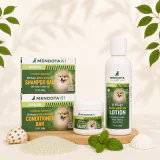
That’s what the Dermagic System is built to do. Four steps — cleanse, treat, target, restore — with no steroids, no hormones and nothing systemic.
| Step | Product | What it does |
|---|---|---|
| 1. Cleanse | Skin Rescue Shampoo Bar | Clears grease and yeast out of a dense double coat so treatment can reach skin. Sulphate-free. |
| 2. Treat | Skin Rescue Lotion | The engine of the System. Helps manage skin prone to secondary yeast and bacterial overgrowth. |
| 3. Target | Hot Spot Salve | For raw or scratched patches. Thick enough to stay put where lotion would be licked away. |
| 4. Restore | Cell Restoration Crème | For the regrowth phase — softens thickened, darkened skin and supports the returning coat. |
Run all four. They aren’t alternatives to each other and they compound. The cleanse is what lets the lotion reach skin through a Pomeranian’s double coat. The lotion helps manage skin prone to secondary overgrowth. The salve covers broken skin where lotion would be licked off within a minute. The crème protects a coat that will have taken months to grow back. Every Pomeranian recovery we publish ran the complete System — when we hear that Dermagic didn’t work, it’s nearly always a half-run protocol.
The Skin Essentials System bundles the first three steps together and costs less than buying them individually; add the Cell Restoration Crème for the regrowth phase.
 Start the treatment
DERMagic Skin Essentials System
Cleanse, treat and target in one kit — dermagic.eu →
Start the treatment
DERMagic Skin Essentials System
Cleanse, treat and target in one kit — dermagic.eu →Two guides take it from here. The complete guide to the Dermagic System covers the protocol in full, including dosing and timings. The Pomeranian alopecia treatment guide covers the breed-specific technique — getting product through a double coat, applying lotion to skin rather than fur, and stopping a small dog licking it straight off.
We’d also point you at why we avoid steroids for pet skin conditions, since it’s the option most owners are offered first.
What recovery actually looks like
Realistic expectations matter here more than in almost any other skin condition, because a Pomeranian coat is slow by design.
| Timeframe | What to expect |
|---|---|
| Week 1 | Odour reduces. Itching settles. Skin looks less angry. |
| Weeks 2–3 | Greasiness clears. Thickened dark skin begins to soften. |
| Weeks 4–6 | Skin visibly lightening. Fine fuzzy undercoat appears — the first real sign. |
| Months 2–4 | Undercoat thickens. Guard hairs come through. Bare areas shrink inward. |
| Months 4–12 | Full plush coat. A heavy Pomeranian coat can take most of a year. |
The skin changes come quickly. The coat takes as long as the hair cycle takes, and no product shortens that.
Two Pomeranians who regrew their coats
Rather than tell you it works, here are two we’ve followed.
- Sir Winston — five years old, effectively bald, lethargic, and written off as cosmetic. Six months later: full coat, and his energy back.
- Yogi — diagnosed at ten and told to live with it. Years on, pink skin and his personality returned.
Both ran the complete System. Neither involved hormones, steroids or clippers.
What to do next
- Look at the skin. Pale means a coat process — brush and wait. Red and irritated means a skin problem. Grey or black means Alopecia X until proven otherwise.
- Check the pattern against the table at the top of this page.
- Ask whether the dog is itchy, and whether anything else has changed — thirst, appetite, weight, energy.
- Get the bloodwork and a skin scrape before anyone settles on Alopecia X.
- Don’t clip, whatever else you do.
- Start the topical protocol once serious causes are excluded, and give it three months before judging the skin, six before judging the coat.
Different breed? Our French Bulldog skin guide covers folds, tail pockets and dilute-coat hair loss, and the Golden Retriever guide covers hot spots under a heavy coat.
Still not sure what you’re looking at? Get in touch — tell us your Pomeranian’s age, where the loss started, what colour the skin is and whether the dog is itchy, and we’ll tell you honestly what we think you’re dealing with.