This page used to open by telling you a dog’s skin has one layer and is three times thinner than yours. That is not true, we had been publishing it for years, and we have taken it out. Here is what replaced it — and it still gets you to a dog-specific shampoo, by a better road.
The claim we have withdrawn from this page
For most of this page’s life the argument above the fold was: your skin has three layers, your dog’s has one, so a harsh shampoo does disproportionate damage. It is the single most repeated line in pet grooming copy, we repeated it, and it does not survive contact with the literature.
Dog skin has the same three compartments yours does — epidermis, dermis, subcutis. There was never a one-layer species. And the barrier itself is not notably flimsy: when the canine stratum corneum was actually counted, it averaged around 47 cell layers, with the intercellular lipid extending through most of them. Where direct comparative absorption studies exist they generally run the other way — substances crossing human skin more readily than dog skin, with some compounds lingering on the dog’s surface rather than passing through.
So the thin-skin argument is gone. We are not replacing it with a softer version of itself, because the honest reasons are better anyway.
The three reasons that do hold up
1. Surface pH is genuinely different — just not in the direction most people say. Human skin sits in a tight, acidic band, a little under pH 5. Measured canine skin does not: a 2022 study of 77 dogs found surface pH ranging from about 4.4 to 8.2 in adults, and roughly 4.0 to 5.7 in puppies. The useful consequence is not that dog skin is alkaline — it is that it is variable and higher-ranging, so a human shampoo buffered to pH 5.5 is not “matched to skin” when it goes on a dog, whatever the bottle says.
2. Frequency. This is the one that actually matters, and it is the one nobody mentions. A person might use a medicated wash occasionally. A dog being treated for a skin problem is frequently bathed two or three times a week, for weeks. Whatever the surfactant does to the barrier, it is doing it on repeat, to skin that is already inflamed. Choose a shampoo on the assumption it will be used often, because if the skin is diseased, it will be.
3. Dogs lick. Anything that does not rinse cleanly out of a coat gets eaten. That is an exposure route human cosmetic safety assessment does not have to model and pet products do.
Those three are checkable. The one-layer line was not.
About the detergent
The original version of this page named “Sodium Laurel Sulphate” — a misspelling of sodium lauryl sulfate, SLS — as the villain. We have dialled that back too, because the evidence on SLS is narrower than its reputation: it is a well-characterised irritant at high concentration under occlusion, which is precisely why it is used as the positive control in patch testing, but that is a long way from the claims made about it online. The frequency argument above is the real reason we build without it, not the engine-degreaser line.
The full workings, including what we got wrong about parabens on the way, are in Parabens and SLS in dog shampoo.
The three essentials of dog skin care
There are three simple habits that protect your dog’s coat and skin:
1. Regular grooming
Keep your dog groomed neatly and regularly. It removes matted hair — which is a haven for parasites — and it gives you a clear view of any irritation that’s starting to develop.
2. Vigilant brushing
Check for fleas, ticks, and any other parasites. Look for thorns, cuts, or anything that might irritate the skin and trigger an infection. Catching a problem at “small red patch” stage is dramatically easier than treating a full hot spot a week later.
3. Proper bathing
Bathe with a shampoo formulated specifically for dogs — one designed to soothe irritated skin and maintain a healthy coat.
A second correction, while we are here. This page used to say “not more than once a month” and that over-bathing makes skin problems worse. We have withdrawn that as well. For a healthy dog, bathe when the dog needs it; there is no magic interval. But for skin that is greasy, scaling or actively diseased, frequent bathing is the part of topical care with the strongest evidence behind it, and two or three baths a week is an ordinary starting point in veterinary dermatology. Stretching the gaps to “protect the coat” is one of the most common reasons an owner concludes a topical regimen has not worked.
Technique is where baths are usually lost: part the coat in lines and work the lather down to skin, leave it in contact for a few minutes before rinsing, then rinse for longer than feels necessary — residue in a dense coat irritates on its own.
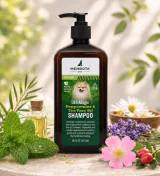
The Dermagic Peppermint and Tea Tree Shampoo
Here is the actual label, in label order, because that is more use to you than an adjective:
Water, aloe barbadensis leaf juice, isostearamidopropyl ethyldimonium ethosulfate, disodium coco-glucoside citrate, sodium coco-glucoside tartrate, alcohol, glycerin, lavender flower extract, chamomile flower extract, lauryl betaine, myristyl betaine, triethanolamine, melaleuca alternifolia (tea tree) leaf oil, mentha piperita (peppermint) oil, panthenol, hydrolysed wheat protein, rosa canina fruit oil, oat kernel extract, salix nigra (willow) bark extract, jojoba seed oil, tocopheryl acetate, phenoxyethanol, tetrasodium EDTA, xanthan gum.
What that tells you:
- It is genuinely sulphate-free. The detergents are coco-glucoside derivatives and betaines. There is no SLS and no SLES in it — a claim we can make because you can read it off the list.
- The tea tree and peppermint are thirteenth and fourteenth of twenty-four. They are the name on the bottle, not the bulk of the formula. What that position does not do is prove a percentage — ingredient lists only have to run in descending order down to 1%, and below that the order is free. We have asked for the exact tea tree figure; the full safety picture, including why this shampoo is for dogs and not cats, is in is tea tree oil safe for dogs and cats.
- It contains water, so it contains a preservative — phenoxyethanol. We used to let “natural” do work it could not do here; see the preservative table for why a water-based product has no honest alternative.
And one claim we have dropped from this section. It used to say “pH-balanced for dogs — not for humans.” We have withdrawn it for the same reason the pH paragraph above is written the way it is: canine surface pH is not a single number to match, it is a wide range. “Sulphate-free” is a formulation fact we can stand behind. “pH-balanced for dogs” was an adjective pretending to be one.
 Start the treatment
DERMagic Peppermint & Tea Tree Shampoo
Shop on dermagic.eu →
Start the treatment
DERMagic Peppermint & Tea Tree Shampoo
Shop on dermagic.eu →The matching conditioner
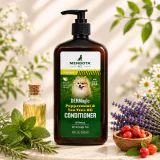
The Peppermint and Tea Tree Conditioner is designed to be used after the matching shampoo. Its useful ingredients are aloe vera and glycerine for moisture, castor and rosehip oil, panthenol, hydrolysed wheat protein, and lavender and chamomile extracts.
This page called it “100% natural” for thirteen years. It is not, and we have withdrawn that. The label also lists stearalkonium chloride, phenoxyethanol, propylene glycol and triethanolamine — four synthetic ingredients, printed on the bottle the whole time we were saying otherwise.
We are not apologising for their presence, only for the adjective. A conditioner works by depositing a positively charged agent onto negatively charged hair; stearalkonium chloride is that agent, and there is no natural substitute that does the same job. The product contains water, so it needs a preservative. What was wrong was the word “100%”, and the fact that anyone could have caught it by turning the bottle around.
The shampoo cleans and prepares the skin. The conditioner protects and softens the coat, which on a dense double coat is what lets you get a comb through afterwards without tearing at the undercoat.
 Start the treatment
DERMagic Peppermint & Tea Tree Conditioner
Shop on dermagic.eu →
Start the treatment
DERMagic Peppermint & Tea Tree Conditioner
Shop on dermagic.eu →The takeaway
Grooming, brushing and bathing. Three simple habits, done with the right products, give your dog the best chance of healthy skin and a beautiful coat. And it leaves you knowing you’ve done your best for the pet you love.
If your dog already has a skin condition, the bath is step 1 of something bigger — the Dermagic System sets out the full four-step protocol.
For specific guidance email customerservice@dermagic.eu or call +44 7425 388643.