If your dog is itchy, greasy and smells musty, there’s a good chance yeast is part of the picture. But the question “is it allergies or is it yeast?” sets up a choice that usually doesn’t exist — in most dogs it’s both, in a specific order.
The question most owners are asking
We hear from owners every week whose dogs have been on allergy medication for months and are still itchy, still greasy, still smelly. The reasonable conclusion they draw is that the allergy diagnosis was wrong and something else is going on.
Often the diagnosis wasn’t wrong. It was just incomplete.
What yeast overgrowth actually is
The yeast involved is Malassezia pachydermatis. It lives as a normal resident on every dog’s skin and in every dog’s ears, and most of the time it causes no trouble whatsoever.
It becomes a problem when it overgrows — when conditions on the skin surface shift in its favour. That happens where the skin barrier has been damaged, where moisture gets trapped in folds and between toes, where the skin is already greasy, and where the local immune response has been suppressed.
Two things worth being clear about, because a lot of material online gets them wrong — including, until recently, some of ours:
It is a surface overgrowth, not a systemic infection. Malassezia lives on the skin and in the ear canals. It doesn’t colonise the bloodstream or take up residence in the organs. Genuine systemic fungal disease in dogs — blastomycosis, histoplasmosis, cryptococcosis — exists, is serious, and looks completely different: coughing, weight loss, eye and neurological signs. It needs oral antifungal drugs and a vet, not a lotion. If your dog is systemically unwell, that is a veterinary emergency and no topical product has any part to play in it.
Clipping doesn’t cause it. We used to say that a clipper blade pressed close to the skin injects yeast underneath and triggers a body-wide infection. There’s no evidence for that, and we’ve withdrawn it. Clippers can cause mechanical irritation or a surface folliculitis, and clipping a plush double coat can leave it slow to grow back — both real, both worth avoiding, neither the same claim.
Why it’s usually both
Here’s the sequence that plays out in a very large share of itchy dogs:
- An allergy comes first. Environmental atopy, a food reaction, or flea allergy. This damages the skin barrier and drives inflammation.
- The barrier stops doing its job. Skin gets greasier and more permeable. Local defences weaken.
- Malassezia takes its opportunity and multiplies well past normal levels.
- The yeast drives its own inflammation — and its own itch, on top of the allergic itch.
Step four is the important bit commercially and clinically. Yeast overgrowth is itchy in its own right, so a dog whose allergy is being well managed can still be miserable if nobody has dealt with the yeast layer. That’s exactly the dog whose owner concludes the allergy diagnosis was wrong.
It also runs the other way. Treat the yeast alone and it will clear — and then come straight back, because the allergy that created the conditions for it is still there.
Signs of yeast overgrowth
None of these is proof on its own, but the picture is fairly distinctive:
- Rusty-red or brown staining between the toes and around the nail beds — that’s saliva staining from constant licking
- Greasy or waxy feel to the coat and skin
- A musty, distinctive odour — often noticeable from across the room
- Redness in the warm, folded areas — armpits, groin, skin folds, around the lips, under the tail
- Recurrent ear problems, with brown waxy discharge
- In long-standing cases, thickened, darkened, lichenified skin — the “elephant skin” look
One sign that commonly gets misfiled: flare-ups that come in spring and fade in autumn. That seasonal pattern is the signature of a pollen allergy, not of yeast. Older versions of this page listed it as a yeast sign, which had it backwards. If your dog’s itching is clearly seasonal, the allergy is the thing to chase — though a yeast layer may well have built up on top of it.
Get it confirmed properly
The old version of this page told you to treat and see what happened — response to treatment as the diagnostic test. That’s a poor test and we shouldn’t have offered it, because plenty of things improve with regular bathing.
There’s a much better one, and it’s neither slow nor expensive: skin cytology. Your vet presses a strip of tape or a slide against the affected skin, stains it, and looks at it under a microscope. Malassezia has an unmistakable peanut shape. You get an answer in minutes rather than months.
Ask for it by name. If your dog has been treated for allergies for a long stretch and is still greasy and smelly, cytology is the single most useful thing you can request.
What to do about it
Here’s the part where the evidence genuinely supports the approach this site has argued for years: topical therapy is first-line treatment for Malassezia dermatitis. That isn’t a natural-products talking point — it’s the mainstream veterinary dermatology position. The yeast lives on the surface, so treating the surface is both effective and avoids committing the dog to oral antifungals.
What that requires is consistency, and more of it than most owners expect:
- Bathe regularly with the Peppermint and Tea Tree Oil Shampoo or the Skin Rescue Shampoo Bar. Frequency matters more than most people realise — this is the step that physically removes yeast and the grease it thrives in. Leave the lather on for a few minutes before rinsing, working it down to the skin rather than over the coat.
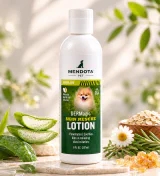
- Massage Skin Rescue Lotion into the affected areas, twice daily to begin with.
- Use Hot Spot Salve on localised spots that won’t settle.
- Switch to Cell Restoration Crème once the skin is calm and you’re maintaining rather than treating.
A soft t-shirt keeps the lotion in place and stops the dog licking it off. Expect weeks, not days.
And deal with what’s underneath. If there’s an allergy driving the cycle, washing will take the greasy, odorous layer off and improve the dog considerably — but it will keep coming back until the underlying trigger is managed. That usually means working with your vet on allergy control alongside the topical routine, not instead of it. Anyone telling you a lotion removes the need for that is selling you something.
When it isn’t yeast
Worth ruling out, because the symptoms overlap: sarcoptic mange, flea allergy dermatitis, and bacterial pyoderma — which frequently sits alongside yeast rather than instead of it. And if the main sign is hair loss without much itch, that points somewhere else entirely; see why a dog loses hair but isn’t scratching.
For the wider picture on allergy management, see what is canine atopic dermatitis and dog skin allergies.
 Start the treatment
DERMagic Skin Rescue Lotion
Treat the yeast layer — dermagic.eu →
Start the treatment
DERMagic Skin Rescue Lotion
Treat the yeast layer — dermagic.eu →For specific guidance email customerservice@dermagic.eu or call +44 7425 388643.