
Gunner had surgery in 2011. His hair never grew back, his skin darkened, and the crisp outline of the clip was still visible months later. Here’s what that condition is, and what four months of daily topical care did — and didn’t — do.
By Dr. Adelia Ritchie — Dermagic founder.
The starting point — November 2011
Gunner had surgery back in 2011, and after the surgical shaving, his hair never came back. His skin became blackened across the shaved area, with the crisp outline of the clipper still visible months later — a classic post-shave Black Skin Disease pattern.
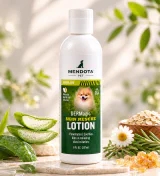
So Gunner’s mom Stacy ordered DERMagic Skin Rescue Lotion and started massaging it into his skin every day, starting in November 2011.
Three months in — February 2012
By February, Stacy reported that pink skin was returning across the affected area — and that his skin felt warm to the touch.
The reliable part of that is the condition of the skin itself. Bald skin is exposed skin: it dries out, scales, and picks up secondary yeast and bacterial overgrowth. Clearing that takes weeks of consistent topical work, and it’s what changes how the skin looks and feels.
The pigmentation fading, and the first whiskers of new hair, followed. We’d love to tell you the lotion caused that. Honestly, we can’t — see below.
Four to five months in — March 2012
By the end of March 2012, Gunner’s beautiful fur-covered backside was on its way back to a full glorious coat and healthy skin. Just a bit more to go, and he’d be just about perfect again.
Why this happens after surgery
The condition has a name: post-clipping alopecia. A dog’s follicles cycle independently of each other, and at any moment a proportion of them are in telogen — the resting phase. Clip the coat and those resting follicles can simply fail to re-enter the growth phase. The hair doesn’t come back, and the bald patch keeps the crisp outline of the clipper because that’s exactly where the coat was removed.
The skin then darkens. That’s secondary hyperpigmentation associated with the affected hairless skin — not a disease of its own and not something growing on the surface. Older Dermagic material described this as clippers injecting fungus into the skin. There’s no evidence for that, and we’ve corrected it. Clippers can cause mechanical irritation or surface folliculitis, which is a real but different problem.
Double-coated breeds are the ones this catches out most often. The patch may regrow in months, may take a year, or may not come back at all.
What we can honestly say about Gunner
Gunner’s coat came back over four to five months on daily Skin Rescue Lotion, and his owner was delighted. What we won’t do is present that as proof the lotion regrew the hair — post-clipping alopecia frequently resolves on its own over a similar timescale, and an uncontrolled set of photographs can’t separate the two.
What topical care does dependably is look after the exposed skin in the meantime: keep it conditioned, help manage skin prone to secondary yeast and bacterial overgrowth, and settle the scaling and irritation. That’s a real benefit and it doesn’t require overstating anything.
A note for surgical shaves
Ask your vet to clip as little as the procedure allows, and no closer than necessary. It’s a reasonable request and most will accommodate it.
If a close clip is unavoidable, look after the bare skin while it’s bare — that’s where the Skin Rescue Lotion earns its place. It won’t guarantee the coat comes back, and anyone telling you otherwise is guessing.
For the full picture on arrested hair cycles and what each treatment route actually achieves, see Alopecia X treatment: what works, what doesn’t, and why.
Gunner — thanks for being such a good sport about publicly displaying your little bottom. And no, your new hair does NOT make your butt look big.
 Start the treatment
DERMagic Skin Rescue Lotion
Treat post-surgical hair loss — dermagic.eu →
Start the treatment
DERMagic Skin Rescue Lotion
Treat post-surgical hair loss — dermagic.eu →For specific guidance after a surgical shave, email customerservice@dermagic.eu or call +44 7425 388643.